
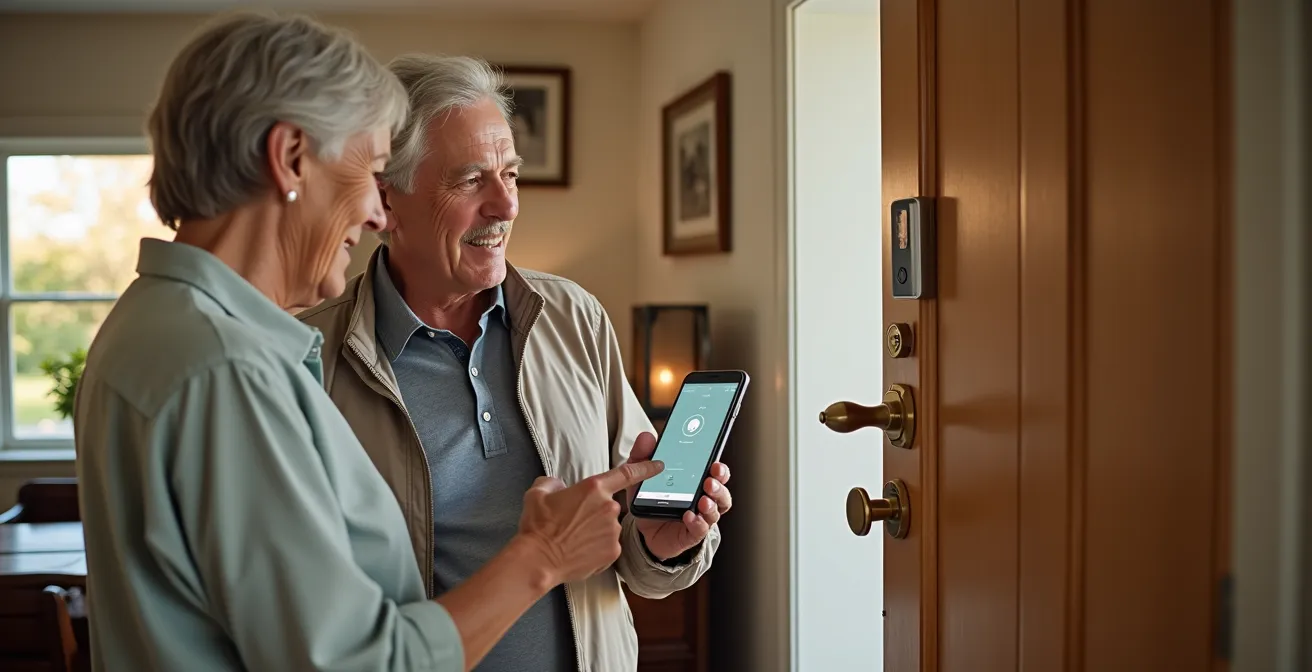
True security for seniors is not about buying complex gadgets, but about systematically removing the vulnerabilities that criminals and scammers actively seek. This guide moves beyond basic advice to show you how to make your home a “hard target.” By reinforcing physical weak points, using simple technology to control your space, and building an “emotional firewall” against manipulation, you can proactively deter threats and maintain your independence with confidence.
The thought of a stranger at your door or an unexpected noise at night can be unsettling, especially when living alone. For many seniors, the desire to age in place comes with a legitimate concern for personal safety. The common advice is often to install a security system or be wary of strangers, but these suggestions barely scratch the surface of the sophisticated threats that exist today, from forceful entry to manipulative online scams.
These threats prey not just on physical vulnerability, but on trust and isolation. The reality is that criminals, whether they are breaking a door down or breaking a heart online, are looking for an easy target. They follow a script, searching for predictable weaknesses they can exploit. This means that true security isn’t a passive state; it’s an active strategy of deterrence.
But what if the key to safety wasn’t just about reacting to threats, but about fundamentally changing the equation? Instead of just locking the door, what if you could make that door so difficult to breach that a burglar gives up before they even start? Instead of just ignoring a scammer, what if you could recognize their script so clearly that their attempts become powerless? This is the principle of making yourself a hard target. It’s about adding layers of friction that make you an unattractive option for any would-be criminal.
This guide provides a protective framework, detailing the specific, often low-cost actions you can take to fortify your home and your mindset. We will cover physical reinforcements, smart use of technology, and the psychological tactics needed to dismantle threats before they can take root, ensuring you can live securely and with peace of mind.
This article provides a comprehensive security briefing, covering everything from the most critical physical reinforcements for your home to the essential strategies for identifying and deflecting common scams. Explore the sections below to build your layered defense plan.
Contents: A Strategic Guide to Fortifying Your Home and Life
- Reinforcing the strike plate: the $10 fix that stops kick-ins
- How a video doorbell allows you to answer the door without opening it?
- Red flags: how to spot a fake repairman offering driveway work?
- The danger of the “hidden key”: why smart locks are safer than rocks?
- Dusk-to-dawn timers: creating the illusion of occupancy when you travel
- Smart bulbs vs separate motion detectors: which reacts faster to movement?
- The romance scam: how lonely seniors are specifically targeted on social media
- Where to Position Motion-Sensor Lighting to Prevent Nighttime Falls on Stairs?
Reinforcing the strike plate: the $10 fix that stops kick-ins
Your front door may feel solid, but its weakest point is often hidden from view: the door frame. Most break-ins are not sophisticated lock-picking operations. They are brutal, fast, and rely on force. In fact, an astonishing 95% of burglaries involve forceful entry into the home, with a kick to the door being the most common method. A standard lock and deadbolt are only as strong as the soft wood frame they are screwed into. With one or two forceful kicks, that frame splinters, and the door flies open.
This is where reinforcing the strike plate becomes the single most cost-effective security upgrade you can make. The strike plate is the small metal piece on the door frame where the latch and deadbolt enter. The screws that come with it are often less than an inch long. They offer almost no resistance.
By replacing these short screws with 3-inch-long hardened steel screws, you anchor the strike plate not just to the flimsy door jamb, but deep into the solid wall stud behind it. This simple change distributes the force of a kick across the entire structure of the wall, making it exponentially harder to break through. You are adding a significant layer of physical friction for any intruder, turning an easy entry point into a formidable obstacle. For less than ten dollars and a few minutes of work, you transform your door from a vulnerability into a bulwark.
How a video doorbell allows you to answer the door without opening it?
The doorstep is a critical threshold. Opening it to an unknown person relinquishes your control and exposes you to potential risk, whether it’s a pushy salesperson, a distraction burglar, or worse. A video doorbell fundamentally changes this dynamic by giving you the power to identify and interact with visitors from a safe distance, without ever turning a knob. It creates a digital buffer zone between you and the outside world.
When someone presses the button or when motion is detected, a video doorbell sends an alert directly to your smartphone or a dedicated indoor monitor. You can see a live video feed of the person at your door and speak with them using two-way audio. This allows you to give instructions to a delivery driver, politely decline an unsolicited offer, or verify the identity of a supposed utility worker before even considering opening the door. It removes the pressure and uncertainty of a face-to-face interaction, putting you firmly in command.
Many seniors may feel apprehensive about new technology, but modern video doorbells are designed with simplicity in mind. Some models offer battery-powered options to avoid complex wiring, and their apps often feature large, clear icons for easy navigation. The key is choosing a device that fits your comfort level, not the one with the most features. Even the most basic model provides the two most crucial security functions: remote viewing and communication.
The image below illustrates this principle perfectly: maintaining security and control from the comfort and safety of your own living room.
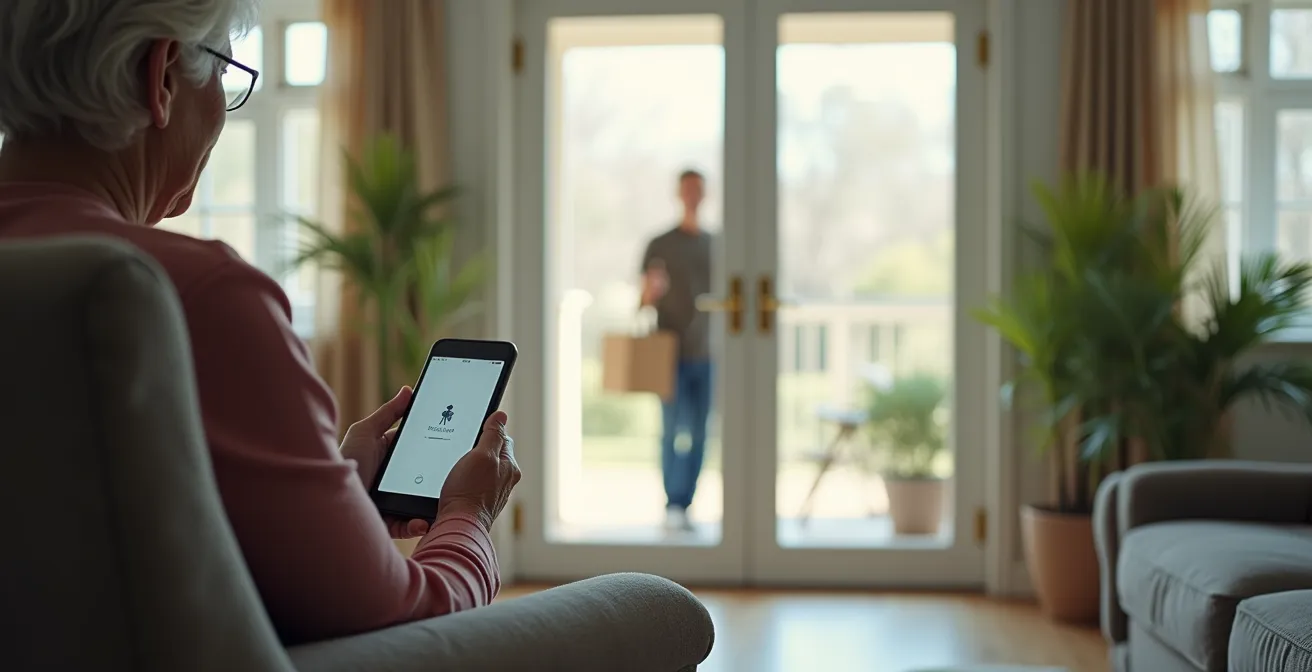
This ability to screen visitors is a powerful deterrent. A potential scammer or burglar who sees a video doorbell knows they are being recorded and that the occupant is alert. It signals that this is not an easy target. For a clear comparison of features suited for seniors, the following table breaks down what to look for.
| Feature | SimpliSafe | ADT | Traditional Peephole |
|---|---|---|---|
| Two-way audio | Yes, with loud speaker | Yes | No |
| App simplicity | Large icons, easy navigation | Professional monitoring included | N/A – No app needed |
| Battery vs Wired | Battery option available | Primarily wired | No power needed |
| Subscription required | Optional | Yes | None |
| Evidence recording | Cloud storage available | Included with plan | No recording |
Red flags: how to spot a fake repairman offering driveway work?
Doorstep scams, particularly those involving home repairs, are designed to exploit a homeowner’s trust and create a false sense of urgency. The “driveway repairman” is a classic example. The scammer approaches unsolicited, claiming they have “leftover materials” from a job nearby and can offer a fantastic deal on sealing your driveway or fixing your roof, but only if you act “today.” This is the first and most significant red flag: high-pressure, unsolicited offers.
A legitimate contractor runs a business; they do not have “leftover” materials they need to offload at a discount. Their business relies on reputation, written quotes, and scheduled work. A scammer, by contrast, relies on speed and confusion. They will resist providing verifiable information and push for a quick decision before you have time to think or consult with family. Your best defense is to have a prepared policy and script to deploy.
You must be firm and unwavering. The moment you feel pressured, deploy a polite but firm refusal. Here are key red flags to watch for and scripts to use:
- Red Flag: “Today Only” Deals. Scammers create false urgency. A real professional’s quote is valid for a reasonable period. Your response should be: “I have a policy of getting three written quotes for any work.”
- Red Flag: Request for Upfront Cash. They may ask for a large cash deposit or even full payment before work begins, often claiming they need it for materials. A reputable business will have credit with suppliers. Your response: “Please leave your business card and license number. I’ll contact you after discussing it with my family.”
- Red Flag: No Verifiable Information. A scammer will be vague about their company, have no business cards, or drive an unmarked vehicle. Their goal is to be untraceable. Your response: “I only work with contractors recommended by my trusted neighbors or local senior center.”
These scripts do not invite negotiation; they are conversation enders. By having a clear, pre-planned policy, you remove the emotion and uncertainty from the situation. You are not being rude; you are being secure. This is a crucial part of your “emotional firewall.”
The danger of the “hidden key”: why smart locks are safer than rocks?
The spare key hidden under a rock, inside a fake sprinkler head, or on top of the door frame is a well-intentioned convenience that has become a glaring security risk. Burglars are not creative geniuses; they are opportunistic. They know all the common hiding spots because they use the same playbook everywhere. Leaving a physical key outside your home is like leaving the front door unlocked. It completely bypasses all your other security measures.
The modern solution is keyless entry, which eliminates the need for a physical spare key entirely. While fully “smart” locks connected to Wi-Fi and smartphones offer many features, they can sometimes feel complex or depend on a charged phone. For many seniors, the ideal solution is a middle ground that offers the security of keyless entry without the technological hurdles.
Keyless smart locks equipped with chips or cards offer a safe and convenient entry method for seniors aging in place, eliminating the need for physical keys.
– Ultimate Care NY Research Team, Home Safety for Aging in Place Guide
This insight points toward a highly practical and secure alternative: the mechanical keypad lock. This device offers the perfect balance of security and simplicity, making it a superior choice for aging in place.
Case Study: Mechanical Keypad Locks as an Ideal Solution
A case study from Ultimate Care NY highlights the effectiveness of mechanical keypad locks for seniors. These locks require no smartphone, no Wi-Fi, and no batteries to change, yet they completely eliminate the risk of a hidden key being found. For seniors with arthritis or dexterity issues, punching in a simple code is far easier than manipulating a small, difficult key. A memorable code can be programmed and shared only with trusted individuals like family or a caregiver, and it can be changed easily if necessary. It provides the security of a smart lock with the reliability and simplicity of a traditional one.
By removing the physical key from the equation, you eliminate a major vulnerability that burglars actively hunt for. You are no longer relying on the hope that your hiding spot is clever enough; you are relying on a secure system that only grants access to those who have the code.
Dusk-to-dawn timers: creating the illusion of occupancy when you travel
An empty house is a magnet for burglars. They often surveil a neighborhood, looking for signs of absence: overflowing mailboxes, dark windows night after night, and an overall static, lifeless appearance. Your goal when you are away—whether for an evening or a week-long vacation—is to create a convincing “illusion of occupancy.” This is a proactive deterrence strategy that makes your home appear lived-in and active, persuading a potential intruder to move on to an easier target.
According to burglary pattern analysis, while we often fear nighttime break-ins, a significant number occur in broad daylight. In fact, research shows about 65% of burglaries happen during daytime hours when homes are most likely to appear empty. Simple, inexpensive plug-in timers are your best tool for countering this. By automating your lights, you can mimic the natural rhythm of a person living at home.
However, the key to an effective illusion is realistic randomness. A single lamp turning on at 7 PM and off at 11 PM every night is predictable and unconvincing. You need to create a “lived-in symphony” of light and sound. Set multiple timers in different rooms to create a more dynamic and believable pattern. For instance, have a living room light turn on at sunset, followed by a bedroom light turning on later as the living room light goes off. Adding a radio or a TV simulator on a separate timer introduces a sound element that dramatically enhances the realism.
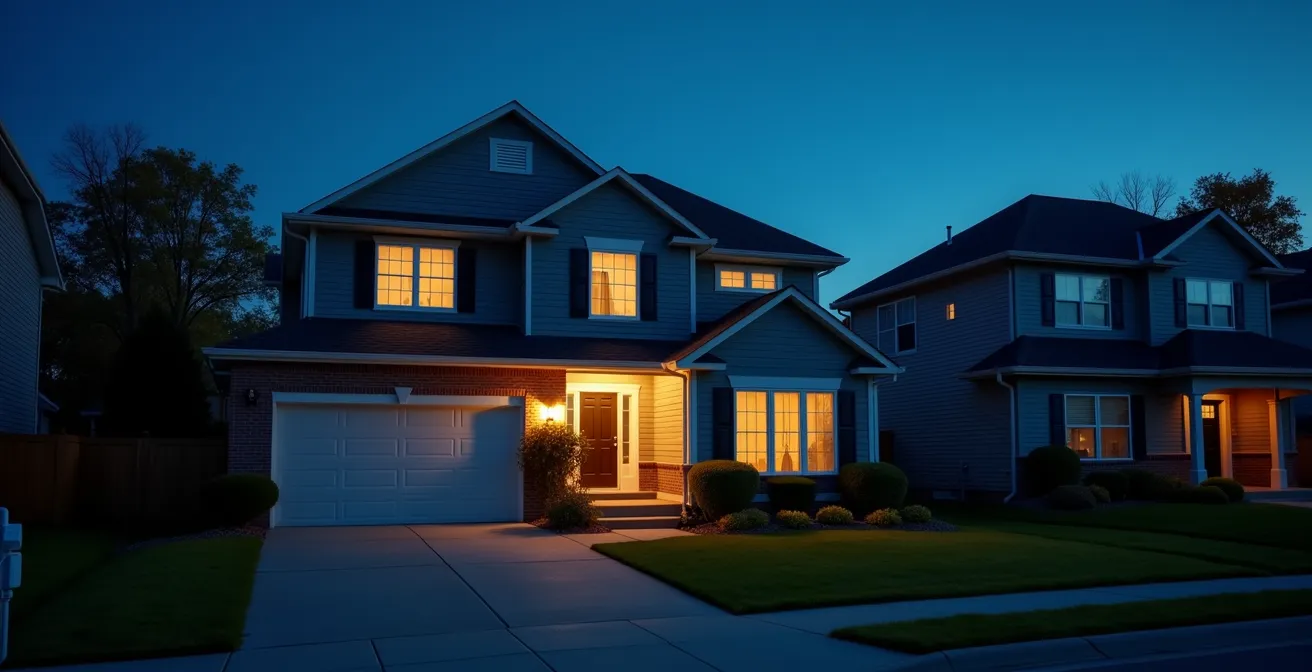
This strategy of automated, staggered lighting, as seen in the image above, transforms your home from a dark, vacant target into a place that appears active and occupied. It’s a simple, low-cost method for building another powerful layer of security, making your home a much less appealing prospect for anyone watching.
Smart bulbs vs separate motion detectors: which reacts faster to movement?
Automated lighting is a cornerstone of both safety and security. It deters intruders on the exterior and prevents falls on the interior. The two primary technologies for achieving this are smart bulbs with built-in motion sensing and dedicated, separate motion detectors that control standard light fixtures. While both can be effective, they serve slightly different purposes, and their reaction speed is a critical differentiator.
For raw speed, a dedicated motion detector is the undisputed winner. These devices, especially hardwired models, are single-purpose. Their sole job is to detect movement and immediately trigger a circuit. Their response time is typically under half a second. This near-instantaneous reaction is crucial for security applications where you want to startle an intruder with a sudden flood of light. It’s also vital for interior fall prevention, ensuring a dark hallway or staircase is illuminated the moment you enter the space.
Smart bulbs, on the other hand, offer incredible convenience but introduce a slight delay. When their sensor detects motion, the signal often has to travel over your Wi-Fi network to a server and back before the light activates. This process can take 1-2 seconds. While this may seem minor, it can be the difference between preventing a stumble and not. However, smart bulbs excel in their ease of installation (simply screw it in) and their flexibility. They require no extra wiring and can be programmed for different colors and brightness levels, offering gentle, warm light for nighttime paths to the bathroom, which is often preferable to the harsh blast of a security floodlight.
The best strategy often involves a hybrid approach:
- Use dedicated motion detectors for critical security and safety zones: exterior perimeters, entryways, and staircases where instant reaction is paramount.
- Use smart bulbs for convenience and ambient safety lighting in less critical areas like bedrooms and hallways, where a one-second delay is acceptable and the ability to control warmth and brightness is a benefit.
The romance scam: how lonely seniors are specifically targeted on social media
Not all threats to your security are physical. Some of the most devastating are emotional and financial, originating online from predators who weaponize loneliness. The romance scam is a particularly cruel form of fraud that specifically targets seniors on social media and dating sites. These criminals are masters of manipulation, and their goal is singular: to steal your money by first stealing your heart.
The scam begins with “love bombing”—an overwhelming torrent of affection, flattery, and declarations of deep connection that happens unnaturally fast. The scammer creates a detailed but fake persona, often posing as a successful professional working overseas (an oil rig engineer, a military doctor, an international businessman). This built-in excuse is why they can never meet in person or even video chat, as there is always a sudden crisis or technological failure. This is a massive, non-negotiable red flag.
After establishing this intense emotional bond over weeks or months, the requests for money begin. They are always framed as desperate emergencies: a medical crisis, a problem with customs, a stolen wallet, or funds needed to finally buy a plane ticket to come visit you. The requests start small and escalate. The financial toll can be catastrophic, with reports showing an average loss of around $34,200 for each senior victim. The emotional devastation, however, is often far worse, leaving a profound sense of shame and betrayal. Building an “emotional firewall” is your primary defense. This means setting firm boundaries and recognizing the scammer’s script. A key rule must be to never, under any circumstances, mix finances and a new relationship. Your deflection script should be firm: “I care for you, but I have a firm rule to never send money to someone I haven’t met in person.” There is no shame in being targeted; the shame belongs entirely to the criminal. If you suspect a scam, report it to the FBI’s IC3.gov portal and seek support from the AARP Fraud Watch Network.
Key Takeaways
- True security is about creating layers of deterrence—physical, technological, and behavioral—to make your home an unattractive target.
- Simple, low-cost fixes like reinforcing a door’s strike plate are often more effective at preventing break-ins than expensive, complex systems.
- Building an “emotional firewall” by recognizing scam scripts and setting firm boundaries is as crucial as locking your doors for protecting your financial and emotional well-being.
Where to Position Motion-Sensor Lighting to Prevent Nighttime Falls on Stairs?
While we often think of motion-sensor lighting for deterring intruders outside, its most critical life-saving role may be inside your home, specifically around stairs. A fall can be a life-altering event for a senior. It’s a stark reality that, according to CDC data, one in four adults over 65 reports falling each year, and stairs are one of the most common locations for these accidents. Fumbling for a light switch in the dark or navigating poorly lit steps is an unnecessary risk that can be completely eliminated with strategic lighting.
The goal is to create a seamless, automatic “path of light” that activates the moment you approach the stairs, from either direction. This requires more than a single fixture. A complete system involves placing a motion sensor at both the top and the bottom of the staircase. This ensures that whether you are coming from upstairs or downstairs, the entire flight of stairs is illuminated before you take your first step. This bidirectional coverage is non-negotiable for safety.
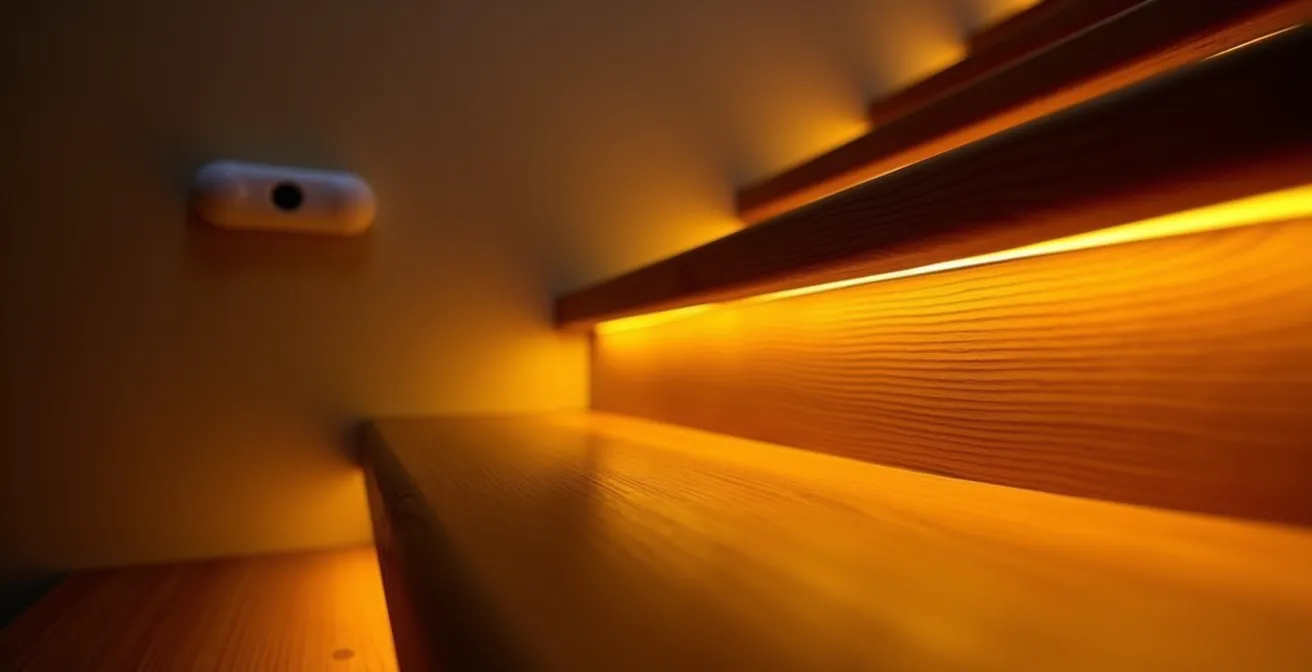
Furthermore, the quality of the light is as important as its presence. Harsh, glaring light can be disorienting to aging eyes. Opt for fixtures that direct light downward onto the treads, not into your face. A warm white light (around 2700K-3000K) is less jarring at night. To enhance safety even further, apply high-contrast, non-slip tape to the edge of each step. Some tapes even glow in the dark, providing an extra visual cue that remains visible for a short time after the lights go out. Your path of light should extend beyond the stairs, linking your bedroom to the bathroom and other frequently traveled nighttime routes.
Action Plan: Your Nighttime Path Illumination System
- Install a motion sensor at the top of the stairs with a 2700K-3000K warm white light.
- Place a second sensor at the bottom of the stairs to ensure complete bidirectional coverage.
- Add a hallway sensor that connects your bedroom to the bathroom for a continuous, unbroken path of light.
- Use downward-facing light fixtures to illuminate the steps without creating glare.
- Apply high-contrast, non-slip tape to the edge of each stair tread for enhanced visibility.
By implementing these layered strategies—from physical fortifications to digital awareness and behavioral changes—you are not just installing security measures; you are building a proactive system of defense. This approach empowers you to maintain your independence and feel truly secure in the place you call home. For a personalized assessment of your specific needs, the next logical step is to consult with a certified aging-in-place specialist or a trusted security professional.