
The true value of an automated medication dispenser lies not in its ability to dispense pills, but in its function as a risk-management system that prevents the catastrophic failures of manual medication management.
- It actively prevents common errors like “double-dosing” through robust locking mechanisms and alerts.
- It ensures communication reliability with cellular-based models that work even when home WiFi fails.
- It creates a verifiable data trail of adherence that empowers families and doctors to optimize treatment.
Recommendation: Evaluate dispensers based on their capacity to solve your loved one’s specific medication challenges, rather than focusing solely on the initial purchase price.
For any family managing the care of a senior with memory loss, the daily medication routine is a source of constant, low-grade anxiety. Did they take their pills? Did they take the right ones? Did they forget, or worse, take a dose twice? The traditional solutions—a plastic pill organizer and frequent check-in calls—feel increasingly fragile as a loved one’s needs become more complex. This often leads to a difficult crossroads: is it time to hire professional nursing help, or could technology offer a more sustainable solution?
The market is now filled with automated medication dispensers, sophisticated devices that promise to solve this very problem. They are often presented as high-tech gadgets with alarms and mobile apps. However, this feature-focused view misses the point. The decision to invest in a dispenser, which can cost several hundred dollars plus a monthly subscription, isn’t about buying convenience. It’s a strategic choice about risk mitigation. The real question is whether this automated system can more effectively and affordably prevent the common, and often costly, failure points of manual medication management compared to adding more human intervention.
This analysis moves beyond a simple feature comparison. We will deconstruct the core operational challenges of medication management for individuals with cognitive decline. By reframing the dispenser as a comprehensive safety system, we can conduct a true cost-benefit analysis. We will examine how these devices handle medication compatibility, prevent unauthorized access, ensure alert delivery, manage the critical initial setup, and adapt to life outside the home. This framework will empower you to decide if this technology is the right investment for your family’s peace of mind and your loved one’s safety.
This article provides a detailed framework for evaluating automated medication dispensers as a strategic part of a senior’s care plan. The following sections break down the critical factors to consider, helping you make an informed decision beyond the price tag.
Summary: A Cost-Benefit Analysis of Automated Medication Dispensers
- Pills vs Capsules: which shapes jam smart dispensers most often?
- Locking mechanisms: preventing “double dipping” in dementia patients
- WiFi vs Cellular models: which alerts you faster if a dose is missed?
- The initial fill: why you might need a pharmacist to load the machine first?
- What to do when you leave the house: portable solutions vs the big machine?
- Duplicate prescriptions: the danger of seeing doctors in different networks
- How to use smart assistants to prompt medication and hydration effectively?
- Effective Pharmacotherapy: How to Start the Conversation About Deprescribing with Your Doctor?
Pills vs Capsules: which shapes jam smart dispensers most often?
A primary concern when considering an automated system is its mechanical reliability. A jammed dispenser is not just an inconvenience; it’s a critical failure that can lead to a missed dose. Manufacturers have invested heavily in creating versatile machines. Most modern dispensers are engineered to handle a wide variety of medication shapes and sizes, from small, round tablets to larger oblong capsules. In fact, some leading models can dispense pills of nearly any shape or texture. This versatility is a testament to their advanced engineering.
However, the system’s integrity relies on understanding its limitations. The most common sources of failure are not standard pills but rather exceptions to the rule. For example, most dispensers cannot handle half pills, as their irregular shape and sharp edges are prone to jamming the mechanism. Similarly, they are incompatible with non-solid forms like liquids, soft gummies, injectables, or powders. This is not a design flaw but a crucial operational parameter. It means that the medication regimen itself may need to be compatible with the dispenser.
Before investing, it’s essential to audit your loved one’s current prescriptions. If they rely on half-doses, a conversation with the pharmacist or doctor is necessary. The solution might be as simple as prescribing two smaller-dose pills instead of one pill that needs to be split. This proactive step ensures that you are not trying to force an incompatible element into an otherwise reliable system, thereby safeguarding against the most common cause of mechanical failure.
Locking mechanisms: preventing “double dipping” in dementia patients
For seniors with dementia or other cognitive impairments, one of the greatest medication risks is “double dipping”—taking a dose and then, having forgotten, taking it again. This can lead to a dangerous overdose. A simple, unlocked pill organizer offers zero protection against this. This is where the security features of automated dispensers provide one of their most significant returns on investment: active prevention of unauthorized access.
Dispensers employ a range of locking mechanisms, each offering a different level of security. The choice depends on the user’s cognitive state and the level of risk. Basic models may use a physical key, which is effective but requires a caregiver to manage the key. More advanced systems integrate PIN protection or smart locks that can only be bypassed at the designated time or with a caregiver’s remote override. These features transform the dispenser from a simple reminder tool into a secure vault that enforces the prescribed schedule.
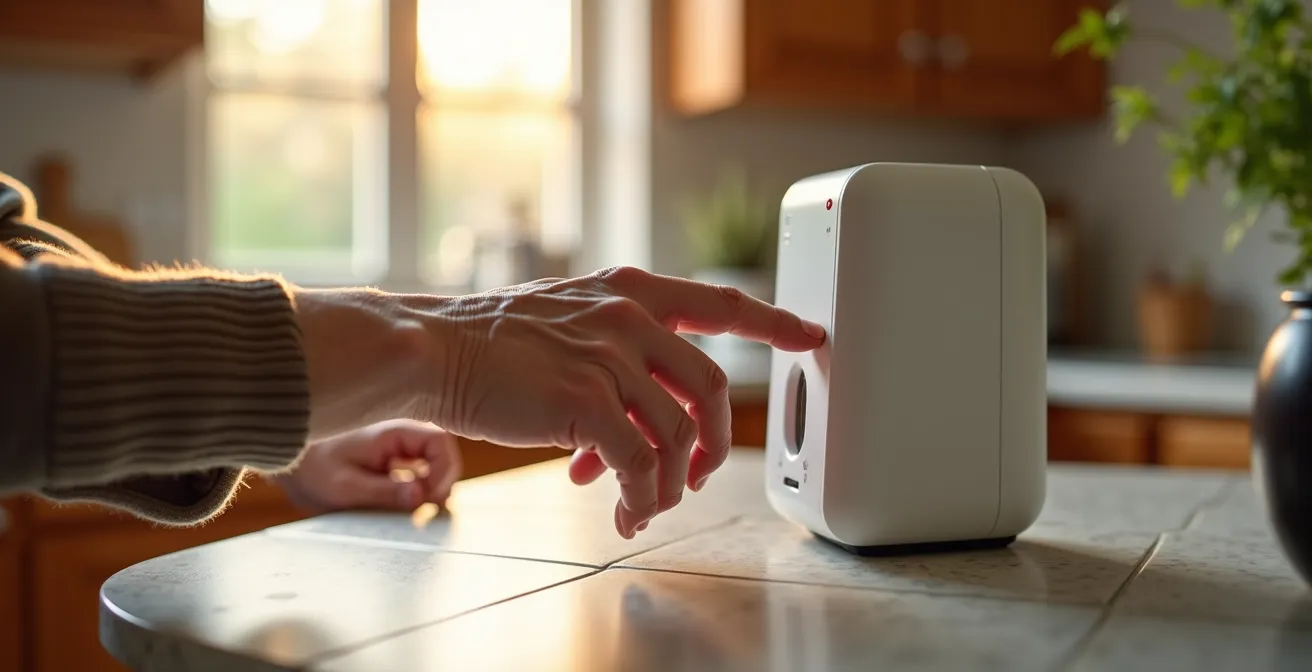
This photo illustrates how a secure dispenser can be integrated into a home environment without feeling clinical or intrusive, promoting safety while preserving a sense of normalcy.

Furthermore, the most sophisticated devices include tamper alerts. If the machine is tilted, shaken, or forced open, it sends an immediate notification to the caregiver’s smartphone. This constant monitoring provides an unparalleled layer of security and peace of mind. A clinical study on one such device, MedaCube, demonstrated its profound impact, showing it improved medication adherence from an average of 48% to an impressive 97%, making it invaluable for complex regimens.
This chart compares the security features of several popular models, helping you assess which level of protection is right for your situation.
| Device | Locking Mechanism | Tamper Alert | Remote Monitoring |
|---|---|---|---|
| LiveFine | Physical lock with key | No | Via app |
| Philips | Smart lock with alerts | Yes | Yes |
| Hero | PIN protection | Yes | Full app control |
| MedaCube | Tilt-sensor alerts | Yes | Web portal access |
WiFi vs Cellular models: which alerts you faster if a dose is missed?
An automated dispenser’s alert system is its central nervous system. When a dose is missed, a timely notification to a caregiver is not just helpful—it’s the critical intervention that the entire system is built to enable. However, the reliability of that alert depends entirely on the device’s connectivity. Most people assume a standard WiFi connection is sufficient, but this can be a significant point of failure in a risk management strategy.
Home WiFi networks are notoriously fickle. They can be knocked out by a power outage, a router malfunction, or an internet service provider issue. If the dispenser relies solely on WiFi, a missed dose alert may never be sent. This is why a growing number of premium dispensers are built with a dual-connectivity or cellular-first approach. As the TechRadar review team notes, this design choice is a game-changer for reliability:
The dispenser is connected via an AT&T cellular data connection, making it independent of any local WiFi internet service.
– TechRadar Review Team, TechRadar Medication Dispensers Review 2025
A cellular connection operates like a mobile phone, using its own data plan to communicate. This means that even if the home’s power and internet go down (assuming the dispenser has battery backup), the device can still send a critical alert. When evaluating cost, the small monthly fee for a cellular plan should be weighed against the immense cost of a single, uncommunicated missed dose. For a high-risk individual, cellular connectivity is not a luxury feature; it is an essential component of a robust safety system.
Your Connectivity Checklist: Key Points to Verify
- Assess the building’s WiFi coverage, noting that concrete and steel construction often blocks signals.
- Check if the dispenser requires 2.4GHz or 5GHz WiFi frequency bands and confirm your home network is compatible.
- Verify cellular coverage (e.g., AT&T, Verizon) in the specific room where the dispenser will be placed.
- Test the dispenser’s backup battery duration to understand its capabilities during a power outage.
- Confirm the escalation chain for missed dose alerts: does it text, then call a primary contact, then an emergency contact?
The initial fill: why you might need a pharmacist to load the machine first?
The moment of loading the dispenser is the most critical human-in-the-loop task. An automated system is only as accurate as the information it is given. Putting the wrong pill in the wrong slot, or entering the wrong schedule, completely undermines the entire purpose of the device. While many manufacturers advertise an easy setup process, the cost-benefit analysis must consider the risk of human error during this crucial phase.
Modern dispensers have streamlined this process significantly. Some systems require you to pre-sort pills into a tray, similar to a traditional organizer. Others, like Hero, allow you to pour bottles of a single medication into a cartridge, which the machine then calibrates. Advanced devices like MedaCube allow for bulk loading of unsorted pills, with the setup taking less than two minutes per medication via a web portal. The focus is on speed and user-friendliness.
This image highlights the precision required during the loading process, an argument for professional oversight.

However, for a family managing 10+ prescriptions for a loved one with memory loss, the cognitive load of ensuring 100% accuracy is immense. This is why some families opt to have a pharmacist perform the initial load and subsequent refills. While this may involve a service fee, it effectively outsources the risk of error to a trained professional. This transforms the dispenser from a DIY project into a professionally managed system. The cost of a pharmacist’s time must be weighed against the potential cost of a single loading error, which could lead to weeks of incorrect dosing before being discovered.
What to do when you leave the house: portable solutions vs the big machine?
A senior’s life doesn’t happen entirely within the four walls of their home. They have doctor’s appointments, family visits, and social outings. A significant failure point for any medication system is how it handles these deviations from the daily routine. A large, stationary dispenser is excellent for home use, but what happens when a dose needs to be taken on the go? This is a critical question of flexibility in your cost-benefit analysis.
The most basic solution is to manually take pills from the main dispenser before leaving. This reintroduces the risk of human error—taking the wrong pills, forgetting them, or taking them at the wrong time. Recognizing this weakness, leading dispenser manufacturers have built in features to specifically address travel and short trips. Many systems allow caregivers to remotely dispense a dose “as needed” into the cup, which can then be taken along. Some devices, like Hero, even allow you to plan ahead and dispense medication up to 7 days in the future for an upcoming trip.
The most advanced solution, offered by a select few dispensers like Livi, is the ability to create dedicated, portable travel packs. With the press of a button, the machine dispenses the correct medications for a specific day or time into a sealed, labeled pouch. This combines the accuracy of the automated system with the portability of a traditional pill organizer. It eliminates the need for manual sorting and ensures the right medications are taken at the right time, even when away from the main machine. This feature directly addresses a major logistical headache and risk factor for caregivers, adding significant value beyond simple at-home dispensing.
Duplicate prescriptions: the danger of seeing doctors in different networks
An automated dispenser can ensure the right pill is taken at the right time, but it cannot fix a flawed prescription list. One of the most insidious dangers in senior healthcare is that of therapeutic duplication, which occurs when a patient is prescribed the same or similar medications by different doctors, often specialists in separate healthcare networks who don’t communicate. The patient may end up taking two different drugs for the same condition, dramatically increasing the risk of overdose and side effects.
This problem is shockingly common. Medication-related self-management errors (MSEs) are widespread among older adults, and a 2024 study in PLOS One found that the frequency of MSEs was 69.2%. The issue is systemic, as noted by the MedShadow Foundation:
Each year, an estimated 1.5 million people in the U.S. are affected by medication errors. Older adults face an even greater risk due to the challenges of juggling multiple daily prescriptions.
– MedShadow Foundation, Medication Safety For Older Adults Report 2025
While a dispenser cannot solve this problem directly, it plays a crucial role in managing it. The process of loading the machine forces a caregiver to consolidate all prescriptions into a single, comprehensive list. This act of “medication reconciliation” is often the first time anyone gets a complete picture of everything the senior is taking. It can reveal duplications or dangerous interactions that were previously hidden. The dispenser’s adherence log then provides a clean data set to take to a primary care physician or pharmacist, who can act as the “quarterback” to de-conflict prescriptions from different specialists.
How to use smart assistants to prompt medication and hydration effectively?
For seniors with memory loss, a simple beep from a dispenser might not be enough to spur action. They may not hear it, may not understand what it means, or may simply ignore it. To create a truly robust prompting system, caregivers can layer the dispenser’s native alerts with the capabilities of common smart home devices like Amazon Alexa or Google Assistant. This creates a multi-sensory alert environment that is much harder to miss.
Instead of just a single alarm, imagine a system where at medication time, the dispenser beeps, the living room lights flash blue, and a familiar voice from a smart speaker says, “Mom, it’s time to take your 10 AM medication. Please go to the dispenser and press the blinking button.” This layered approach provides auditory, visual, and verbal cues, significantly increasing the likelihood of a timely response. It transforms a passive alert into an active, conversational prompt.
Case Study: MedMinder’s Multi-Modal Alert System
The MedMinder device exemplifies this multi-modal approach. It doesn’t rely on a single cue. Its system incorporates a sequence of alerts, starting with flashing lights on the specific pill compartment that needs to be taken. If that is ignored, it triggers an audible chime. If there is still no response, the system can be programmed to place automated phone calls to the user and then escalate to caregivers. This layered strategy demonstrates a deep understanding of the challenges in dementia care, where redundancy is key to ensuring adherence.
Setting up this ecosystem is more straightforward than it sounds. You can create simple routines in your smart assistant’s app to link a specific time to a series of actions. This can also be used to prompt other crucial behaviors, such as hydration. For example:
- Program your smart assistant (Alexa/Google) to announce medication times 5 minutes before the dispenser alarm.
- Set up smart lights to flash or change color when it’s medication time.
- Create a confirmation routine where the assistant asks, “Have you taken your medication?” until a “yes” response is given.
- Link hydration reminders to occur immediately after medication confirmation: “Great! Now it’s a perfect time to drink a glass of water.”
Key Takeaways
- The true cost of a dispenser should be measured against the cost of a single medication error leading to hospitalization.
- Prioritize system reliability (cellular connectivity, battery backup) over non-essential “smart” features.
- The value of a locking mechanism is directly proportional to the risk of a loved one’s potential for confusion or double-dosing.
Effective Pharmacotherapy: How to Start the Conversation About Deprescribing with Your Doctor?
The ultimate goal of any medication management system is not just adherence, but improved health outcomes. An automated dispenser is a powerful tool, but it can also become a crutch that enables a more insidious problem: polypharmacy, the use of multiple (often five or more) medications. Research shows that approximately 44% of men and 57% of women older than 65 take five or more medications per week. While some of these are necessary, others may be outdated, ineffective, or causing side effects that are then treated with yet another pill.
This is where the dispenser’s role evolves from a simple tool to a strategic asset. The adherence data it collects provides objective, undeniable proof of what is being taken and when. This data is a powerful conversation starter for “deprescribing”—the planned and supervised process of discontinuing medications that may no longer be of benefit. Instead of telling a doctor, “I think Mom is taking too many pills,” you can present a report that says, “She has taken these 12 medications with 99% adherence for three months, yet she is still experiencing dizziness and fatigue. Could we re-evaluate if all of these are still necessary?”
This data-driven approach shifts the dynamic from a subjective complaint to a collaborative review of effective pharmacotherapy. It empowers you to advocate for your loved one. Technology, in this case, is a bridge to better medical care. As one report highlighted, technology can play a significant role in improving medication safety. A review by the MedShadow Foundation revealed that AI and automation tools helped reduce medication errors in 71% of analyzed studies, including overprescribing.
The next logical step is to use this framework to map your loved one’s specific medication challenges and behaviors against the risk-mitigation features we’ve discussed. This turns the complex choice between a nurse and a machine into a clear, confident decision based on a true cost-benefit analysis of your family’s unique needs.
Frequently Asked Questions about Automated Medication Dispensers
Can the Livi dispenser prepare travel medication packs?
Yes, the Livi dispenser is capable of dispensing portable travel packs that can contain up to 14 days of medication, making it suitable for travel.
What happens to my Hero dispenser if I lose power during travel?
Every Hero smart dispenser is equipped with a Safety Key that allows you to manually open the device and access your pills in case of a power failure. For uninterrupted use, it is recommended to connect the device to an Uninterruptible Power Supply (UPS).
Do I need WiFi access when traveling with a smart dispenser?
Most smart dispensers can operate offline once they have been programmed. However, remote monitoring and alert capabilities will be lost without an active internet connection, meaning caregivers will not receive notifications for missed doses.