
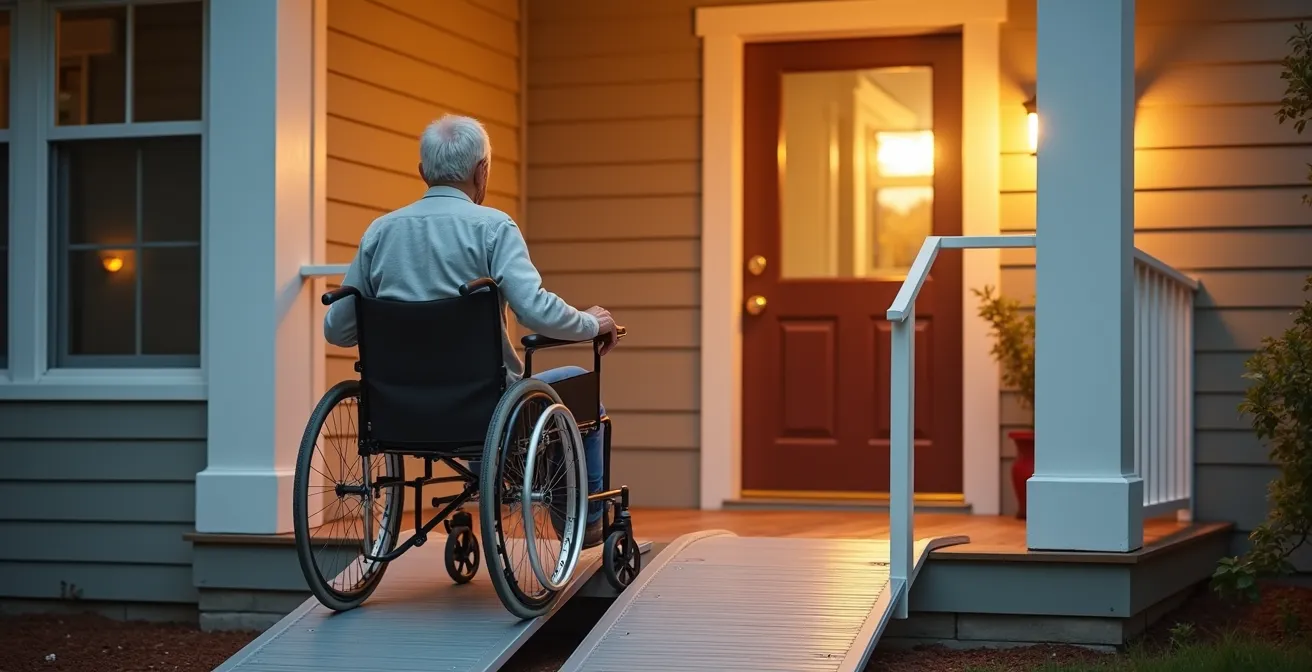
True home accessibility is not about meeting minimum codes, but about creating a seamless, low-energy path that ensures genuine safety and independence.
- A ramp’s slope is just one part of a “kinetic chain of access” that includes landings, doorways, and even tires.
- Material choices for ramps and handrails directly impact user comfort, long-term maintenance, and safety in adverse weather.
Recommendation: Audit the entire path from the vehicle to the interior, focusing on eliminating thresholds, ensuring proper lighting, and reducing the physical effort required at every step.
For any family navigating the challenges of aging in place, ensuring a loved one’s safe access to their own home is paramount. The conversation often starts with wheelchair ramps, and quickly focuses on a single number: the 1:12 slope ratio recommended by the Americans with Disabilities Act (ADA). While this standard is a crucial starting point, achieving true, effortless accessibility requires a far more holistic view. It involves moving beyond mere code compliance to understand the physics of movement and the human factors that define genuine safety.
The reality is that a code-compliant ramp can still be a significant barrier if the user lacks the strength for the incline, if the handrails aren’t designed for their specific needs, or if the doorway at the top presents another obstacle. This guide adopts the perspective of an architectural accessibility consultant. We will dissect the entire “kinetic chain of access”—the complete journey from the driveway to the living room. Our focus is not just on the rules, but on the principles behind them, translating abstract standards into practical, safety-first decisions that provide real peace of mind for you and your family.
This article will guide you through the critical components of creating a safe and independent living environment. We will explore everything from establishing a safe daily routine to the technical details of ramp construction, material selection, and essential safety features that are often overlooked. Each section is designed to empower you with the knowledge to make informed, life-enhancing modifications.
Summary: A Consultant’s Framework for Senior Home Accessibility
- How to Build a Daily Wellness Routine That Preserves Independence After 65?
- How to Build a Modular Wood Ramp That Withstands Winter Weather?
- Aluminum vs. Treated Wood: Which Requires Less Maintenance in Snowy Climates?
- The Handrail Omission That Makes Ramps Dangerous for Walker Users
- When to Apply Non-Skid Strips to Outdoor Ramps Before the First Freeze?
- Solid Tires vs. Pneumatic: Which Is Better for Cobblestone Streets?
- How a Video Doorbell Allows You to Answer the Door Without Opening It?
- Installing Door Wideners: How to Gain 2 Inches of Clearance Without Removing Frames?
How to Build a Daily Wellness Routine That Preserves Independence After 65?
Preserving independence after 65 is less about a single action and more about creating a supportive ecosystem. A daily wellness routine is a cornerstone of this, but it can only succeed if the physical environment is fundamentally safe and accommodating. The risk of falls is a major threat to senior independence; in fact, over 14 million, or 1 in 4 older adults, report falling every year. Therefore, the first step in building a sustainable wellness routine is to proactively eliminate environmental hazards that can lead to such accidents.
The goal is to design a living space that encourages movement rather than discouraging it. When navigating the home requires conscious effort or induces anxiety, a person is less likely to stay active, leading to a decline in physical and mental well-being. A safe environment forms the foundation upon which routines for exercise, social engagement, and daily activities can be built. This involves a critical audit of the home’s primary pathways, entrances, and essential living areas to ensure they support, rather than hinder, independent mobility. Think of it as creating a ‘path of least resistance’ for daily life.
By addressing architectural barriers, you are not just preventing falls; you are enabling the consistency required for any wellness plan. An accessible home allows for safe, regular trips outdoors for fresh air, easy navigation to the kitchen to prepare healthy meals, and secure access to bathrooms. These modifications are not just about safety; they are proactive investments in a person’s long-term health, confidence, and ability to live a full life on their own terms. The following modifications are essential for creating this safe foundation.
- No-Step Entries: Install ramps or create zero-threshold entries to encourage daily outdoor activities without the risk of tripping.
- Wide Passageways: Ensure hallways and doorways are extra-wide to allow for easy and comfortable navigation with a wheelchair or walker.
- Ground-Floor Living: Concentrate essential living spaces, including a bedroom and a full bathroom, on the ground floor to eliminate the need for stairs.
- Accessible Controls: Install light switches, thermostats, and lever-style door handles at a lower, more accessible height.
- Outdoor Lighting: Add motion-activated or timed lighting along the path from the parking area to the entrance for safe arrivals and departures after dark.
Ultimately, a safe home is an enabling home. By removing these common physical barriers, you create a space where a senior can focus on their health and well-being, rather than on simply navigating their surroundings. This is the true start of preserving independence.
How to Build a Modular Wood Ramp That Withstands Winter Weather?
Treated wood is a common choice for residential ramps, appreciated for its natural aesthetic and potential for custom, on-site construction. However, in regions with significant winter weather, its performance is entirely dependent on proper construction and a rigorous maintenance schedule. To withstand freeze-thaw cycles, a wooden ramp must be built with materials and techniques that actively combat moisture retention, which is the primary cause of rot, warping, and ice formation.
The selection of materials is your first line of defense. Use only pressure-treated lumber rated for “ground contact,” even for surfaces that aren’t touching the ground, as this provides a higher level of preservative. All cut ends must be sealed with a wood preservative before assembly, as these are the most vulnerable points for water ingress. For fasteners, use high-quality, hot-dip galvanized or stainless steel screws and bolts to prevent rust and corrosion, which can compromise the ramp’s structural integrity over time. The design should also promote drainage, with minimal spacing between deck boards to allow water and melting snow to escape rather than pool on the surface.
Case Study: Winter Performance of Alternative Materials
While wood requires diligent upkeep, it’s useful to understand the trade-offs with other materials. A study by Lifeway Mobility on modular aluminum ramps in harsh winter climates offers a valuable contrast. The study found that aluminum ramps can be safely installed year-round and that their primary maintenance involves using non-corrosive ice melts (like magnesium chloride) and plastic shovels to avoid damaging the surface. The powder-coated finish offered extra protection at a higher cost. This highlights a key difference: wood maintenance focuses on preserving the material itself from moisture, while aluminum maintenance focuses on using the right tools to clear it safely without causing chemical or physical damage.
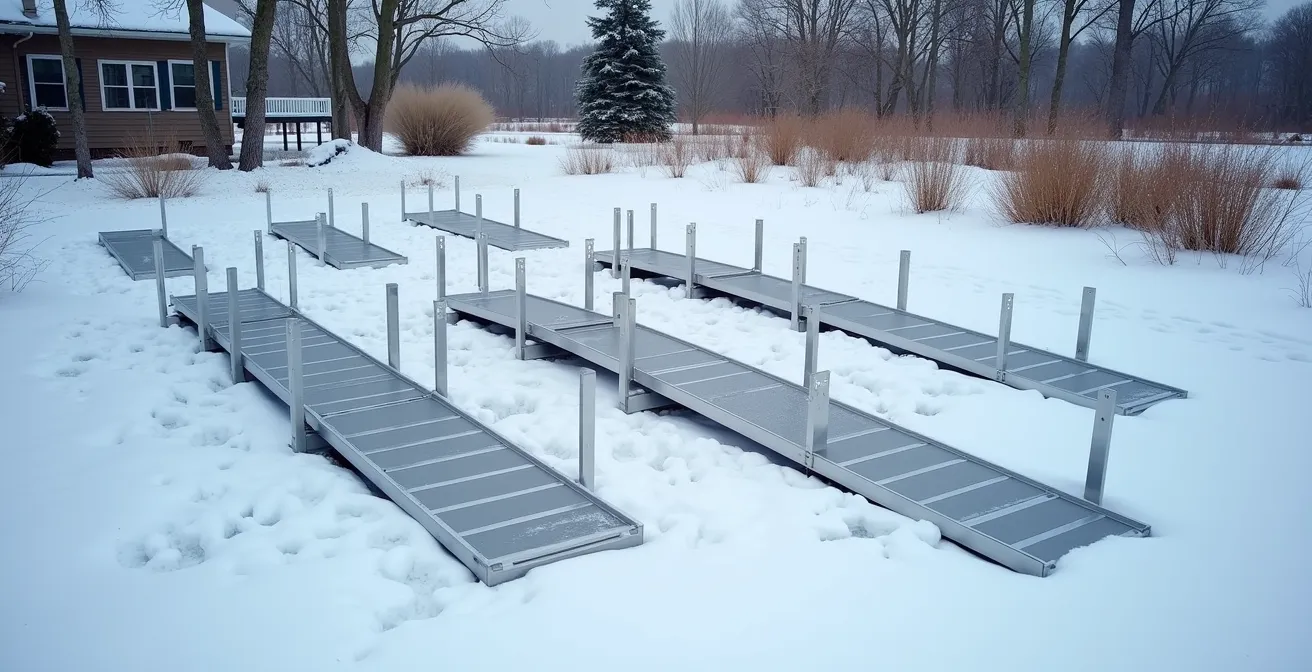
The illustration of a modular aluminum ramp being assembled in winter underscores a key advantage of prefabricated systems: speed and predictability. Unlike wood, which may require ideal weather for cutting and sealing, modular systems can often be installed more quickly in a wider range of conditions. For a wooden ramp, the most critical maintenance task is the annual application of a water-repellent sealant or stain. This should be done in the late summer or early fall, well before the first freeze, to ensure the wood is protected from the coming moisture. Without this protective barrier, a wooden ramp can quickly become a safety hazard and a costly maintenance burden.
In summary, a winter-proof wooden ramp is achievable, but it is not a “build it and forget it” project. It demands superior materials, drainage-focused design, and an unwavering commitment to annual maintenance to ensure it remains safe and structurally sound through years of harsh weather.
Aluminum vs. Treated Wood: Which Requires Less Maintenance in Snowy Climates?
When selecting a ramp material for a snowy climate, the decision between aluminum and treated wood extends beyond initial cost and aesthetics; it is a long-term commitment to a specific maintenance regimen. From a purely maintenance-focused perspective, aluminum is the clear winner. As accessibility experts from Lifeway Mobility note, its advantages are significant:
Aluminum is recommended over steel and wood ramps because it is maintenance-free, more durable and will never rust, rot or warp.
– Lifeway Mobility Accessibility Experts, Aluminum Wheelchair Ramps Guide
This inherent durability means aluminum does not require the annual sealing, staining, or painting that is essential to protect treated wood from moisture, rot, and decay caused by repeated freeze-thaw cycles. An aluminum ramp’s surface and structural integrity will remain consistent for decades with minimal intervention. However, “low maintenance” does not mean “no maintenance,” especially in winter. The primary task for aluminum is safe snow and ice removal. It is critical to use only plastic shovels and non-corrosive ice melt products, as metal shovels can gouge the surface and rock salt can cause pitting and corrosion over time. The following table provides a direct comparison based on an analysis of winter conditions.
| Feature | Aluminum Ramps | Treated Wood Ramps |
|---|---|---|
| Winter Maintenance | Virtually maintenance-free, won’t rust or corrode | Requires annual sealing, prone to rot in freeze-thaw cycles |
| Thermal Properties | Can become cold to touch in winter | More comfortable for users with arthritis |
| Snow/Ice Removal | Use plastic shovel, non-corrosive ice melt only | Can use standard tools and rock salt |
| Traction Surface | Built-in textured surface, expanded mesh options | Requires aftermarket non-skid strips |
| Lifespan in Cold Climate | 20+ years with minimal care | 10-15 years with regular maintenance |
| Cost Range | $1,000-$10,000 depending on configuration | $2,000-$10,000+ including labor |
The table highlights a crucial human factor: thermal properties. Aluminum becomes extremely cold in winter, which can be uncomfortable or even painful for users with arthritis or sensitivity to cold who rely on the handrails. Wood, by contrast, is a natural insulator and remains more comfortable to the touch. This “thermal comfort” is a non-trivial consideration for the user’s daily experience. Furthermore, while many aluminum ramps come with excellent built-in textured surfaces for traction, wood ramps almost always require the addition of aftermarket non-skid strips, which are a recurring maintenance item themselves.
Ultimately, aluminum offers a significantly lower maintenance burden and a longer lifespan in snowy climates. However, the decision must also account for the user’s physical comfort and the discipline to use only appropriate snow removal tools to protect the investment.
The Handrail Omission That Makes Ramps Dangerous for Walker Users
While wheelchair users often rely on momentum and wheel grip to ascend a ramp, individuals using walkers or canes depend heavily on handrails for stability, propulsion, and braking. Omitting handrails, or installing them incorrectly, creates a significant and often underestimated danger for these ambulatory users. A walker provides forward and lateral support, but it offers little to prevent a backward fall on an incline. Handrails serve as the essential safety anchor, allowing the user to pull themselves up and steady themselves on the way down. The danger is magnified when a user must stop mid-ramp; without a secure handhold, maintaining balance on a slope while managing a walker is incredibly difficult.
Proper handrail design is not merely a suggestion; it is a highly specified safety system. According to U.S. Access Board ADA guidelines, handrails must provide a continuous gripping surface at a consistent height, typically between 34 and 38 inches. This specification ensures a user can maintain an unbroken grip along the entire length of the ramp, including at landings and turns. An interruption in the handrail can be as dangerous as no handrail at all, forcing the user to let go and re-establish their grip, creating a moment of instability.

Beyond the basic height requirement, a truly safe handrail system considers the ergonomic needs of its users. The close-up detail of a dual-height system reveals design considerations that go beyond minimum code. A dual-height system, with a second rail at a lower height, provides a more appropriate grip for seated wheelchair users. The grip diameter (typically 1.25 to 2 inches) is crucial for those with arthritis or limited grip strength. Finally, loop returns at the ends of the ramp, where the rail curves back to the post, are a critical feature to prevent loose clothing or bags from snagging and causing a fall.
Your Handrail Safety Audit: 5 Points to Verify
- Grip Points: Identify all areas where a user will need support, including the full length of all sloped sections and level landings.
- Specifications Inventory: Measure the planned or existing handrail height and grip diameter. Does it fall within the 34-38 inch height and 1.25-2 inch diameter ranges?
- User-Centric Coherence: Confront the design with the specific user’s needs. Is a second, lower handrail needed for a wheelchair user? Is the grip diameter suitable for someone with limited hand strength?
- Visual & Physical Safety: Check for high-contrast colors for visibility and ensure end-returns are looped to prevent snagging. Is the entire gripping surface continuous and smooth?
- Integration Plan: Based on the audit, create a priority list to implement any missing features, such as adding a lower rail or wrapping a too-thin rail to increase its diameter.
In conclusion, handrails are not an optional accessory; they are an integral part of the ramp’s safety system, particularly for the most vulnerable ambulatory users. A failure to install them correctly is a direct failure to provide a safe means of access.
When to Apply Non-Skid Strips to Outdoor Ramps Before the First Freeze?
The question of when to apply non-skid strips is, for an accessibility consultant, a trick question. The optimal time is never. While adhesive anti-slip tape seems like a quick and easy solution for a slippery wooden ramp, extensive field experience shows it is a fundamentally flawed approach for winter climates. The core issue lies with the adhesive’s performance in fluctuating temperatures and moisture, and the strips themselves often create new problems.
The primary failure point is the adhesive bond. In freeze-thaw cycles, moisture inevitably seeps under the edges of the tape. When this moisture freezes, it expands, breaking the bond with the wood. The strip peels, curls, and becomes a trip hazard itself—the exact opposite of its intended purpose. Furthermore, when these strips are removed, they often leave behind a sticky, unsightly residue that is difficult to clean and can attract dirt, further compromising the ramp’s surface. A case study on winter traction solutions confirms these findings.
Case Study: The Failure of Adhesive Strips in Cold Climates
Research from installations in northern climates demonstrates that adhesive anti-slip strips consistently fail in cold weather. The adhesive does not maintain its integrity when wet and frozen, leading to peeling and the creation of trip hazards. When removed, they leave behind marks that damage the ramp’s appearance. The study found that far more effective and durable solutions include ramps with built-in textured surfaces, such as expanded metal mesh or serrated aluminum ridges. For temporary needs on existing ramps, heavy-duty rubber mats, placed before the first freeze, provided superior traction and durability compared to any adhesive product.
So, if not strips, what is the correct strategy? The professional approach prioritizes permanent, maintenance-free traction that is integral to the ramp’s surface. For aluminum ramps, this means choosing an expanded metal or serrated surface from the outset. For wooden ramps, this involves routing grooves into the wood or, more effectively, installing high-friction tread inserts made of materials like aluminum oxide. If a temporary solution is absolutely necessary, the best time to act is in the late fall, typically when overnight temperatures consistently drop below 40°F (4°C). At this point, place heavy, perforated rubber mats on the ramp surface. These mats allow snow and water to drain through and can be easily removed in the spring for cleaning.
Ultimately, a proactive approach that avoids temporary, failure-prone products like adhesive strips is the safest and most cost-effective strategy. Invest in a ramp with built-in traction or use robust, removable mats to ensure reliable safety all winter long.
Solid Tires vs. Pneumatic: Which Is Better for Cobblestone Streets?
While the question references cobblestone streets, the underlying principle—how a tire interacts with an uneven surface—is directly applicable to wheelchair performance on ramps. A ramp is not always a perfectly smooth plane. Transitions at the top and bottom can create bumps, and outdoor ramps can have surfaces affected by weather or wear. The choice between pneumatic (air-filled) and solid tires significantly impacts both the safety and comfort of navigating these inclines.
Pneumatic tires act as the wheelchair’s first line of suspension. Their ability to deform and absorb imperfections provides two key benefits on a ramp. First, they offer superior grip. As noted by wheelchair ramp design experts, “Pneumatic tires offer superior grip on wet or imperfect ramp surfaces.” This is because the flexible rubber maintains a larger contact patch with the ramp, especially if the surface is wet or slightly uneven. Second, they provide significant vibration dampening, absorbing the jarring sensation from hitting the threshold at the top of the ramp or the transition plate at the bottom. This reduces user fatigue and discomfort.
Pneumatic tires offer superior grip on wet or imperfect ramp surfaces, potentially making a code-minimum 1:12 slope more manageable for users.
– Wheelchair Ramp Design Experts, 2026 Wheelchair Ramp Guide
Solid tires, on the other hand, offer the benefit of being maintenance-free and puncture-proof. However, this reliability comes at the cost of performance. Because they are rigid, they transfer significantly more vibration to the user and the wheelchair frame. On a ramp, their grip is consistent on dry, smooth surfaces, but less adaptive to moisture or texture, potentially leading to slippage. The jolt experienced when crossing the transition from ramp to landing is much more pronounced with solid tires, which can be jarring and uncomfortable.
| Tire Type | Ramp Grip Performance | Vibration Transfer | Transition Handling |
|---|---|---|---|
| Pneumatic (Air-filled) | Superior grip on wet/imperfect surfaces | Absorbs vibration well | Smooth over bumps and gaps |
| Solid Tires | Consistent but less adaptive grip | Transfers more vibration | Can jar user at transitions |
| Foam-filled | Moderate grip performance | Some vibration dampening | Better than solid, less than pneumatic |
Foam-filled tires present a hybrid option, offering a compromise between the two. They provide better vibration absorption than solid tires and are puncture-proof, but they do not match the superior grip and ride quality of a properly inflated pneumatic tire. For users who prioritize comfort and safety on outdoor ramps, pneumatic tires are the superior choice, provided they are willing to perform regular maintenance to ensure proper inflation.
In the kinetic chain of access, the tires are the final point of contact. Optimizing them for grip and comfort can make a significant difference in the daily usability and safety of any ramp system.
How a Video Doorbell Allows You to Answer the Door Without Opening It?
A video doorbell is more than a convenience; for a senior or a person with mobility challenges, it is a powerful safety tool that directly addresses a key risk factor for falls: urgency. The pressure to quickly get up and rush to answer a ringing doorbell can lead to hasty movements and devastating accidents. As research from the National Council on Aging shows, falls result in $50 billion in medical costs annually, and a primary prevention strategy is to reduce situations that create a sense of urgency.
A video doorbell with two-way audio effectively breaks this cycle. It allows the resident to see and speak with the visitor from anywhere in the home using a smartphone or a dedicated monitor. This simple act transforms the interaction from a panicked rush into a calm, controlled exchange. The resident can identify the person, ask them to wait, provide instructions for a delivery, or inform them that they are on their way to the door—all without taking a single hurried step. This technology buys precious time and eliminates the anxiety associated with an unexpected visitor.
Proper integration into the home’s accessibility plan is key to maximizing a video doorbell’s effectiveness. It should not be an afterthought. Mounting the device at a wheelchair-accessible height (around 48 inches) ensures the user can be seen clearly by the visitor if they do approach the door. Connecting the system to caregivers’ smartphones provides an additional layer of security, allowing family members to monitor visitors and assist remotely. Furthermore, using features like pre-set motion zones and automated announcements can help manage visitor expectations, for example, by playing a message like, “I’ll be right with you, thank you for your patience,” giving the resident even more time to approach the door safely.
- Visitor Identification: Choose a model with clear two-way audio to identify visitors before even starting to move towards the door.
- Accessible Mounting: Install the doorbell at a height of approximately 48 inches so a seated user is visible in the frame.
- Remote Assistance: Connect the doorbell to caregiver smartphones, allowing them to answer the door remotely if the resident is unable.
- Proactive Alerts: Set up motion detection zones on the walkway leading to the ramp to receive an alert before the visitor even rings the bell.
- Manage Expectations: Use pre-recorded announcement features to let visitors know you need a moment, reducing their impatience and your stress.
By fundamentally changing the dynamic of answering the door, a video doorbell serves as a critical tool in a holistic fall prevention strategy, promoting both safety and peace of mind.
Key Takeaways
- True accessibility prioritizes a manageable “usable slope” over simply meeting the minimum “code slope,” considering the user’s specific strength and assistance level.
- View home access as a “kinetic chain” where every element—from outdoor lighting to ramp landings and door width—must work together seamlessly.
- Material choices are a long-term commitment; balance the low maintenance of aluminum with the thermal comfort and aesthetic of properly maintained wood.
Installing Door Wideners: How to Gain 2 Inches of Clearance Without Removing Frames?
The perfect ramp is rendered useless if the doorway at its destination is too narrow. This final link in the kinetic chain of access is a common and frustrating barrier. Standard interior doors often lack the clearance needed for comfortable wheelchair passage. While ADA compliance standards for public spaces mandate a clear width of 36 inches, many older homes fall short. Widening a doorway traditionally involves costly and disruptive construction to remove and reframe the entire opening. However, a far simpler and more elegant solution exists: specialized hinges.
The most effective and least invasive method for gaining precious inches is to replace standard hinges with offset hinges, also known as swing-clear or expandable hinges. These clever devices are designed with a Z-shape that swings the door completely out of the doorway when opened, resting it parallel to the wall. This simple change can add up to 2 inches of usable clearance without any modification to the door or the frame. This can be the difference between a tight squeeze and comfortable passage, significantly reducing the daily frustration and physical effort for a wheelchair user.
Case Study: The Impact of Hinge Modification on User Effort
Accessibility assessments by National Ramp highlight the dramatic impact of hinge choice. Their findings show that while offset hinges can add up to 2 inches of clearance, more robust swing-clear hinges can provide as much as 3.5 inches. Crucially, their data quantifies the human benefit: achieving proper door clearance with these methods reduces the user’s physical energy expenditure by an estimated 40% compared to the difficult, multi-point maneuvers required to navigate a narrow opening. This demonstrates that a small hardware change can have a massive impact on a person’s daily quality of life and independence.
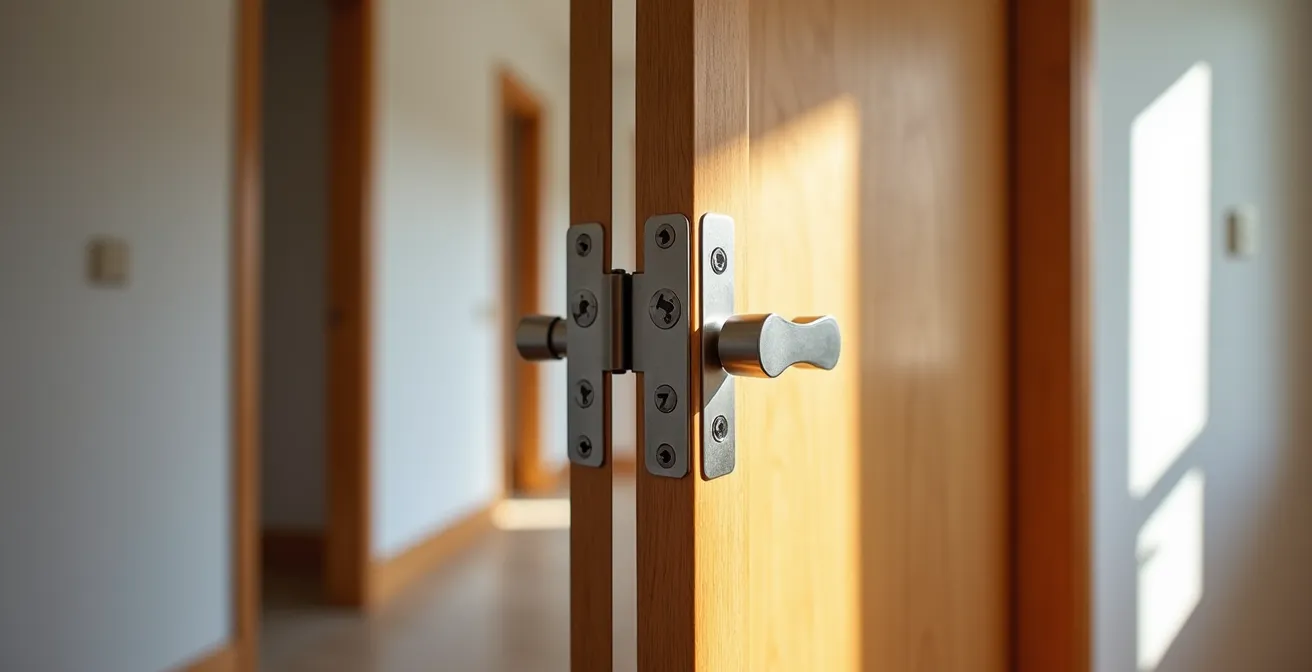
As the illustration of offset hinges shows, the modification is subtle but the effect is profound. The installation process is typically straightforward, involving unscrewing the old hinges and replacing them with the new ones in the same position. This makes it an ideal DIY project or a quick job for a handyman. When planning an accessible route, it’s vital to consider not just the static width of the wheelchair but also the turning radius required to approach the door from the ramp’s top landing. Even a 36-inch doorway can be a bottleneck if the landing doesn’t provide adequate space to align the chair for a straight approach.
Before undertaking major renovations, always evaluate if a simple, low-cost hardware solution like offset hinges can solve the problem. This safety-first, minimally invasive approach is often the most effective way to complete the path to true home accessibility.
Frequently Asked Questions on Ramp Winter Safety
What should I use for ice and snow removal on aluminum ramps?
Use a Magnesium Chloride salt substitute, which is safe for aluminum surfaces. Never use rock salt or calcium chloride as they cause corrosion that can damage the ramp’s structural integrity and void warranties.
When should winter traction measures be applied?
Proactive measures should be taken in the late fall, before the first hard freeze. This is typically when overnight temperatures consistently drop below 40°F (4°C). This is the time to place heavy-duty rubber mats or to inspect built-in traction surfaces for wear.
Are ‘snow tires’ available for wheelchairs?
Yes, specialized wheelchair tires with deeper, more aggressive treads are available. Often called all-terrain or traction tires, they provide significantly better grip on snow, slush, and uneven surfaces, making them a valuable safety upgrade for winter ramp use.