
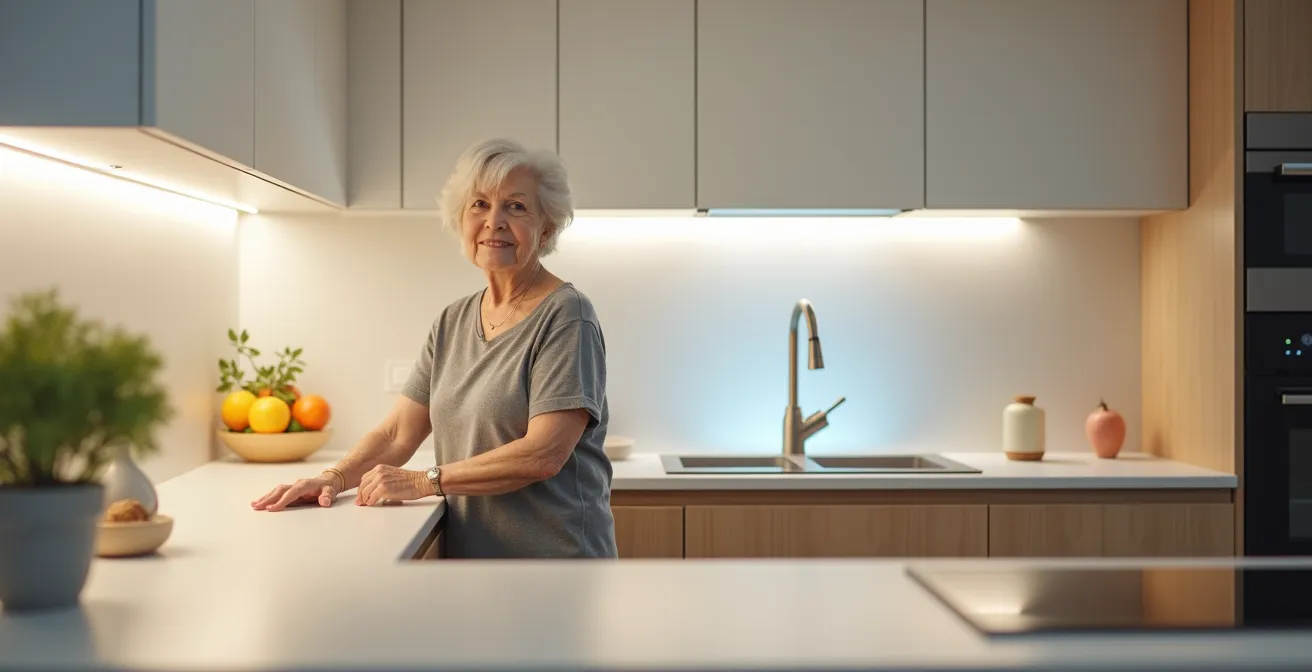
Stop relying on safety rules your aging parent can’t remember. The only real solution is to engineer a kitchen where fires and burns are physically unable to happen.
- This involves installing compensatory technology like automatic stove shut-offs to neutralize the primary fire risk.
- It requires eliminating invisible threats from water temperature, toxic cleaning fumes, and carbon monoxide.
- It means redesigning the physical space to prevent scalds and falls from ergonomic hazards like high microwaves.
Recommendation: Conduct an immediate, room-by-room safety sweep to identify and eliminate these non-obvious hazards before a catastrophic event occurs.
As a fire safety professional, I’ve seen the aftermath of well-intentioned advice. You tell your aging mother not to leave the stove on, but her memory is not what it once was. You remind your father to be careful with hot water, but his thinning skin and reduced sensation create a danger he can’t even feel. The standard kitchen safety checklists given to the general public are tragically insufficient for seniors. They rely on memory, physical strength, and reaction times that are actively diminishing.
The common advice—”be careful,” “don’t get distracted,” “check the temperature”—places the burden of safety squarely on the individual. This approach is doomed to fail when cognitive decline or physical frailty is a factor. This is not about carelessness; it’s about a systemic vulnerability that requires a systemic solution. The hard truth is that you cannot simply remind a person with dementia to be safe. You must build safety into the environment itself.
This guide abandons the failed model of behavioral reminders. Instead, it provides an inspector’s blueprint for systematically engineering a ‘fail-safe’ kitchen. The goal is to neutralize hazards at their source, creating a space where an accident is physically prevented before it has a chance to happen. We will move beyond simple tips and into the realm of compensatory technology, environmental modification, and hazard engineering. This is how you truly protect your loved one.
This article will guide you through the critical checkpoints for transforming a high-risk kitchen into a protected space. We will cover the most urgent fire, burn, and poisoning risks, providing concrete, actionable solutions for each.
Summary: A Proactive Guide to Senior Kitchen Safety
- Automatic stove shut-off devices: are they reliable enough for memory loss?
- Setting the water heater: the exact temperature to prevent burns in thin skin
- Cleaning without fumes: why bleach and ammonia are dangerous for aging lungs?
- Why seniors are more susceptible to CO poisoning and where to place detectors?
- Placement matters: why over-the-range microwaves are a scald hazard?
- How to conduct a room-by-room safety sweep like a pro?
- Locking mechanisms: preventing “double dipping” in dementia patients
- How to Audit a Senior’s Living Space for Hidden Fall Hazards in Under an Hour?
Automatic stove shut-off devices: are they reliable enough for memory loss?
The single greatest fire hazard in a senior’s home is an unattended stove. Forgetting a pot on the burner is not a minor slip-up; it’s the leading cause of home fires for this demographic. Relying on memory is not a strategy; it’s a gamble. The only reliable solution is compensatory technology that physically prevents a fire from starting, regardless of the user’s cognitive state.
Automatic stove shut-off devices are no longer a novelty; they are an essential piece of safety engineering. These devices work by interrupting the power or gas supply to the stove after a predetermined period of inactivity. This is not about convenience; it’s about life-saving intervention. As one user powerfully stated about their mother who has memory issues:
“While I was running an errand, my mother decided to cook some bacon and then go do something else. Needless to say there was no grease fire, just some burnt bacon. Thank you for your great product and for it saving MY home.”
– Homeowner, iGuardFire
There are several types of systems, each with specific applications:
- Motion-sensor devices: These are ideal for active cooks, as they reset their timer whenever movement is detected. However, they can be a risk if a senior becomes distracted but remains physically still in the kitchen.
- Timer-based systems: These are more predictable, shutting off after a preset time (e.g., 15 minutes) regardless of presence. This is safer for profound memory loss but may interrupt legitimate, longer cooking tasks.
- Smoke-detector activated devices: These units plug into the stove’s outlet and have a sensor that listens for the specific sound of a smoke alarm. When it hears the alarm, it cuts power to the stove, preventing a small smoke event from becoming a full-blown fire.
Installation is often straightforward for electric stoves (a simple plug-in device), but gas stoves require professional installation of a shut-off valve. This is a non-negotiable investment for mitigating the most probable and devastating kitchen accident.
Setting the water heater: the exact temperature to prevent burns in thin skin
While fire is a dramatic threat, the insidious danger of scalding water causes horrific injuries every year. A senior’s skin is thinner, less elastic, and has a slower cell turnover rate than a younger person’s. This means a burn that might cause mild redness on a 40-year-old can cause a severe, third-degree burn on an 80-year-old in a fraction of the time. The risk is compounded by decreased temperature sensitivity from nerve damage, meaning they may not even realize they are being burned until it’s too late. The financial and human cost is staggering; research shows tap water scalds lead to 60,000 injuries, 110 deaths, and $70 million in hospital costs over a recent two-year period in the U.S. alone.
The factory setting on most water heaters is 140°F (60°C). At this temperature, a serious burn can occur in just five seconds. This is a catastrophic, built-in hazard. Your first line of defense is to reduce this risk at its source. The universally recommended maximum temperature for a senior’s home is 120°F (49°C). At this temperature, it takes over five minutes of exposure to cause a serious burn, giving ample time to react.
Adjusting the thermostat on the water heater is a critical first step. For an added layer of “passive safety,” you must consider installing thermostatic mixing valves at the faucet or showerhead. These devices automatically mix hot and cold water to ensure it never exceeds a pre-set safe temperature, even if someone turns on only the hot tap. This removes the possibility of human error and makes the water supply inherently safe.
This is a prime example of hazard engineering: you are not asking the senior to “be careful,” you are making it physically impossible for the water to be dangerously hot. You have neutralized the threat before it ever reaches them.
Cleaning without fumes: why bleach and ammonia are dangerous for aging lungs?
The pursuit of a sterile kitchen can create an invisible chemical threat. As we age, our lung capacity and efficiency decrease, making us more susceptible to respiratory irritants. Common cleaning agents like bleach and ammonia, which a younger person might tolerate with minor discomfort, can be genuinely dangerous for a senior. The fumes can trigger asthma attacks, exacerbate COPD, and cause significant respiratory distress. The most urgent danger, however, comes from accidental mixing.
Many people are unaware that mixing common cleaners creates toxic gases. The confusion or memory lapses associated with aging can make these accidental chemical reactions a deadly reality. You must know these combinations and eliminate the risk entirely:
- Bleach + Ammonia: Creates chloramine gas, which causes severe respiratory damage.
- Bleach + Rubbing Alcohol: Creates chloroform, a highly toxic substance.
- Bleach + Acidic Cleaners (like some toilet bowl cleaners): Creates chlorine gas, a chemical weapon.
The only way to prevent this is through environmental neutralization. This means removing these hazardous chemicals from the home entirely. Replace them with simple, effective, and non-toxic alternatives that cannot be combined to create a hazard.

As shown, a safe cleaning arsenal is simple. An all-purpose cleaner can be made from equal parts white vinegar and water. A gentle abrasive scrub for stuck-on food can be made from a paste of baking soda and water. For disinfection, a 3% solution of hydrogen peroxide in a spray bottle kills germs without harmful vapors. These substitutes are not only safer for the lungs but also eliminate the risk of a catastrophic chemical accident.
Why seniors are more susceptible to CO poisoning and where to place detectors?
Carbon monoxide (CO) is a silent killer, but it preys disproportionately on the elderly. The reason lies in their physiology. Seniors often have reduced oxygen transport efficiency due to aging cardiovascular and respiratory systems. This means that even a low-level CO exposure, which a younger person might not even notice, can be hazardous or fatal for an older adult. Confirming this, CDC statistics confirm that adults aged ≥65 years have the highest death rates from CO poisoning of any age group.
The danger is compounded by misdiagnosis. The symptoms of low-level CO poisoning—headache, dizziness, nausea, and confusion—are tragically similar to common age-related complaints or even flu symptoms. A medical analysis highlighted that this overlap often leads to chronic, undiagnosed exposure, with devastating long-term consequences. According to one study, a staggering 40% of patients experience residual neurocognitive impairment even after treatment, underscoring the urgency of prevention.
A single smoke detector is not enough. You must have CO-specific detectors, and their placement is critical. Simply putting one on the ceiling is a common, dangerous mistake. CO is roughly the same density as air and its location depends on temperature. Follow this expert hierarchy for placement:
- Primary Location: Install a detector in the hallway near sleeping areas. Place it at breathing height when lying down, not on the ceiling.
- Kitchen Adjacency: If there’s a gas stove or oven, place a low-level plug-in detector at or below knee height in a room adjacent to the kitchen, as CO from incomplete combustion can accumulate near the floor.
- Every Level: There must be a detector on each level of the home and in the room above an attached garage.
- Maintenance: Replace all detectors every 5-7 years (check manufacturer’s date) and test them monthly. Use a smartphone reminder for both tasks.
Placement matters: why over-the-range microwaves are a scald hazard?
The modern kitchen design trend of placing a microwave over the stove range is a significant, often overlooked, hazard for seniors. This placement creates a perfect storm of ergonomic challenges that can lead to severe scalds and related falls. It is a textbook example of a design that prioritizes aesthetics over the safety of its most vulnerable users.
An occupational therapy assessment reveals the “compound risk” involved. To use an over-the-range microwave, a person must simultaneously:
- Reach Upward: This challenges shoulder flexibility and stability.
- Lean Forward: This shifts their center of gravity over a potentially hot stovetop, challenging their balance.
- Grip and Lower a Hot, Heavy, Sloshing Container: This requires significant grip strength and control while their body is in an unstable position.
A failure in any one of these systems—a moment of dizziness, a weakened grip, a loss of balance—can cause the hot liquid to spill onto their face, chest, and arms, while also potentially causing a fall. This is a multi-system demand that many seniors simply cannot safely meet.
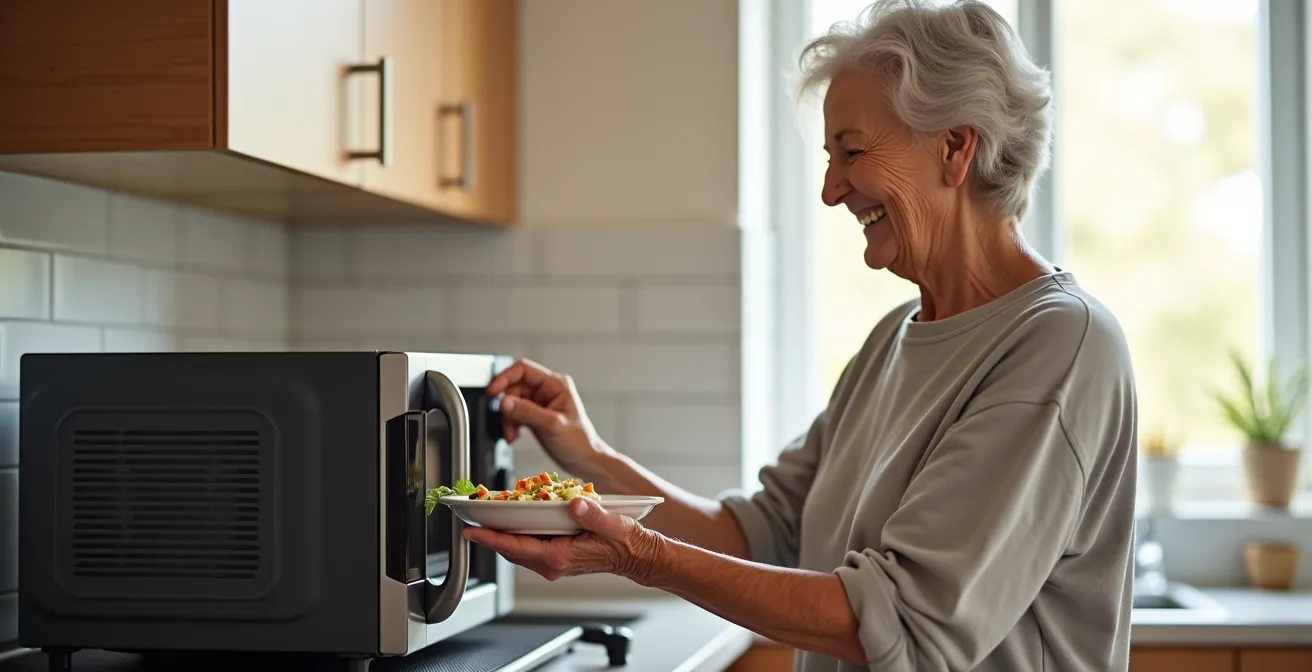
The solution is to re-engineer the environment for accessibility and safety. The microwave must be relocated. The ideal placement is on a sturdy, dedicated countertop or a stable cart with locking wheels. The bottom of the microwave should be positioned at or just below the user’s elbow height. This allows them to slide the container out onto a stable surface without lifting, lowering, or compromising their balance. It completely eliminates the compound risk created by the over-the-range design.
How to conduct a room-by-room safety sweep like a pro?
Creating a safe kitchen requires a systematic, investigative approach, not a casual glance. You must think like an inspector, actively looking for latent hazards. This is particularly true in the kitchen, which is a concentration point for accidents. As Dr. Michael Cooper of the Staten Island University Hospital Burn Center warns, the kitchen is considered a high-risk area, and falls are a major contributor to emergency room visits for seniors.
Conducting a professional safety sweep involves looking at the room through the lens of a senior’s potential limitations. It’s not just about what is there, but how it interacts with declining senses, balance, and cognition. Follow this professional checklist to guide your inspection:
- Sensory-First Check: Begin by using your own senses. Can you smell any faint gas odors near the stove? Are the oven dials and microwave buttons easily readable in the existing light? Are there tactile indicators (like raised dots) on essential buttons like “Start” or “Cancel”?
- Pathway Assessment: Walk the primary work triangle: from the refrigerator to the sink, to the stove, and to the counter. Carry an empty pot while you do it. Identify any and all trip hazards like throw rugs, electrical cords, or general clutter that obstruct this path.
- Medication-Awareness Review: Consider the side effects of your parent’s medications. If they cause dizziness or drowsiness, how does that affect their safety? Test the floor’s slip-resistance. A floor that seems fine normally might become treacherous for someone experiencing a bout of dizziness.
- The Reach Test: Try to access commonly used items—a coffee mug, a plate, a favorite pan. If getting to anything requires significant stretching, bending, or using a step stool, it’s a hazard. Relocate all frequently used items to an easily accessible zone between waist and shoulder height.
- Emergency Readiness: Verify that the fire extinguisher is fully charged and accessible (not buried in a back cabinet). Test all smoke and CO detectors. Ensure emergency numbers are posted in large, clear print on the refrigerator. Finally, walk the fire escape route from the kitchen to the nearest exit to ensure it is clear and well-lit.
Locking mechanisms: preventing “double dipping” in dementia patients
For individuals with dementia, the kitchen presents a unique and heartbreaking set of dangers. The issue is often not a single act of forgetfulness, but repetitive, unsafe behaviors driven by confusion, such as turning a stove burner on and off repeatedly, or taking medication multiple times—a behavior sometimes called “double dipping.” In these cases, simple reminders are useless, and a more robust strategy of hazard engineering is required.
Research into dementia care has shown that combining physical barriers with environmental cues is highly effective. One case study analysis revealed that a layered approach can reduce dangerous repetitive behaviors by as much as 75%. This is not about locking a person out of their own kitchen, but about selectively disabling the most dangerous elements while redirecting their attention. It’s a compassionate approach that prioritizes autonomy within a secure environment.
The goal is to implement non-obtrusive safety measures that prevent accidents without creating a restrictive, prison-like atmosphere. Consider this hierarchy of interventions:
- Stove Knob Covers: Simple, clear plastic covers that prevent a person from accidentally turning on a burner. They require a two-step action to remove, which is often enough to deter a person acting out of confusion while still allowing for supervised use.
- Appliance Control: Use smart plugs on small appliances like coffee makers, toasters, and microwaves. These can be turned on or off remotely via a caregiver’s smartphone app, ensuring they are only active during safe, supervised times.
- Induction Cooktops: As a major upgrade, switching to an induction cooktop is one of the most effective safety measures. The surface itself does not get hot and only heats when specific magnetic cookware is present, virtually eliminating the risk of burns from a hot surface or items left on the cooktop.
- Visual Boundaries and Redirection: In early-to-mid stage dementia, simple visual cues can be surprisingly effective. Placing a line of brightly colored tape on the floor a few feet from the stove can create a psychological barrier. Nearby, create an “activity station” with safe, engaging items like photo albums, puzzles, or textured fabrics to successfully redirect their focus away from the hazardous appliances.
Key Takeaways
- Standard safety advice fails because it relies on memory and physical ability, which are often compromised in seniors.
- The most effective strategy is “hazard engineering”: modifying the environment itself to make accidents physically impossible.
- Invisible threats like water temperature, cleaning fumes, and carbon monoxide require proactive, systemic solutions, not just warnings.
How to Audit a Senior’s Living Space for Hidden Fall Hazards in Under an Hour?
We’ve addressed specific fire and burn risks, but many kitchen injuries are a combination of events. A spill of hot water can lead to a slip, a fall, and a burn. In fact, injury prevention data shows burns are the second leading cause of home injury among seniors, with slippery kitchen floors being a primary contributor to falls. Therefore, a comprehensive safety audit must address fall hazards with the same urgency as fire hazards. This audit protocol is designed to be completed in under an hour and focuses on the most critical risks.
This final audit brings all our principles together. It is a systematic process to identify and neutralize the hidden dangers that create the conditions for a fall. A fall in the kitchen is never just a fall; it’s a fall surrounded by hard surfaces, sharp objects, and hot appliances. Preventing it is paramount.
Your One-Hour Kitchen Fall Hazard Audit
- Floor & Lighting Inspection (25 min): Immediately remove all throw rugs. Check for any potential water sources (leaky sink, dishwasher) that could create slippery spots. Critically, assess lighting at different times of day; test task lighting over the stove and sink to identify shadows that could hide hazards. Install motion-activated night lights for pathways to and from the kitchen.
- Footwear & Seating Check (15 min): Examine your parent’s most-worn indoor footwear. Look for worn, smooth soles or open-backed slippers that provide no support. Recommend rubber-soled shoes with a secure heel. Remove any chairs with wheels from the kitchen. If a step stool is used, ensure it is highly stable and has a handrail for support.
- Hot Liquid Pathway Test (10 min): This is a critical simulation. Carefully walk the path from the stove to the dining table while carrying a pot filled with water. Note any tight turns, obstacles, or uneven surfaces that could cause a spill or a stumble. Clear this pathway completely.
- Storage Accessibility Audit (10 min): Identify all daily-use items (plates, glasses, common food items). Move anything stored in high cupboards or low cabinets to easily accessible counter-height shelves. The goal is to eliminate the need for reaching or bending, two of the most common actions that lead to a loss of balance.
- Emergency Plan Verification: Confirm a phone is easily accessible from the floor in case of a fall. Ensure emergency contacts are programmed on speed dial. The final step is to make sure the safety plan is not just in place, but also easily executable in a moment of crisis.
The safety of an aging loved one is not a matter of chance or gentle reminders. It is a direct result of deliberate, systematic action. By implementing these environmental modifications and technological safeguards, you are creating a kitchen where safety is the default setting. The next logical step is to take this checklist and conduct your own audit immediately. Do not wait for a close call; engineer the safety into their home today.