

Shoulder pain from a mobility aid stems from improper biomechanics, not weakness; correcting the fit is about aligning the device with your body’s natural function.
- An elbow bend of 15-20 degrees is non-negotiable for proper triceps engagement and joint protection.
- Handle design must match hand condition (e.g., ergonomic grips for arthritis) to prevent pressure point injuries.
- The entire “kinetic chain”—from your hand to your ankle—is affected, meaning environmental factors like doorways and stairs also require specific strategies.
Recommendation: Use the wrist-crease measurement as a starting point, but always confirm the 15-degree elbow angle and level shoulder posture to ensure the device is a true extension of your body.
That persistent ache in your shoulder, the strain in your wrist—it’s a common complaint from individuals using a hand-me-down or improperly sized cane. Many believe this discomfort is an unavoidable consequence of needing a mobility aid. The standard advice is often a simple instruction: “measure the cane to your wrist.” While not incorrect, this rule is dangerously incomplete. It addresses a single data point but ignores the complex biomechanics of how your body interacts with the device.
Using a cane or walker is not just about having something to lean on; it’s about integrating a tool into your body’s kinetic chain. The proper height and setup directly influence muscle engagement, joint pressure, and overall stability. An incorrect fit forces your body into unnatural positions, leading to compensatory strain that travels from your wrist up to your elbow, shoulder, and even your neck and back. This is particularly true for the sensitive glenohumeral joint in the shoulder, which is not designed for constant, misaligned load-bearing.
But what if the key wasn’t just the measurement, but understanding the *why* behind it? This guide moves beyond simple rules. As a physical therapist, my goal is to empower you with a deeper anatomical understanding. We will deconstruct the principles of proper fitting, from the critical function of your triceps to the subtle but significant impact of ankle stiffness. By grasping these biomechanical concepts, you can transform your mobility aid from a source of pain into a seamless, empowering extension of your body.
For those who prefer a visual format, the following video provides a practical demonstration of how to use a cane correctly, which complements the detailed biomechanical principles discussed in this article.
To help you navigate this detailed analysis, this article is structured to build your understanding from the ground up. We will cover the core principles of fit, explore equipment adaptations for specific needs, and address how to interact with your environment safely and efficiently. The summary below outlines the key areas we will explore.
Summary: A Biomechanical Approach to Mobility Aid Fitting
- Why a 15-degree bend is critical for tricep function and stability?
- Ice tips vs Rubber ferrules: changing accessories for winter safety
- Arthritic hands: choosing a palm-contoured handle vs a standard round one
- Bariatric supports: why standard walkers collapse under higher loads?
- Quad canes: when is the extra stability worth the awkward gait pattern?
- Why standard hinges steal 2 inches of walkable width from your doorway?
- Why stiff ankles are the silent cause of balance issues on stairs?
- Overcoming the Cane Stigma: How to Frame Mobility Aids as Tools for Freedom?
Why a 15-degree bend is critical for tricep function and stability?
The most crucial element of fitting a cane or walker is achieving the correct elbow flexion. Clinical research shows that maintaining an elbow bend of 15-20 degrees is optimal for both stability and joint health. This specific angle is not arbitrary; it is rooted in fundamental biomechanics. When your elbow is bent at this angle, your triceps brachii muscle—the large muscle on the back of your upper arm—is placed in an ideal position to engage effectively. This allows you to press down on the cane to support your weight without locking or hyperextending your elbow, which can lead to joint strain.
If the cane is too high, your elbow will be excessively bent, forcing your shoulder to hunch upwards to compensate. This position places the glenohumeral joint (your shoulder’s ball-and-socket) under constant, unnatural stress, leading to impingement and pain. Conversely, if the cane is too low, you must stoop to reach it, compromising your posture and stability. A low cane also forces your elbow into near-full extension, preventing your triceps from acting as an effective “shock absorber” and transferring jarring forces directly into your wrist and shoulder joints.
Therefore, the 15-degree bend serves a dual purpose: it maximizes your ability to generate supportive force through your arm while minimizing the stress on your joints. It transforms the cane from a simple prop into a functional part of your kinetic chain, working with your muscles, not against them. Achieving this angle is the first and most important step in preventing chronic pain.
Your Action Plan: 4 Steps to Verify Proper Cane Height and Angle
- Stand tall in your everyday shoes with your arms relaxed naturally at your sides.
- Have someone measure the distance from the floor to the crease of your wrist; this measurement is your ideal cane height.
- When holding the cane grip, verify that your elbow bends at a comfortable 15 to 20-degree angle.
- Walk several steps to confirm your shoulder remains level and relaxed, not raised or hunched, ensuring a natural gait.
Ice tips vs Rubber ferrules: changing accessories for winter safety
The point where your cane meets the ground—the ferrule—is your primary interface with the environment. While a standard rubber ferrule provides excellent grip on dry, indoor surfaces, its efficacy plummets on wet, icy, or uneven terrain. For winter safety, swapping out the standard tip is not an option but a clinical necessity. The two primary alternatives are retractable ice picks and flexible, wider-based ferrules.
An ice pick tip features a sharp metal point that can be deployed to bite into ice, providing crucial traction where rubber would slip. A flexible or articulating ferrule, on the other hand, has a wider base and a pivot mechanism that allows the tip to remain flat on the ground even when the cane is held at an angle, maximizing surface contact on uneven ground. Choosing the right accessory depends on the specific environmental challenge you face.

Beyond safety, the ferrule also offers diagnostic information. The wear pattern on the rubber can tell a physical therapist a great deal about your gait and the correctness of your cane’s fit. Proper use results in even wear across the bottom of the tip, while an ill-fitting cane or an abnormal gait pattern creates uneven wear.
Case Study: Ferrule Wear Pattern as a Diagnostic Tool
Physical therapists frequently use ferrule wear patterns to assess a patient’s usage. If the wear is concentrated on the outer edge of the tip, it often indicates the cane is too long, forcing the user to hold it at an outward angle. Conversely, wear on the inner edge might suggest the cane is too short. This simple visual cue provides immediate feedback on alignment and gait, allowing for quick adjustments to prevent long-term joint strain, as reported by clinical experts.
Arthritic hands: choosing a palm-contoured handle vs a standard round one
For users with arthritis, carpal tunnel syndrome, or decreased grip strength, the design of the cane’s handle is as important as the cane’s height. A standard, round “crook” handle concentrates the body’s entire supportive load onto a very small surface area of the palm. This creates peak pressure points that can be intensely painful for sensitive, arthritic joints. The solution lies in choosing a handle that distributes this load more evenly.
As physical therapy guidelines emphasize, the goal is to reduce pressure on the carpal tunnel and inflamed joints. This is where ergonomic handles come into play.
Ergonomic ‘palm’ or ‘Fischer’ grips distribute weight across the entire palm surface, reducing peak pressure on the carpal tunnel and sensitive arthritic joints.
– Physical Therapy Clinical Guidelines, Physiopedia – Canes Assessment Guide
These specialized grips are contoured to fit the shape of the hand, transforming a line of pressure into a wide, supportive surface. An offset handle, which centers the user’s weight directly over the shaft of the cane, further reduces torque on the wrist joint. For those with severe arthritis and minimal ability to grip, a forearm platform or trough allows weight to be borne by the forearm instead of the hand, bypassing the painful joints entirely.
The following table, based on data from clinical physiotherapy resources, breaks down which handle type is best suited for different conditions and needs.
| Handle Type | Best For | Pressure Distribution | Key Benefit |
|---|---|---|---|
| Standard Round | Mild arthritis, good grip strength | Line pressure across palm | Simple, lightweight |
| Ergonomic/Fischer | Moderate arthritis, carpal tunnel | Distributed across entire palm | Reduces peak pressure points |
| Offset Handle | Wrist deformity, supination issues | Weight aligned over shaft | Reduces torque on wrist joint |
| Forearm Platform | Severe arthritis, minimal grip | Weight on forearm | Eliminates need to grip |
Bariatric supports: why standard walkers collapse under higher loads?
Standard aluminum walkers are engineered for individuals within a specific weight range. When subjected to higher loads, they are prone to structural failure. This is not due to a single weak point, but a systemic design limitation. The lightweight aluminum tubing, the height adjustment pin holes, and the folding mechanisms are simply not designed to withstand the forces exerted by a bariatric user. A collapse is not just an inconvenience; it is a catastrophic event that can lead to serious injury.
Bariatric walkers and canes address this through superior engineering and materials. Instead of aluminum, they typically use reinforced steel tubing, which offers significantly greater compressive strength. The joints and welds are fortified to handle increased stress, and the height adjustment mechanisms often use more robust locking systems to prevent shearing under load. This focus on material science and structural integrity is paramount for user safety.
Furthermore, bariatric walkers feature a fundamentally different geometry. They are designed with a wider and often deeper base, creating a more stable “triangle of support” around the user. This wider footprint drastically reduces the risk of tipping, which is a significant concern as the user’s center of gravity is higher. The design isn’t just about holding more weight; it’s about managing that weight safely during dynamic movement.
Case Study: Engineering for Bariatric Walker Safety
Medical equipment specialists report that standard walkers consistently fail at three critical points under bariatric loads: the welds connecting the frame, the punch-holes for height adjustment pins, and the central folding mechanism. In response, bariatric models are built with continuous, reinforced welds and solid-collar locking mechanisms. The wider base directly counteracts the lateral forces generated during walking, ensuring that the walker remains stable and does not tip, even when the user shifts their weight to one side.
Quad canes: when is the extra stability worth the awkward gait pattern?
A quad cane, with its four-legged base, offers a significant increase in stability compared to a single-point cane. However, this stability comes at a cost: a slower, more cumbersome gait pattern. The decision to graduate from a single-point to a quad cane is a clinical one, based on specific functional needs rather than user preference. The primary indication is a need for substantial weight-bearing support.
While a standard cane is a tool for balance, a quad cane is a tool for both balance and partial weight support. Clinical guidelines indicate that when patients need to support more than 25% of their body weight through the device, a single-point cane becomes unstable and unsafe. This typically occurs in cases of significant unilateral weakness, such as post-stroke recovery. The wide base of the quad cane provides a stable platform that will not slip or tip under this increased load.
However, using a quad cane requires a different walking sequence. The user must lift and place the entire cane with each step, which can be difficult for individuals with a shuffling gait. Turning is also more complex, requiring a “pivot” technique to avoid tripping over the cane’s extended legs. The transition to a quad cane should only be made when the stability benefits clearly outweigh these mobility trade-offs. The key indicators for this transition include:
- Need to support more than 25% of body weight through the device.
- Balance deficits affecting both sides (bilateral) rather than just one (unilateral).
- A shuffling gait that makes lifting a standard cane difficult or unsafe.
- A history of the single-point cane slipping during weight-bearing.
Why standard hinges steal 2 inches of walkable width from your doorway?
A common and often overlooked obstacle for walker and wheelchair users is the standard residential doorway. While a doorway might measure 30 or 32 inches wide, the actual usable, clear opening is significantly less. This is because standard door hinges are mounted on the inside of the door frame. When the door is opened, the thickness of the door itself, plus the hinge barrel, remains within the frame, obstructing the opening.
This seemingly minor architectural detail has major real-world consequences. Analysis shows that standard door hinges reduce the clear opening width by 1.5 to 2 inches. For a walker user, those two inches can be the difference between passing through smoothly and getting stuck, scraping knuckles, or being forced to turn sideways. This daily frustration can severely limit mobility and independence within one’s own home.
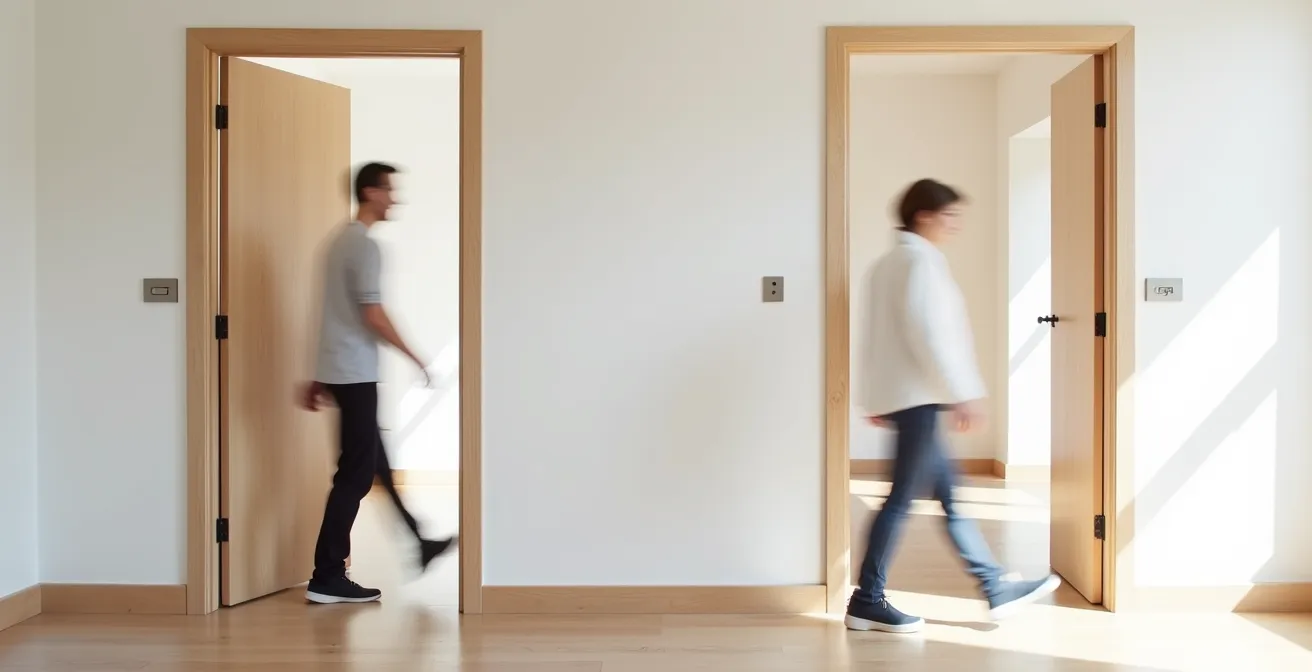
The solution is a simple but brilliant piece of hardware: the offset or swing-clear hinge. These hinges are designed with a “Z” shape that swings the door completely clear of the doorway when opened to 90 degrees. By moving the pivot point outside the frame, they allow the door to open wider, restoring those critical two inches of clearance. Installing offset hinges is a low-cost, high-impact modification that can dramatically improve home accessibility for anyone using a wider mobility device.
Why stiff ankles are the silent cause of balance issues on stairs?
Navigating stairs is a complex biomechanical task that requires a coordinated effort from your ankles, knees, and hips. While many people focus on leg strength, a surprising number of balance issues on stairs originate from a lack of ankle flexibility, specifically poor ankle dorsiflexion. Dorsiflexion is the movement of pulling your foot and toes up toward your shin. This motion is critical for clearing the edge of the step as you ascend and for placing your foot securely as you descend.
When ankle dorsiflexion is limited—often due to age-related stiffness, arthritis, or injury—your body is forced to compensate. To lift your foot high enough to clear a step, you must use exaggerated hip and knee flexion. This altered movement pattern raises your center of gravity, making you less stable. It also forces your knee to travel forward past your toes, placing significant strain on the patellar tendon and knee joint. On descent, a stiff ankle prevents you from placing your foot flatly on the step below, forcing a jarring, toe-first landing that further compromises balance.
Using a cane on stairs requires adapting to this biomechanical challenge. The guiding principle is “up with the good, down with the bad.” When ascending, step up with your stronger leg first, followed by the cane and your weaker leg. When descending, lead with the cane and your weaker leg, followed by your stronger leg. This ensures your stronger leg is always performing the powerful “lifting” motion.
Case Study: The Ankle Mobility Self-Assessment
Physical therapy research highlights a simple test to check for adequate dorsiflexion. Stand facing a wall with your toes a few inches away. Keeping your heel flat on the floor, try to touch the wall with your knee. If you can’t, or if you have to lift your heel to do so, your ankle mobility is likely restricted. This limitation is a strong predictor of difficulty and instability when navigating stairs, as it forces dangerous compensations at the knee and hip joints. Improving ankle flexibility through targeted stretches can directly improve stair-climbing safety.
Key Takeaways
- Proper fitting is a biomechanical process, not just a measurement; the 15-degree elbow bend is paramount for muscle function and joint safety.
- Equipment must be customized to the user and environment, from ergonomic handles for arthritis to ice tips for winter.
- Mobility is a holistic system; environmental barriers like narrow doorways and physical limitations like stiff ankles must be addressed.
Overcoming the Cane Stigma: How to Frame Mobility Aids as Tools for Freedom?
For many, the most significant barrier to using a cane is not physical, but psychological. A cane can be incorrectly perceived as a symbol of frailty or a concession to aging. From a clinical perspective, this stigma is one of the most detrimental factors to a person’s long-term mobility and safety. Delaying the use of a necessary mobility aid out of pride or fear often leads to a cycle of inactivity, loss of confidence, and an increased risk of a catastrophic fall. The key to overcoming this is to reframe the device’s purpose.
A cane is not a crutch; it is a tool. It is no different than eyeglasses, which are tools to improve vision. A cane is a tool to improve balance and extend one’s range of activity safely. It is an enabler, not a disabler. The most successful outcomes occur when a user sees the cane not as a sign of what they’ve lost, but as a key to what they can maintain or regain.
This reframing is a powerful psychological shift. It changes the narrative from “I need this because I am weak” to “I use this so I can be active.” It is about focusing on the function and the freedom the tool provides, not on the preconceived notions associated with it.
Therapists report that patients who view their cane as ‘equipment that lets me attend my grandson’s football games’ rather than a sign of disability show significantly better adherence and outcomes. The ‘trial period’ strategy – using the aid only for challenging activities initially – helps reluctant users experience direct benefits.
– Therapist Reports, Walking Aids Best Practices
Now that you are equipped with a deep understanding of the biomechanics and psychology of using a mobility aid, the final step is to ensure it is implemented correctly. The journey to safer, pain-free mobility begins with the decision to prioritize function over stigma and to use every tool at your disposal to maintain the life you want to live. For a personalized assessment and professional fitting, consulting with a physical therapist is the most effective path forward.
Frequently Asked Questions About Fitting and Using a Cane
Will using a cane make me look frail or dependent?
Modern canes come in stylish designs and colors. Many users report feeling more confident and independent with proper support, as it allows them to maintain their active lifestyle longer and with greater safety. The true sign of independence is taking proactive steps to stay mobile.
Should I wait until I absolutely need a cane?
No. Early adoption when experiencing minor or situational balance issues can prevent falls and help maintain muscle strength and mobility longer. Physical therapists often recommend trying a cane for specific challenging situations first, such as walking on uneven ground or in crowded places, to build confidence.
Can I borrow a cane from a friend to try it out?
While borrowing a cane to test the concept is understandable, using one long-term without proper fitting is dangerous. As this article details, a cane that is the wrong height will cause compensatory strain on the shoulder, elbow, and back, and can actually increase your fall risk. A professional assessment is crucial for safety and efficacy.