
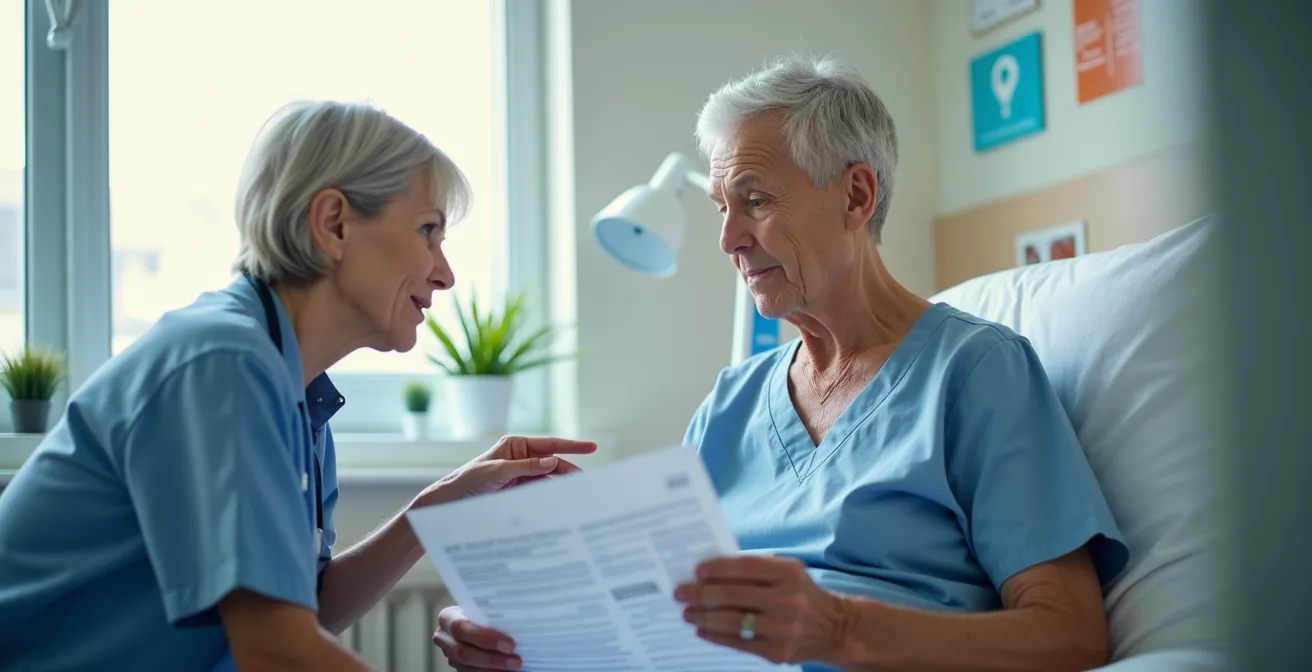
The biggest mistake with a discharge summary is treating it as a final report; instead, it’s the starting point of your investigation into a loved one’s ongoing care.
- This guide provides communication tools like the “Ask Me 3” and “Teach-Back” methods to empower your conversations with healthcare providers.
- Learn to distinguish reliable online health information from noise and create a “Grab-and-Go” medical file for any emergency.
Recommendation: Adopt a ‘medical detective’ mindset to transform the confusing document into a clear, actionable health plan for the person you care for.
Receiving a hospital discharge summary for a family member can feel like being handed a complex legal document in a foreign language. The pages are dense with unfamiliar terms, medication schedules, and follow-up instructions. In that moment of relief and stress, the natural instinct is often to file the papers away, hoping you’ll figure them out later. Many will turn to a quick online search for every confusing word, falling down a rabbit hole of often conflicting and frightening information. This approach is reactive and creates more anxiety than clarity.
The conventional advice—”ask your doctor questions”—is a good start, but it’s incomplete. It assumes you know which questions to ask. What if the key to understanding isn’t just about passively receiving information, but about actively investigating it? This guide repositions you not as a patient’s relative, but as a “medical detective.” Your mission is to investigate the care narrative, identify knowledge gaps, validate the information, and build a case file for what comes next. It’s a shift from being a recipient of instructions to an architect of the post-hospital care plan.
This approach transforms the discharge summary from an intimidating document into a tool for empowerment. We will equip you with the forensic techniques needed to decode medical language, the interrogation skills to get clear answers, and the organizational strategies to build an actionable plan. By the end, you will not only understand what happened during the hospital stay but, more importantly, you will have a clear roadmap for the path to recovery.
This article provides a structured approach to building your health literacy. You’ll find a clear path through the essential skills needed to become a confident advocate for your family member’s health, from understanding core medical concepts to preparing for future consultations.
Table of Contents: A Detective’s Guide to Medical Summaries
- Acute vs Chronic: understanding the specific medical definitions that change care plans
- Relative vs Absolute risk: understanding what a “50% increase” really means?
- The “Ask Me 3” method: how to leave an appointment knowing exactly what to do?
- Dr. Google vs PubMed: how to find reliable health info online?
- Reading the fine print: what are you actually signing before surgery?
- The “Teach-Back” method: ensuring you understood the doctor’s digital instructions
- How to create a “Grab-and-Go” medical file for emergencies?
- How to Prepare for a Telemedicine Consultation to Ensure Your Symptoms Are Taken Seriously?
Acute vs Chronic: understanding the specific medical definitions that change care plans
One of the first clues a medical detective must look for in a discharge summary is how a condition is classified. The words “acute” and “chronic” are not just descriptive; they are fundamental definitions that dictate the entire care plan, from medication to follow-up frequency. An acute condition is typically sudden in onset, sharp, and short-lived, like a broken bone or a bout of pneumonia. The treatment plan focuses on immediate resolution. A chronic condition, however, is a long-term illness that develops over time and may not have a cure, such as diabetes, arthritis, or heart disease. The care plan for a chronic condition is about management, not just a cure.
Understanding this distinction is critical. If a summary lists “acute-on-chronic respiratory failure,” it tells a story: the patient has a long-term lung disease that experienced a sudden, severe worsening. This single phrase signals the need for both immediate treatment for the acute event and a long-term strategy to manage the underlying chronic illness. Misinterpreting this can lead to focusing only on the short-term symptoms while neglecting the crucial long-term management needed to prevent another crisis. This is a widespread issue, as CDC data reveals that 71% of adults older than age 60 had difficulty using print materials related to health information.
As a medical detective, your job is to scan the diagnoses section for these keywords. If you see “chronic,” your investigation must shift towards long-term surveillance. What are the baseline symptoms? What are the red flags for another “acute” flare-up? This initial classification is the cornerstone of the entire care narrative, guiding every subsequent step you take. It determines whether you are solving a single case or beginning a long-term surveillance mission.
Relative vs Absolute risk: understanding what a “50% increase” really means?
Medical summaries and news headlines often use percentages to describe risk, but these numbers can be misleading without proper context. A medical detective must learn to differentiate between relative risk and absolute risk to accurately assess a situation. Relative risk tells you how much a treatment or behavior changes risk compared to a different group, while absolute risk is the actual probability of an event happening to you. This distinction is crucial because a large relative risk change can correspond to a very small absolute risk change.
For example, a report might state that a new medication “reduces the risk of stroke by 50%.” This sounds incredibly effective. However, this is a relative risk reduction. To understand the real-world impact, you need the absolute risk. If the initial (absolute) risk of having a stroke was 4 in 1,000 people, a 50% reduction means the new risk is 2 in 1,000 people. While helpful, the change is a reduction of just two cases per thousand, which may or may not justify potential side effects or costs for a specific individual.

This visualization helps conceptualize the difference. Imagine the 1,000 people as marbles; the 50% reduction means two red marbles are removed, not 500. When you see a percentage, your detective question should always be: “Fifty percent of what?” The table below breaks down these concepts into a simple “codebook” for deciphering risk.
| Risk Type | What It Means | Real-World Example | Questions to Ask |
|---|---|---|---|
| Absolute Risk | Your actual chance of experiencing an outcome | 4 in 1,000 people will have a stroke | What is my personal risk without treatment? |
| Relative Risk Reduction | How much a treatment reduces risk compared to no treatment | 50% reduction means 2 in 1,000 instead of 4 in 1,000 | How many people need treatment to prevent one event? |
| Number Needed to Treat (NNT) | How many people must take the medication for one to benefit | NNT of 500 means 500 people take it for 1 to avoid stroke | What is the NNT for someone with my profile? |
The “Ask Me 3” method: how to leave an appointment knowing exactly what to do?
A good detective knows that the quality of an investigation depends on the quality of the questions asked. In a healthcare setting, this is even more critical. The “Ask Me 3” method is a simple yet powerful interrogation technique designed to ensure patients and their families leave a consultation with the most vital information. It provides a structured framework to cut through the noise and focus on what truly matters for the next steps in care.
Developed by the Institute for Healthcare Improvement, this method encourages you to get clear answers to three fundamental questions before the conversation ends. As the Institute itself states, this structured approach is designed for clarity and action. According to the IHI Ask Me 3 Program Guidelines, the goal is to empower patients.
The Ask Me 3 program encourages patients to understand the answers to three questions: What is my main problem? What do I need to do? Why is it important for me to do this?
– Institute for Healthcare Improvement, IHI Ask Me 3 Program Guidelines
This framework turns a potentially one-sided conversation into a collaborative dialogue. It’s not about challenging the doctor, but about ensuring mutual understanding. Write these three questions at the top of your notepad before any appointment. As the doctor speaks, listen for the answers. If they aren’t provided clearly, it is your role as the medical detective to ask them directly. This technique is incredibly effective; in fact, research shows that 96% of patients rated teach-back combined with Ask Me 3 as effective or highly effective for understanding discharge instructions. This simple tool is one of the most effective in your investigative toolkit.
Dr. Google vs PubMed: how to find reliable health info online?
Once you have the discharge summary, the temptation to search for every term online is immense. However, a medical detective knows that not all information sources are created equal. The internet is filled with everything from peer-reviewed research to forums driven by fear and misinformation. Your first task is to differentiate between quick reconnaissance (using a search engine like Google) and gathering credible evidence (using scientific databases like PubMed).
Using “Dr. Google” can be a valid first step for one purpose: defining basic terms. If you don’t know what “hypertension” is, a quick search provides a general definition. However, for anything related to prognosis, treatment options, or alternative therapies, a general search is a minefield. Your investigation requires more reliable intelligence. This is where you turn to vetted sources. The most trustworthy information comes from websites run by universities, government health agencies (like the CDC or NIH), major non-profits (like the American Heart Association), and reputable healthcare systems.
A University of Michigan poll confirmed this, finding that 63% of older adults found university/medical school websites very trustworthy, while only 16% rated non-medical sources with the same level of trust. For deeper dives, PubMed is the gold standard. It’s a free database of biomedical literature. While many articles are highly technical, you can use the “Review” filter to find summary articles that synthesize research on a topic, which are often more accessible. The ultimate goal is not to become an expert yourself, but to gather reliable information to formulate better questions for the next doctor’s appointment.
Reading the fine print: what are you actually signing before surgery?
Before any significant procedure, a flurry of paperwork appears, most notably the informed consent form. As a medical detective, this document is a critical piece of pre-operative evidence. It’s not a waiver of your rights; it’s a contract that formalizes a conversation between the healthcare team and the patient. Signing it confirms that you have received and understood key pieces of information. Rushing through this step is a common but critical error.
The core of an informed consent form should document three key areas. First, it must clearly state the nature of the procedure—what is going to be done, in plain language. Second, it must outline the risks and benefits. This includes common, minor side effects as well as rare but serious complications. Third, it must discuss reasonable alternatives to the proposed procedure, including the option of no treatment, and their respective risks and benefits. This is your opportunity to ensure the full picture has been considered.
Your role here is to act as the verifier. Before the form is signed, ask clarifying questions. “What is the most common complication you see with this procedure?” “What does the recovery process typically look like?” “Why is this a better option for my family member than the alternatives you mentioned?” The form is the end product of a dialogue, not the start of one. Ensure the conversation happens and that the answers are satisfactory. Remember, a signature is legal and binding acknowledgment that this crucial conversation took place and all your questions were answered to your satisfaction.
The “Teach-Back” method: ensuring you understood the doctor’s digital instructions
If “Ask Me 3” is the detective’s interrogation technique, the “Teach-Back” method is how you confirm the witness’s testimony. It is a simple, powerful tool to close the communication loop and ensure that the information given by a healthcare provider has been understood correctly. Instead of a simple “Yes, I understand,” the teach-back method involves explaining the instructions back to the provider in your own words. This immediately reveals any misunderstandings or gaps in comprehension.
You can initiate this by saying, “I want to make sure I have this right. So, you’re saying I need to take this pill twice a day, once in the morning with food and once at night, and I should watch for dizziness as a side effect. Is that correct?” This simple act transforms you from a passive listener into an active participant in the care plan. It gives the provider a chance to confirm your understanding or clarify any points of confusion. It’s a collaborative way to ensure everyone is on the same page before you leave the office or end the call.

This technique is not a test of your memory, but a test of how well the information was explained. Its effectiveness is well-documented. For instance, a 2024 community health study demonstrated that patients using teach-back showed significantly higher communication scores. By adopting this practice, you create a safety check that catches potential errors before they happen, making it one of the most vital tools for any family caregiver acting as a medical advocate.
How to create a “Grab-and-Go” medical file for emergencies?
The ultimate goal of a medical detective’s work is to produce a clear, concise, and actionable “case file.” In a healthcare context, this is the “Grab-and-Go” medical file—a single folder or document that contains all the vital information needed in an emergency. This file is not just for you; it’s for paramedics, emergency room doctors, and any new specialist who needs to understand a patient’s medical history quickly. As successful transitional care models show, clear, portable documentation is proven to reduce hospital readmissions and improve patient outcomes.
Creating this file means synthesizing all the clues you’ve gathered from discharge summaries, test results, and medication lists into a coherent brief. It should be structured for speed and clarity, allowing a healthcare professional to get a comprehensive overview in under 60 seconds. The file should be both physical (a folder kept by the door) and digital (a photo on a phone’s lock screen). A crucial, often overlooked, element is the “My Baseline” section. This tells medical staff what is “normal” for the patient, such as a typically high blood pressure or a lower baseline oxygen saturation, preventing unnecessary and potentially harmful interventions based on generic “normal” values.
Building this file is perhaps the most important proactive step you can take. It moves you from reacting to health crises to being prepared for them. The following checklist provides a simple, three-section system for organizing your Grab-and-Go file.
Your Action Plan: Building Your Emergency Medical File – The 3-Section System
- Section 1 – The Unchangeables: List Name, DOB, blood type, allergies, and key diagnoses on a single laminated card for durability.
- Section 2 – Current Situation: Maintain an up-to-date list of all current medications with dosages and the primary doctor’s direct contact number.
- Section 3 – Legal Documents: Include a copy of the advance directive/living will and the healthcare proxy’s contact information.
- Digital Backup: Take a clear photo of the laminated sheet and save it as the phone’s lock screen wallpaper for instant access by first responders.
- Add ‘My Baseline’ section: Document the person’s normal vital signs (e.g., ‘Normal BP is 150/90,’ ‘Baseline oxygen is 92% on room air’).
Key Takeaways
- Adopt an active “medical detective” mindset rather than being a passive reader of medical documents.
- Use simple communication tools like “Ask Me 3” and “Teach-Back” to ensure crystal-clear understanding with healthcare providers.
- The ultimate goal is to synthesize all information into a “Grab-and-Go” medical file, creating a clear, actionable plan for any situation.
How to Prepare for a Telemedicine Consultation to Ensure Your Symptoms Are Taken Seriously?
The rise of telemedicine has changed how we interact with healthcare, but it presents new challenges. A medical detective must now learn to present evidence clearly through a screen. Ensuring a virtual symptom is taken seriously requires more preparation than an in-person visit. The lack of physical touch means you must become a better narrator and presenter of the patient’s condition. This is a significant hurdle for many, as research indicates that only 18% of older adults feel comfortable learning to use a new digital device on their own, adding a layer of tech anxiety to the medical concern.
To have an effective telemedicine consultation, you must prepare your environment and your evidence. First, set up your technology in a quiet, well-lit room with the camera at eye level. This professionalizes the interaction and ensures the doctor can see you and the patient clearly. Second, prepare a symptom timeline. Document when symptoms started, how they’ve progressed (e.g., “the pain was a dull ache on Monday but became a sharp, stabbing pain by Wednesday”), and what makes them better or worse. This narrative provides the context a doctor needs.
Finally, prepare to guide the virtual exam. Have tools like a thermometer or flashlight ready. Be prepared to demonstrate the issue, using clear language like, “I want to show you the swelling on her ankle, I’m angling the camera down now,” or “When I press here, the pain is a 9 out of 10, but over here, it is only a 4.” This proactive preparation transforms a potentially frustrating video call into a highly effective diagnostic session, ensuring your concerns are seen, heard, and taken seriously.
By embracing these investigative techniques, you shift from a position of confusion to one of control. Your ability to decode documents, ask targeted questions, and organize information is the most powerful tool you have to advocate for your family member’s health and well-being. To put these skills into practice, the next logical step is to begin assembling your own “Grab-and-Go” medical file today.
Frequently Asked Questions on Health Literacy: How to Decode Hospital Discharge Summaries Without a Medical Degree?
How can I quickly assess if a health website is reliable?
Check if the site is run by universities, medical schools, non-profits, health care systems, or government agencies. These sources are rated as very trustworthy by over 57% of healthcare professionals.
What’s the difference between using Google and PubMed for health information?
Google helps you understand medical terms and generate questions for your doctor. PubMed provides peer-reviewed scientific studies – use the ‘Review’ filter to find summaries written for broader audiences.
How should I use AI tools like ChatGPT for health information?
Use AI to simplify complex medical terms from your discharge summary, but always follow up with: ‘Now provide the sources for that information from reputable medical journals or university websites.’