
In summary:
- Social isolation is a critical health issue, with risks comparable to smoking, but it can be managed with a proactive strategy.
- Building a “Support Ecosystem” involves activating different layers of help, from informal neighbor check-ins to professional services.
- Knowing the difference between companion care and medical care is crucial for planning, as are the specific criteria for when to hire a professional coordinator.
- Transportation and finding welcoming social groups are common barriers, but specific services and evaluation methods can overcome them.
The quiet that settles in after a spouse passes away, the phone that doesn’t ring for days, the world that seems to shrink after you stop driving—these are the subtle signs that a vibrant life is becoming increasingly isolated. For millions of seniors, and for the neighbors who notice the curtains staying drawn, this isn’t just a feeling of loneliness; it’s a growing crisis. The common advice often falls short. “Join a club” feels impossible when you’re anxious about new people, and “rely on family” is a painful reminder for those whose relatives are distant or unavailable. We’re told to reach out, but what if we don’t know where to begin?
The truth is, combating isolation isn’t about finding one single solution. It’s about a fundamental shift in perspective. Instead of searching for a magic bullet, the key is to think like a community coordinator and strategically build a personalized Support Ecosystem. This is a layered network of resources—from the simplest neighborly gesture to structured professional help—that you can activate based on specific needs. It’s a proactive plan that puts you, or the person you’re helping, back in control. It transforms the overwhelming question of “What do I do?” into a series of clear, manageable steps.
This article provides an action-oriented blueprint for building that very system. We’ll move beyond generic tips to give you concrete tools: checklists to vet services, tables to compare costs, and clear signals for when to escalate care. We will explore how to mobilize the first line of defense in your community, secure reliable transportation, navigate the complexities of home care, and ultimately, design a fulfilling lifestyle that is rich with purpose, even when living alone.
This guide is structured to walk you through the essential layers of your support system, from understanding the basics of care to finding a new sense of purpose. Below is a summary of the key areas we will cover to help you build a resilient and connected life.
Summary: How to Access Vital Support Services to Combat Senior Isolation in Your Community?
- Companion services vs medical home care: what’s the difference?
- How to arrange reliable transport to senior centers if you don’t drive?
- The “Loneliness Effect”: why isolation is as deadly as smoking 15 cigarettes a day?
- Why neighbors are often the first line of defense against isolation?
- Managing the “Holiday Blues”: when to seek extra support during festive seasons?
- Local club memberships: how to choose a group that actually welcomes new members?
- Geriatric Care Managers: when is it worth paying for professional coordination?
- Finding Purpose: How to Design a Fulfilling Senior Lifestyle When Living Alone?
Companion services vs medical home care: what’s the difference?
One of the first and most confusing hurdles in building a support system is understanding the landscape of home care. The terms “companion care” and “medical home care” are often used interchangeably, but they represent fundamentally different services with distinct costs, coverage, and skill levels. Getting this wrong can lead to significant out-of-pocket expenses or a gap in essential care. Companion care focuses on social and emotional support, helping with tasks like meal preparation, light housekeeping, and providing a friendly face. It is designed to combat loneliness and assist with daily living.
In contrast, medical home care is clinical in nature, provided by licensed professionals like nurses or therapists. It involves skilled services such as wound care, medication administration, and physical therapy, and it must be prescribed by a doctor. The payment structures are just as different; Medicare typically does not cover non-medical companion care, whereas it often covers medical home care if it’s deemed a necessity. Understanding these distinctions is the first step in making an informed decision about the right level of support.
To clarify these critical differences in service and cost, the following table breaks down the most common types of in-home support.
| Service Type | Medicare Coverage | Medicaid Coverage | Private Pay Average | Key Services Included |
|---|---|---|---|---|
| Companion Care | Not covered | Limited (varies by state) | $20-30/hour | Social interaction, light housekeeping, meal prep, transportation |
| Medical Home Care | Covered if medically necessary | Usually covered | $75-150/hour | Skilled nursing, therapy, wound care, medication management |
| Personal Care Aide | Not covered | Often covered | $25-35/hour | Bathing, dressing, toileting assistance |
Your Checklist: 5 Key Questions for Home Care Agencies
- How do you match caregivers to clients based on personality and interests, not just availability?
- Can you provide references from families with similar care needs and verify caregiver background checks?
- What is your policy for caregiver continuity – will my loved one have the same caregivers regularly?
- How do you handle emergencies or last-minute cancellations, and what’s your backup coverage plan?
- Can you provide a detailed breakdown of all costs, including minimum hours, holiday rates, and cancellation fees?
How to arrange reliable transport to senior centers if you don’t drive?
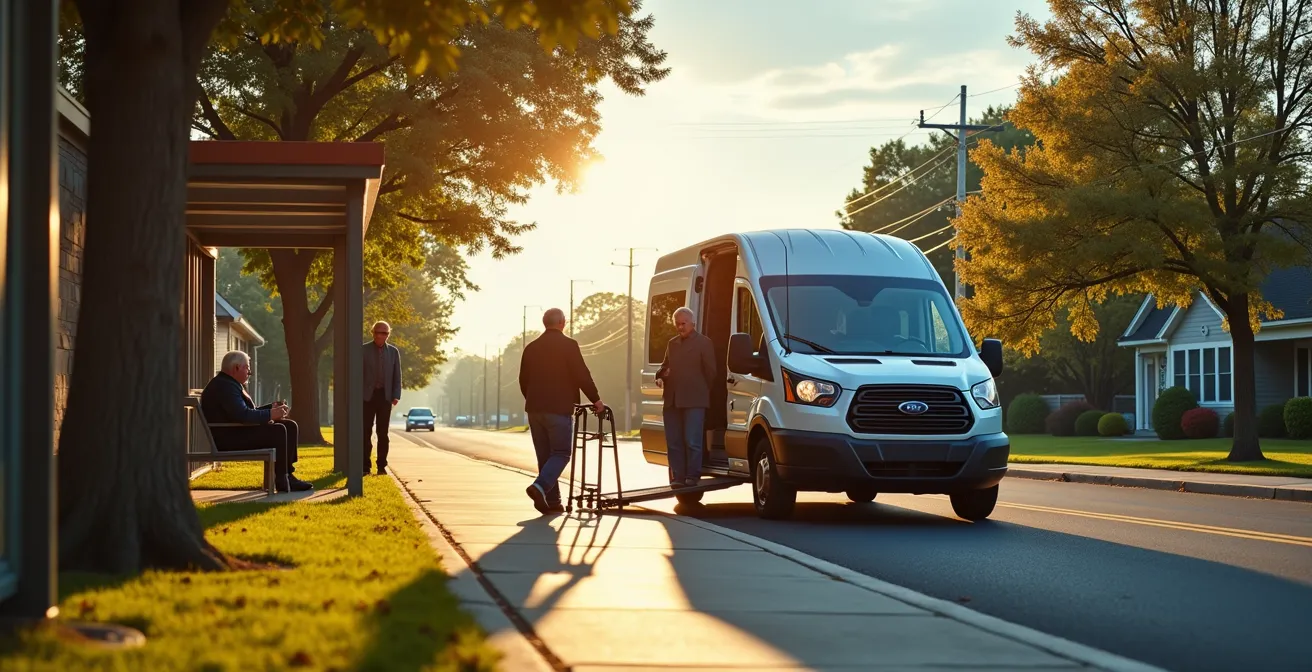
The moment a senior hands over their car keys can feel like a loss of independence, but it is often a major trigger for social isolation. Without the ability to drive to the grocery store, doctor’s appointments, or community events, a person’s world can shrink dramatically. However, a growing number of innovative and reliable transportation solutions are emerging to bridge this gap. Building this transit link is a cornerstone of any effective support ecosystem, ensuring that physical mobility is no longer a barrier to social connection. The key is knowing where to look and how to access these services.
The first point of contact should be your local Area Agency on Aging, accessible via a national hotline (800-677-1116), which can direct you to subsidized or volunteer-based programs in your specific region. For tech-savvy seniors or their families, services like GoGoGrandparent cleverly manage rideshare apps like Uber and Lyft via a simple phone call, eliminating the need for a smartphone. Many local faith-based organizations and community centers also run their own volunteer driver programs, often free of charge. For those with medical needs that prevent the use of regular transit, applying for paratransit services is another essential option. Finally, don’t underestimate the power of community: organizing a simple transportation co-op with neighbors can provide a flexible and friendly solution.
Case Study: Lori’s Hands Intergenerational Support
Lori’s Hands, a nonprofit organization, builds positive partnerships between college students and people with chronic illness. Students make weekly visits to community members who are isolated, helping with activities like grocery shopping and accessing resources. The program has successfully expanded to multiple universities, providing reliable transportation and companionship while giving students valuable service-learning experience.
The “Loneliness Effect”: why isolation is as deadly as smoking 15 cigarettes a day?
The term “loneliness” often conjures images of sadness or emotional distress, but the scientific community now views it as a serious public health threat. The “Loneliness Effect” is not just a feeling; it is a measurable physiological condition with devastating consequences. The U.S. Surgeon General has issued a stark warning that prolonged social isolation carries a health risk equivalent to smoking up to 15 cigarettes a day. This isn’t an exaggeration; it’s a data-backed reality that underscores the urgency of building community connections.
The danger lies in how our bodies respond to perceived isolation. It’s important to distinguish between loneliness (the subjective feeling of being alone) and social isolation (the objective lack of social contact). Your brain processes chronic social isolation similarly to how it processes physical pain. This triggers a cascade of stress responses, including elevated cortisol levels and systemic inflammation, which are known precursors to a host of chronic diseases. Over time, this constant state of high alert can accelerate cognitive decline, increase the risk of heart disease and stroke, and weaken the immune system. Addressing loneliness is therefore not just about improving quality of life; it is a critical act of health preservation. It’s about turning off a biological alarm that was never meant to stay on indefinitely.
Why neighbors are often the first line of defense against isolation?
In the architecture of a robust support ecosystem, neighbors represent the foundation. They are the “first line of defense” not because they are medical professionals, but because of their unique position of proximity and potential for casual, consistent contact. A concerned neighbor is often the first person to notice when a daily routine changes—when the newspaper isn’t picked up, the porch light stays off, or the curtains remain closed. This simple, ambient awareness is a powerful, non-intrusive safety net that no formal service can replicate. The key is to establish a system of connection that respects privacy while ensuring well-being.
Building this connection doesn’t require grand gestures. Simple, agreed-upon systems can provide peace of mind for everyone. The “Good Neighbor Protocol” involves creating low-effort, high-impact check-ins. This could be a “porch light signal” (light on by 9 AM means all is well) or a “curtains check” (curtains opened by noon signals a normal start to the day). Exchanging phone numbers for a quick text or call at a pre-arranged time can also foster connection without being intrusive. The goal is to move from being anonymous residents to being a community that looks out for one another.

As the Senior Lifestyle Research Team notes in their “What is Senior Isolation Study,” the value of this informal support cannot be overstated:
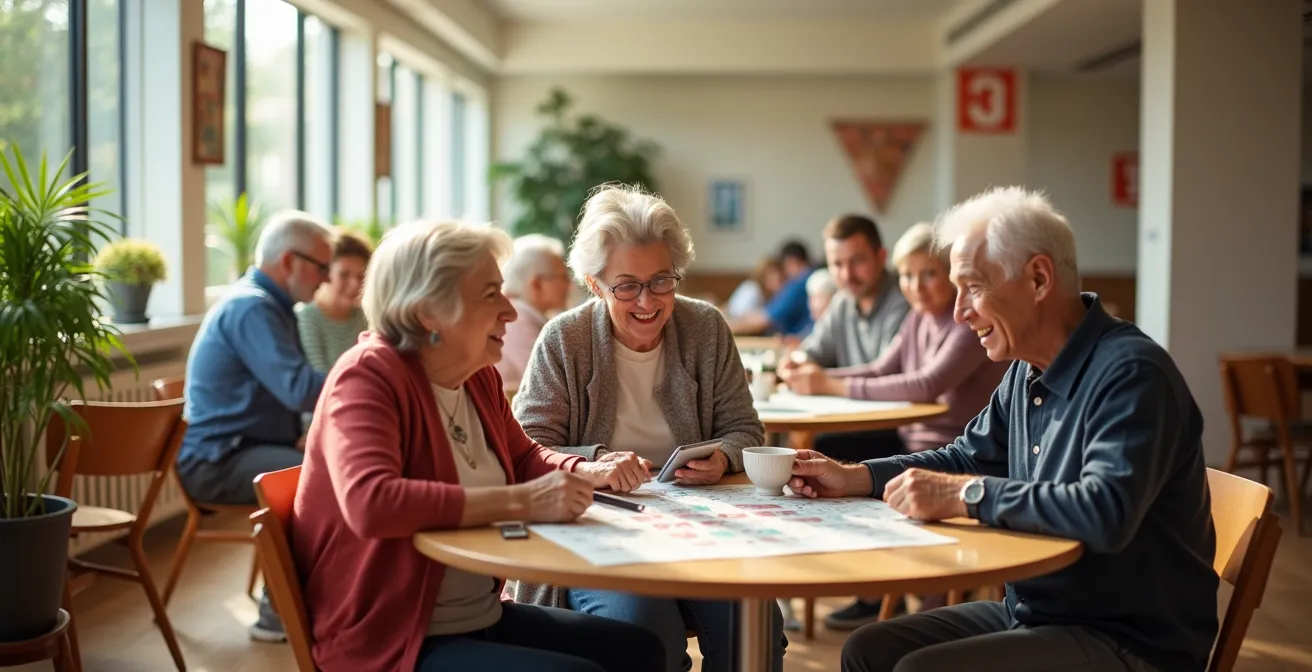
Volunteers can regularly visit isolated seniors, providing companionship and support. These visits can include activities like playing games, reading together, or simply having a conversation
– Senior Lifestyle Research Team, What is Senior Isolation Study
These small acts of connection form the most accessible and often most meaningful layer of the support network.
Managing the “Holiday Blues”: when to seek extra support during festive seasons?
The holiday season, with its relentless focus on family, togetherness, and celebration, can be an intensely painful time for those experiencing isolation. For seniors, this period can amplify feelings of loneliness, grief, and nostalgia, a phenomenon often called the “Holiday Blues.” While media portrays joyful gatherings, the reality for many is an empty chair at the table or silence where laughter used to be. The National Poll on Healthy Aging found that one in three adults age 50 to 80 experience social isolation, with many reporting that these feelings intensify significantly during festive periods. Recognizing this and planning ahead is a crucial act of self-care.
The key to managing the Holiday Blues is to be proactive, not reactive. Instead of waiting for sadness to set in, create a structured but flexible plan in early November. This involves managing expectations and focusing on small, achievable sources of joy. Schedule video calls with distant family on specific dates to have them on the calendar. Book transportation to a community holiday concert or a local faith service well before the December rush. It’s often better to plan 2-3 small, manageable activities per week rather than a single, overwhelming large gathering. It’s also vital to identify potential emotional triggers—like a specific song or tradition—and have a coping strategy in place, such as calling a friend or going for a walk. Most importantly, it’s crucial to know when the “blues” are something more. If feelings of sadness, changes in sleep, or a loss of appetite persist for more than two weeks, it’s time to contact a doctor or mental health professional.
Local club memberships: how to choose a group that actually welcomes new members?
“Join a club” is perhaps the most common advice given to combat loneliness, but it’s also one of the most fraught with anxiety. The fear of walking into a room of strangers, of facing established cliques, or of simply not fitting in can be a powerful deterrent. Not all groups are created equal when it comes to integrating new people. The secret to success is not just to find a group that shares your interests, but to find one that has a built-in culture of welcome. Learning how to spot these welcoming signs can turn a daunting prospect into an exciting opportunity.
You can actively screen groups by using a “3-Point Welcome Test” before you even commit to joining. First, observe their process: does the group have a designated greeter or a “buddy system” that pairs new members with established ones? Second, pay attention to their meetings: are new faces formally and warmly introduced at the start? Third, check their follow-through: does someone from the group reach out via phone or email within a day or two of your first visit? Websites like Meetup.com are also invaluable, as you can read comments and see the group’s online interaction patterns before attending. As a rule of thumb, niche interest groups (like bird watching, local history, or book clubs) tend to be more welcoming than generic “social clubs” because the shared passion provides an immediate and natural point of connection. Your local senior center or public library are excellent starting points for finding lists of these specialized groups.
Key takeaways
- Social isolation is a serious health risk, not just an emotional state, requiring a proactive, structured response.
- A “Support Ecosystem” approach, starting with neighbors and escalating to professionals as needed, is more effective than seeking a single solution.
- Knowing the specific “activation points”—the clear criteria for when to hire professional help like a Geriatric Care Manager—is key to effective care coordination.
Geriatric Care Managers: when is it worth paying for professional coordination?
As a person’s support needs become more complex, managing everything can feel like a full-time job. Juggling multiple doctors, complex medication schedules, and conflicting family opinions can lead to burnout for both the senior and their loved ones. This is the “activation point” where a Geriatric Care Manager (GCM) transitions from a luxury to a necessity. A GCM is a professional, often a social worker or nurse, who acts as a “quarterback” for a senior’s care. They assess needs, create a care plan, and coordinate all the different services, from medical appointments to home care agencies.
But how do you know when it’s time to make this investment? The decision often hinges on complexity. A few clear indicators suggest a GCM could provide significant value. If the senior sees five or more different specialists, takes a half-dozen medications with potential interactions, or if family members are long-distance or in disagreement about the care plan, a GCM can provide essential, neutral coordination. A formal dementia diagnosis is another critical trigger. While there is a cost to these services, it’s important to view it as an investment. A study from the National Association of Professional Geriatric Care Managers highlighted that GCMs can ultimately save families money by preventing costly hospital readmissions and connecting them to subsidized community resources they were unaware of.
The following table provides clear indicators for when the complexity of a situation may warrant professional coordination.
| Complexity Factor | Low Need | Moderate Need | High Need (Consider GCM) |
|---|---|---|---|
| Number of Doctors | 1-2 providers | 3-4 providers | 5+ specialists |
| Medications | Under 3 | 4-6 medications | 7+ with interactions |
| Family Dynamics | Local, aligned | Some distance/disagreement | Long-distance or conflict |
| Cognitive Status | Fully independent | Mild memory issues | Dementia diagnosis |
| Monthly Care Costs | Under $1,000 | $1,000-3,000 | Over $3,000 |
As demonstrated in a cost-benefit analysis by the National Association of Professional Geriatric Care Managers, the financial return can be significant.
Geriatric care managers can save families an average of $4,000 annually by preventing hospital readmissions and connecting families to subsidized community resources
– National Association of Professional Geriatric Care Managers, 2023 Industry Report
Finding Purpose: How to Design a Fulfilling Senior Lifestyle When Living Alone?
The ultimate goal of combating isolation is not simply to fill empty hours, but to fill a life with meaning. The final, and most profound, layer of the support ecosystem is the one you build for yourself: a life designed around purpose. After a lifetime of work, raising a family, or caring for others, retirement or living alone can create a “purpose vacuum.” Filling this vacuum with intention is the most powerful antidote to loneliness. This involves creating what can be called a “Purpose Portfolio,” a balanced collection of activities that nurture different aspects of your well-being.
This portfolio should be built on four pillars: Contribution, Creation, Learning, and Legacy. Contribution involves giving back, which can be done from anywhere. The AmeriCorps Seniors Program matches adults 55+ with volunteer roles, and digital opportunities like the Smithsonian Transcription Center allow you to contribute to history from your own home. Creation is about making something new, whether it’s opening an Etsy shop for handmade crafts or starting a blog to share your life experiences. Learning keeps the mind sharp; services like GetSetUp offer free online classes designed for seniors, and many universities allow you to audit courses. Finally, Legacy focuses on passing down your wisdom, whether through recording your life stories with the StoryCorps app or creating an ethical will to share your values with future generations.
By consciously investing time in each of these four areas, you are not just passing the time; you are architecting a life that is resilient, engaging, and deeply fulfilling, regardless of your living situation.
Building a support system is not a one-time task but an ongoing process of connection and resourcefulness. The first step is often the hardest, but it’s also the most important. Start today by taking one action from this guide—whether it’s looking up your Area Agency on Aging, leaving a note for a neighbor, or exploring a new online class.