

In summary:
- Morning stiffness is a signal that your joints need gentle movement, not prolonged rest, to stay lubricated and healthy.
- A simple, daily routine of chair-based yoga and in-bed stretches can significantly improve your range of motion and confidence.
- Building stability through balance exercises and gentle strength training is just as crucial as stretching for long-term independence.
- The ultimate skill for independent living, getting up from the floor, can be learned by practicing a few simple “micro-skills” every day.
That familiar morning stiffness in your hips and knees can feel like a daunting forecast for the day ahead. If you’re starting to worry that this stiffness is the first step towards losing your ability to walk with ease, you are not alone. It’s a common fear, and one that often leads to a well-intentioned but counterproductive reaction: moving less to avoid discomfort.
Many will advise you to simply “rest it out” or “take it easy.” But as a mobility coach, I’ve seen firsthand how this approach can unintentionally accelerate the very decline you’re trying to prevent. The key to preserving your mobility isn’t about fighting your body with intense exercise or surrendering to rest. It’s about starting a gentle, intelligent conversation with your joints.
But what if the true secret wasn’t about stretching harder, but moving smarter? What if you could teach your joints to be fluid, stable, and reliable again, using simple movements you can do from a chair or even before you get out of bed? This guide is built on that very principle. We will explore the science behind why movement is medicine for stiff joints, provide safe and effective routines, and build the skills that are most critical for maintaining your cherished independence.
This article will guide you through a complete, reassuring, and practical approach to reclaiming your mobility. We’ll start by understanding the problem and then build, step-by-step, toward a future of confident movement.
Summary: Your Path to Regaining Joint Freedom
- Why resting a stiff joint actually makes mobility loss worse?
- How to perform a full-body yoga routine without leaving your chair?
- Ignoring morning stiffness: the mistake that leads to permanent range loss
- Balance pads vs wobble boards: which is safe for home practice?
- Morning vs Evening stretching: when are joints most receptive?
- The 90/90 stretch: unlocking tight hips to improve walking stride
- How to perform resistance training without straining arthritic joints?
- Why the ‘Floor-to-Stand’ Transfer Is the Single Most Critical Skill for Independent Living?
Why resting a stiff joint actually makes mobility loss worse?
The instinct to rest a stiff, achy joint makes perfect sense. If it hurts to move, not moving seems like the logical solution. However, for the kind of stiffness that greets you in the morning, which isn’t caused by a new injury, prolonged rest is often the enemy. To understand why, we need to look inside the joint itself. Your joints are lubricated by a substance called synovial fluid, which acts like engine oil, reducing friction and nourishing the cartilage.
When you are immobile for long periods, like overnight, this fluid changes. It becomes thick and gel-like. This is the primary cause of that “stuck” feeling in the morning. Gentle movement is the signal your body needs to warm up that fluid, making it thinner and more effective as a lubricant. Without this daily signal, the joint remains poorly lubricated, which can lead to increased friction and a gradual loss of mobility.
Furthermore, this lack of movement has a cascading effect. According to research from 2024, reduced hyaluronic acid production in immobile joints leads to decreased lubrication and increased friction over time. The muscles and connective tissues around the joint also begin to shorten and tighten, further restricting your range of motion. So, while rest is crucial for acute injuries, for chronic stiffness, the mantra must be “motion is lotion.” It is the gentle, daily act of moving that keeps the machinery of your joints running smoothly.
How to perform a full-body yoga routine without leaving your chair?
The idea of a “full-body” workout can sound intimidating, especially when dealing with stiff hips and knees. But you don’t need a yoga mat or the ability to get on the floor to reap the benefits. Chair yoga is a wonderfully accessible and effective way to move your entire body safely. It provides support, reduces the risk of falls, and allows you to focus on the quality of your movement.
A successful chair yoga practice focuses on moving every major joint through its comfortable range of motion. This includes the spine, shoulders, hips, and ankles. The goal isn’t to force a deep stretch, but to gently explore what movement is available to you today. A study involving seniors with an average age of 88 found that practicing chair yoga regularly for just eight weeks significantly improved their mobility and, just as importantly, reduced their fear of falling. Participants reported increased confidence in daily movements, proving that even the gentlest of practices yields powerful results.
One particularly useful technique that can be done from a chair is “nerve flossing,” which helps improve nerve mobility and can reduce sensations of tingling or tightness.
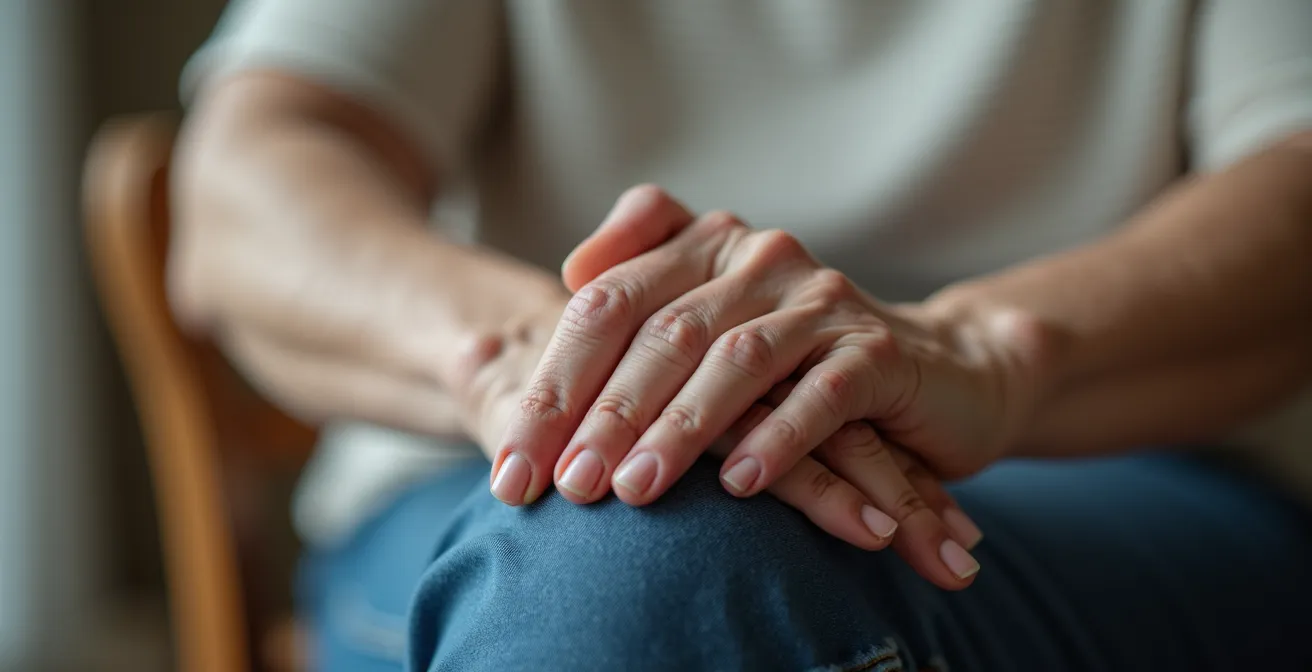
As shown in the image, this involves a series of controlled, gentle movements of the limbs to mobilize the nerves. For the median nerve in the arm, for example, you would sit tall, extend one arm out to the side with the palm up, and then gently tilt your head away from the extended arm. This creates a gentle “flossing” sensation. Remember, this should never be painful. It’s a perfect example of the “joint conversation” philosophy—a gentle request for movement, not a forceful demand.
Ignoring morning stiffness: the mistake that leads to permanent range loss
It’s tempting to dismiss morning stiffness as just a normal part of aging. You might wait it out, have a cup of coffee, and hope it subsides on its own. While it often does ease up after you get moving, consistently ignoring this daily signal can have long-term consequences. This stiffness is your body’s early warning system, indicating that your joints aren’t getting the gentle “wake-up call” they need.
When you consistently skip this crucial morning movement, the cycle of stiffness can worsen. The synovial fluid remains thick for longer, and the surrounding muscles and tissues begin to adapt to a more limited range of motion. Over months and years, this can lead to the formation of adhesions and a permanent shortening of connective tissues, effectively “locking” the joint into a more restricted state. Indeed, clinical observations show that morning stiffness lasting more than 30 minutes often affects a person’s mobility and confidence for the entire day.
The good news is that preventing this decline doesn’t require a huge time commitment. A simple, 5-minute routine performed before your feet even touch the floor can make a world of difference. It tells your joints that it’s time to get ready for the day, promoting lubrication and gently lengthening the tissues. Integrating this small habit is one of the most powerful investments you can make in your long-term independence.
Your 5-minute pre-morning checklist: The before-your-feet-touch-the-floor routine
- Ankle Circles: While still lying in bed, extend your legs and slowly circle your ankles. Do this for 30 seconds in each direction to wake up the lower legs.
- Pelvic Tilts: With your knees bent and feet flat on the bed, gently flatten your lower back into the mattress, then create a small arch. Repeat 10 times to mobilize the lumbar spine.
- Knee Rocks: Gently hug one knee towards your chest, hold for a moment, then release. Alternate legs, performing 5 repetitions per side to warm up the hips.
- Gentle Spinal Twists: With knees bent together, gently let them fall to one side, keeping your shoulders on the bed. Hold for 15 seconds, then repeat on the other side.
- Deep Breathing: Before sitting up, take 3-5 slow, deep breaths to oxygenate your body and prepare for the transition to an upright position.
Balance pads vs wobble boards: which is safe for home practice?
As you work on flexibility, it’s equally important to address stability. Good balance is a skill, and like any skill, it needs to be practiced. It’s the foundation of fall prevention and confident movement. Many people consider buying equipment like balance pads or wobble boards, but it’s crucial to choose the right tool for your current ability level to ensure your practice is safe and effective.
The key difference between these tools lies in their predictability. A balance pad is typically made of firm foam. It creates an unstable surface, but it’s a consistent and forgiving one. A wobble board, on the other hand, is a rigid disc on a single pivot point, making it multi-directional and much more challenging. For a senior just beginning to work on balance, a wobble board can introduce too much risk and is generally not the recommended starting point.
Before investing in any equipment, you can start with what you already have at home. Simply practicing standing on a thick rug or a folded-up yoga mat can provide a safe, entry-level challenge.
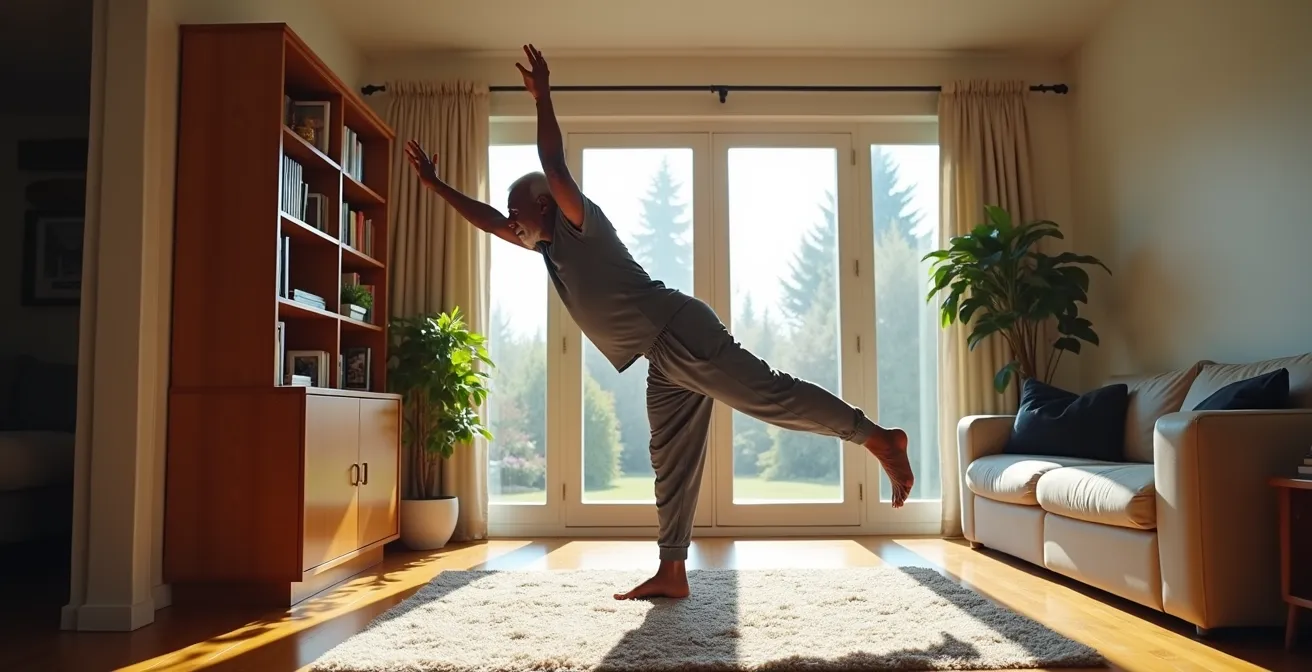
As the image illustrates, the safest way to begin is in a clear, open space with a sturdy object like a bookshelf or kitchen counter nearby for light support. The goal is not to lean on the support, but to have it there for confidence and safety. The following table provides a clear guide to help you choose the right level of challenge.
| Equipment | Skill Level | Fall Risk | Recommended Test |
|---|---|---|---|
| Environmental (pillow/rug) | Entry-level | Very Low | Can stand with feet together for 30+ seconds |
| Balance Pad | Beginner | Low | Can stand on one leg for 15+ seconds |
| Wobble Board | Advanced | Moderate | Can stand on one leg for 30+ seconds |
Morning vs Evening stretching: when are joints most receptive?
Understanding what type of movement to do is only half the battle; knowing when to do it can make your efforts far more effective. Your joints have different needs in the morning than they do at the end of the day. Think of it as a “receptive window”—a time when they are most open to a certain type of movement. Tailoring your stretching to these windows creates a more harmonious conversation with your body.
In the morning, your primary goal is to combat stiffness and lubricate the joints. This is the time for dynamic stretching. These are active, flowing movements that take your joints through their range of motion without holding the end position. Examples include gentle leg swings, arm circles, and the cat-cow stretch from chair yoga. These movements act like a pump, circulating synovial fluid and warming up the muscles. A good rule of thumb for morning movements is to hold for no more than 10-15 seconds, focusing on the flow.
In the evening, the goal shifts. After a day of activity, your muscles may have accumulated tension. This is the ideal window for static stretching—the classic “stretch and hold” technique. This helps to release that accumulated tightness, improve long-term flexibility, and calm your nervous system before sleep. For evening stretches, aim to hold each position for 20-30 seconds, breathing deeply and allowing the muscle to relax into the stretch. It’s important to note that your stretching approach may need to be modified based on the type of arthritis you have. For inflammatory conditions like rheumatoid arthritis, where morning stiffness is severe, gentle dynamic movements are always key. For osteoarthritis, which can feel worse after a day of use, evening static stretching can be particularly beneficial for pain relief.
The 90/90 stretch: unlocking tight hips to improve walking stride
Few areas are more critical to our walking ability than our hips. When hip mobility is limited, particularly the ability to rotate the hip internally, the body is forced to compensate. This often results in an “out-toeing” gait, where the feet turn outwards while walking. While it may not seem like a major issue, biomechanical research indicates that these compensatory gait patterns place unnatural stress on the knees and ankles, increasing wear and tear and affecting balance.
One of the most effective ways to restore this crucial hip rotation is the 90/90 stretch. In its classic form, it’s performed on the floor by creating 90-degree angles with both your front and back legs. However, for many seniors with stiffness, getting to the floor is a significant barrier. This is where a modified, chair-based version becomes an invaluable tool. It allows you to target the same critical muscles without the risk or difficulty of getting down and up.
The chair-based 90/90 achieves similar hip rotation benefits in a supported position. For individuals who can’t get to the floor, this regression pathway is a perfect example of working with your body, not against it. You can place your right foot flat on the floor while positioning your left leg to mimic the 90-degree shape, using your hands on the ground or blocks for support. This modification targets the same muscle groups that are essential for a healthy walking gait, making a profound stretch accessible to almost anyone. It’s a powerful tool for unlocking a smoother, more efficient stride.
How to perform resistance training without straining arthritic joints?
When you have arthritis, the idea of “resistance training” can sound like the last thing you should be doing. We associate it with heavy weights and strain, which seems counterintuitive for a painful joint. However, building the muscles around a joint is one of the most protective actions you can take. Strong muscles act as a “dynamic ligament,” absorbing shock and providing stability that the joint itself can no longer offer.
As confirmed by the U.S. National Center for Biotechnology Information (NCBI):
Muscle strength directly correlates with joint stability, particularly in synovial joints. The muscles and their tendons crossing the joint resist the forces acting on that joint, behaving as a dynamic ligament.
– NCBI Bookshelf, Anatomy, Joints – StatPearls
The secret to building this strength without causing a flare-up is isometric training. Unlike traditional weightlifting where the joint moves through a range of motion (concentric/eccentric contraction), isometrics involve contracting a muscle without changing its length or moving the joint. Think of pushing against an immovable object, like a wall. You are creating tension and challenging the muscle, but the joint itself remains static and protected.
This method allows you to build strength and stability safely, even in a sensitive, arthritic joint. Simple exercises like squeezing a tennis ball, pushing against a wall, or holding a “chair sit” position for a few seconds can be done daily. These small, static efforts send a signal to the muscles to get stronger, gradually building that crucial supportive corset around your hips and knees without aggravating them. It’s the smartest way to build resilience from the inside out.
Key takeaways
- Gentle daily movement is more effective for morning stiffness than prolonged rest, as it helps lubricate the joints with synovial fluid.
- You can achieve a full-body workout safely from a chair, focusing on mobilizing all major joints to improve flexibility and confidence.
- Developing the skill of getting up from the floor is a critical predictor of long-term independence and can be learned by practicing simple “micro-skills.”
Why the ‘Floor-to-Stand’ Transfer Is the Single Most Critical Skill for Independent Living?
Of all the physical skills we possess, the ability to get up from the floor unassisted is perhaps the most fundamental measure of our independence and resilience. It’s a skill we take for granted until it becomes difficult. Its importance goes beyond the practical scenario of recovering from a fall; it is a powerful indicator of overall strength, flexibility, and coordination. In fact, its predictive power is startling.
The Sitting-Rising Test (SRT) is a clinical assessment where a person is asked to sit down on the floor and stand back up, using as little support as possible. The results are profoundly linked to longevity. A landmark 2025 study of 4,282 adults found that those who scored poorly (0-4 out of 10) had a staggering 42.1% mortality rate over the following 12 years, compared to just 3.7% for those who could perform the movement perfectly. This shows that the floor-to-stand transfer isn’t just a movement; it’s a reflection of your body’s overall functional health.
But this statistic shouldn’t be a source of fear. Instead, it should be a call to action. The beauty of the floor-to-stand transfer is that it can be broken down into a series of smaller, manageable micro-skills. You don’t have to master the whole movement at once. By practicing these individual components, you can rebuild this vital skill piece by piece. The four key micro-skills are: the ability to roll from your back to your stomach; getting onto your hands and knees (quadruped); bringing one foot forward into a lunge; and finally, pushing up to a standing position. By practicing these components in a safe environment, you are not just preparing for a potential fall—you are actively investing in a longer, more independent life.
Start today by integrating one or two of these gentle movements into your daily routine. The journey to lasting mobility begins not with a giant leap, but with a single, mindful motion.