
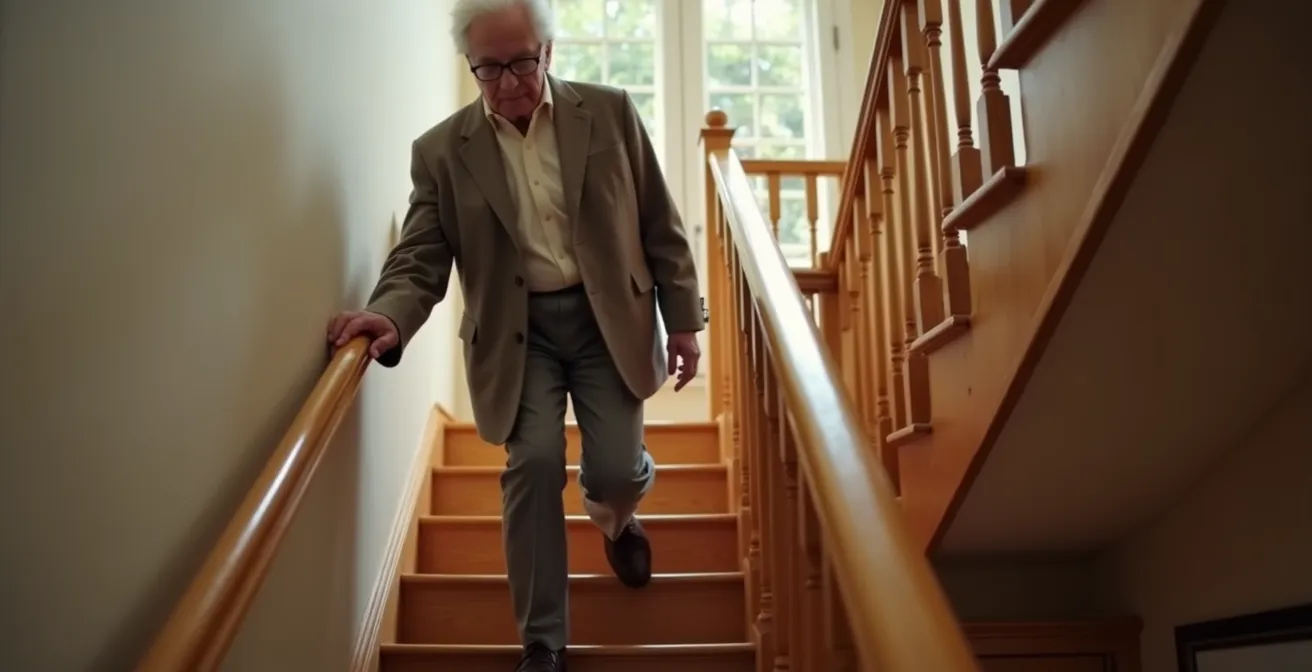
The debate between multifocals and bifocals misses the real cause of falls: perceptual ambiguity. The safest lens is the one that’s part of a complete Visual Safety System.
- Lens technology like anti-reflective coatings is more critical than the basic lens type for improving contrast.
- Precise fitting measurements, not just the prescription, are essential for maintaining balance and correct depth perception.
Recommendation: Work with your dispenser to audit not just your lenses, but the fit, your adaptation habits, and your home environment to truly minimize fall risk.
For any senior getting new glasses, especially multifocals, the fear of a fall is a legitimate and pressing concern. The world can suddenly feel unstable, with stairs appearing to warp and floors seeming to tilt. The common advice is to simply “be careful” or debate the merits of bifocals with their distinct line versus progressive lenses with their seamless transition. This conversation, however, often overlooks the most critical factors. The risk of falling isn’t just about the lens type; it’s a complex interplay between optics, physiology, and the environment.
The truth is that focusing solely on “bifocal vs. progressive” is like discussing the best type of tire for a car without checking the wheel alignment or the road conditions. A poorly fit progressive lens can be more dangerous than a well-fit bifocal, and vice-versa. The key to mitigating fall risk lies in a more holistic approach: building a complete Visual Safety System. This system doesn’t just consider the lens itself, but also advanced coatings that enhance contrast, the precision of the frame fit that governs optical alignment, your brain’s adaptation process, and even the characteristics of your home environment, like flooring and lighting.
This guide moves beyond the superficial debate. We will deconstruct each component of your Visual Safety System. We will explore the physics of the “swim effect,” the non-negotiable role of a precise fit, why standard eye charts are insufficient, and how simple environmental changes can work in tandem with your eyewear to create a stable, predictable, and safe visual world.
This article breaks down the essential components for creating a stable visual experience and minimizing fall risk. Explore the topics below to understand how each element, from lens technology to your home environment, contributes to your overall safety.
Summary: A Technical Guide to Choosing Lenses That Reduce Fall Risk
- The “Swim Effect”: how to safely navigate floors with new progressive lenses?
- Anti-reflective coatings: do they really help with night driving glare?
- Why sliding glasses cause neck pain and balance issues?
- When glasses stop working: recognizing when surgery is the only fix
- Blue light filters: marketing hype or essential for macular protection?
- High-contrast markers: using tape to define step edges cheaply
- Beyond the chart: the contrast sensitivity test you need for night driving
- How to Choose Anti-Slip Flooring That Reduces Fall Risks by 50% in Wet Areas?
The “Swim Effect”: how to safely navigate floors with new progressive lenses?
The “swim effect,” or peripheral distortion, is the most common complaint from new progressive lens wearers and a primary source of anxiety regarding falls. This disorienting sensation, where peripheral vision seems to warp or sway, is an inherent byproduct of how progressive lenses are designed. To create a seamless corridor of clear vision from distance to near, the lens optics are complexly curved, leaving zones of aberration on the right and left. When you turn your eyes instead of your head, you look through these distorted zones, causing the world to appear to move unstably. This creates a significant perceptual ambiguity, especially when navigating uneven surfaces like stairs.
The brain, however, is remarkably adaptable. The process of getting used to progressives is technically known as neuroadaptation, where your brain learns to ignore the peripheral distortions and trust the clear central image. Research shows that the brain’s visual system learns to adjust its focus and movement control, and vergence dynamics were on average faster for presbyopes who adapted to progressive lenses. This adaptation isn’t passive; it can be actively trained.

As the image above illustrates, the key is to keep your primary line of sight within the clear central corridor of the lens. This requires a conscious change in habit: point your nose where you want to look. By turning your head to view objects, you avoid the distorted edges of the lens, providing your brain with clear, stable information. A structured adaptation protocol can significantly shorten the adjustment period and build confidence.
- Start in a safe zone: For the first 3-5 days, wear your new progressives in a familiar, obstacle-free environment like your living room to allow your brain to adjust without pressure.
- Practice the “point your nose” technique: Consciously turn your head to look at objects instead of just shifting your eyes. This keeps your vision in the clearest part of the lens.
- Perform gaze stabilization exercises: Focus on a distant point and slowly turn your head from side to side for 30 seconds. Repeat 3 times daily to train your brain to separate head movement from visual stability.
- Gradually increase complexity: Progress from sitting to standing, then to walking slowly in familiar spaces, and finally practice on a single, well-lit step before tackling a full staircase.
- Be patient: It can take anywhere from a few days to two weeks to fully adapt. Consistent wear is key to accelerating this process.
Following this structured approach transforms the adaptation from a passive waiting game into an active training regimen, building the neural pathways necessary for safe and confident navigation.
Anti-reflective coatings: do they really help with night driving glare?
While lens design gets the most attention, coatings are a critical and often underestimated part of a Visual Safety System. An anti-reflective (AR) coating is not a luxury; for a multifocal wearer concerned with falls, it is an essential safety feature. Its primary function is to minimize reflections from the front and back surfaces of the lens. This has two profound benefits: reducing distracting glare and increasing the amount of light reaching your eye. Both are crucial for navigating safely, especially in challenging lighting conditions like dusk, night, or dimly lit indoor spaces.
From a technical standpoint, standard plastic lenses can reflect up to 8-10% of light, meaning less light is available for you to see. High-quality anti-reflective coatings can allow up to 99.5% of available light to pass through the lens to your eye. This small percentage makes a significant real-world difference. More light means better functional contrast, which is your ability to distinguish objects from their background—like the edge of a step or an obstacle on the floor. At night, this improvement directly combats the “starburst” and “halo” effects from oncoming headlights, which are a major source of perceptual ambiguity for drivers.
The principle of enhancing contrast by managing light is scientifically proven to reduce falls. While not a study on AR coatings directly, a compelling 2022 study on stairway safety demonstrated this exact concept in the physical environment. The research found that by simply adding high-contrast stripes to a stairway, fall-related events were reduced significantly compared to an unmarked stairway. The odds ratio was 2.87, showing a strong correlation between improved visual contrast and a lower likelihood of falls. AR coatings work on the same principle: they maximize the light and contrast information reaching your brain, giving you a clearer, more defined picture of your surroundings so you can navigate with greater certainty.
Therefore, when choosing new lenses, investing in a premium AR coating is a direct investment in your navigational safety, both behind the wheel and on your feet.
Why sliding glasses cause neck pain and balance issues?
Even the most advanced, perfectly prescribed progressive lenses will fail—and can even become dangerous—if they are not fitted correctly to your face and the specific frame you’ve chosen. When glasses slide down your nose, it’s not just an annoyance; it’s a critical failure of the Optical Center Alignment. The optical center (OC) of the lens is the single point that provides the truest prescription, and for progressive lenses, the entire corridor of power is built around it. If your pupil is not aligned with this center, you are effectively looking through the wrong part of the lens, introducing distortion and prescription errors.
This misalignment forces you into subconscious and unnatural postural adjustments. To find the “sweet spot” for reading in lenses that have slipped, you may tilt your head back, lifting your chin. This strains the cervical spine, leading to neck pain and headaches. More dangerously, this constant, subtle head movement disrupts your vestibular system—the sensory system in your inner ear that provides your brain with information about motion, head position, and spatial orientation. The conflict between what your eyes are seeing (a distorted view) and what your inner ear is sensing (unnatural head posture) creates a sense of imbalance and dizziness, directly increasing your risk of a fall.
A professional fitting is a science, involving a series of precise “point-of-wear” measurements that ensure the lens is positioned perfectly for your unique anatomy and posture. These measurements go far beyond just your prescription and pupillary distance. They are the foundation of your Visual Safety System, ensuring the lens performs as it was designed to. A proper fitting audit is the only way to guarantee this.
Your Frame Fit Safety Audit: 5 Points to Verify
- Points of Contact: Identify all points where the frame touches your face—the nose bridge and behind the ears. Are these points secure without causing pressure? Any slippage, even minor, indicates a problem.
- Collect Existing Data: A dispenser must take monocular pupillary distance (PD), optical center (OC) height in the chosen frame, and your natural head posture. These are the baseline metrics for customization.
- Check for Coherence: These measurements are then compared to ideal optical standards. Is the pantoscopic tilt (the angle of the lens to your cheek) between 8-12 degrees? Is the vertex distance (eye-to-lens) between 12-14mm? Deviations must be corrected.
- Assess Stability and Comfort: Wear the glasses and perform real-world movements. Shake your head, look down, and walk around. Do they stay in place? Any feeling of pressure or instability must be addressed as it signals a future problem.
- Establish an Adjustment Plan: Based on the audit, the optician must create a plan to adjust the frame, re-shape the temples, or change the nose pads to achieve a secure, stable, and optically precise fit.
Never underestimate the importance of a perfect fit. It is the crucial link that connects the optical technology of your lenses to your own biological systems, ensuring they work in harmony, not against each other.
When glasses stop working: recognizing when surgery is the only fix
Eyeglasses are powerful tools for correcting refractive errors, but they have limitations. There comes a point for some individuals where, despite having the most accurate prescription and a perfect fit, daily visual tasks remain difficult and frustrating. This is often because the underlying issue is no longer just a simple focusing problem but a degradation in the quality of the visual system itself, most commonly due to cataracts. A cataract is the clouding of the eye’s natural lens, which scatters and blocks light, leading to a significant loss of contrast sensitivity and overall visual clarity.
The hallmark sign that glasses are “no longer working” is a growing disconnect between your measured visual acuity and your real-world visual ability. You might still read the 20/20 line on a high-contrast eye chart in a brightly lit room, but struggle to see facial expressions, drive at night, or distinguish the edge of a curb in the shade. This is the critical difference between standard vision and functional vision. As explained in an article by Harvard Medical School, which summarized studies on multifocal lens fall prevention, this distinction is paramount.
Functional vision is the ability to perform daily tasks. A person can have 20/20 vision but poor functional vision due to low contrast sensitivity.
– Harvard Medical School
When a cataract is the cause of this poor functional vision, no spectacle lens, no matter how advanced, can solve the problem. The issue is not one of focus, which glasses correct, but of light transmission and clarity. A new, stronger prescription won’t make a foggy window clear. Key symptoms that suggest the problem is beyond what glasses can fix include:
- Increasingly blurry or dim vision, as if looking through a dusty film.
- Faded or yellowed appearance of colors.
- Severe glare and halos around lights, especially at night, making driving hazardous.
- The need for much brighter light for reading and other close-up tasks.
- Frequent changes in your eyeglass prescription that provide little to no improvement.
If you experience these symptoms, it is crucial to consult with an ophthalmologist. Cataract surgery, a procedure that replaces the clouded natural lens with a clear artificial one, is often the only effective solution to restore functional vision and, in turn, your safety and independence.
Blue light filters: marketing hype or essential for macular protection?
In the conversation about advanced lens technologies, blue light filters have gained immense popularity, primarily marketed as a way to reduce digital eye strain and protect the macula from long-term damage. While they can be beneficial for individuals spending long hours in front of screens, their role in a Visual Safety System for mobility and fall prevention is questionable and potentially negative. From a purely optical physics standpoint, blue light filters work by blocking a portion of the high-energy visible (HEV) blue light spectrum. This inherently means they reduce the total amount of light reaching the eye.
For a senior whose primary concern is navigating their environment safely, maximizing light is paramount. Reduced light transmission, especially in already dim or indoor settings, can decrease contrast sensitivity and make it harder to detect subtle obstacles or changes in elevation, like the edge of a rug or a single step. This is where a distinction must be made between lens technologies designed for static, seated tasks (like computer work) and those needed for dynamic, mobile activities. For mobility, contrast-enhancing tints, such as light yellow or amber, are often far more effective and safer.
Unlike blue light filters that subtract light, contrast-enhancing tints work by selectively filtering out unfocused blue light haze while emphasizing the yellow and red parts of the spectrum. This has the effect of making edges appear sharper and improving depth perception without significantly reducing overall brightness. The table below outlines the critical differences between these two technologies in the context of fall prevention.
| Feature | Blue Light Filters | Contrast-Enhancing Tints (Yellow/Amber) |
|---|---|---|
| Light Transmission | Blocks 10-30% of blue spectrum | Filters blue while enhancing yellow spectrum |
| Indoor Contrast | May reduce overall brightness | Increases edge definition |
| Stair Navigation | Potentially reduced edge visibility | Enhanced depth perception |
| Best Use Case | Computer/screen work while seated | Walking and mobility tasks |
| Fall Risk Impact | May slightly increase in low light | Generally decreases |
Therefore, while a blue light filter may be appropriate for a secondary pair of glasses dedicated to screen use, it is generally not recommended for primary-pair multifocals intended for all-day wear and mobility. For safety on your feet, prioritizing technologies that enhance contrast is the superior choice.
High-contrast markers: using tape to define step edges cheaply
The most sophisticated eyewear can be rendered ineffective by a poorly lit or low-contrast environment. A crucial part of building your Visual Safety System involves “calibrating” your home to support, rather than challenge, your vision. The most hazardous area for many multifocal wearers is the staircase. Looking down through the reading portion of the lens can distort depth perception, making it difficult to judge the position of each step edge. An incredibly effective and inexpensive solution is to manually increase the visual contrast of each step.
This is achieved by applying high-contrast marking tape to the edge (or “nosing”) of each step. The goal is to create a sharp, unambiguous line that is easily detectable even with a quick glance or through the peripheral zones of your progressive lenses. The color of the tape should be chosen to contrast as strongly as possible with the material of your stairs. For dark wood or carpeted stairs, a bright white or yellow tape is ideal. For light-colored stairs (like beige carpet or light wood), a black or dark blue tape will provide the most visible demarcation.
The effectiveness of this simple modification is backed by science. As mentioned earlier, a 2022 study confirmed that adding a visual stripe to a stairway significantly reduces fall-related events. You can determine the best solution for your own home with a simple test:
- Test tape samples: Place small strips of different colored tapes (e.g., yellow, white, black) on the edge of one step.
- Observe from a distance: Stand at the top of the stairs, wearing your glasses, and observe which color “pops” the most and creates the clearest, most defined line in your typical lighting conditions.
- Apply full-width: Apply the chosen tape along the full width of every step’s leading edge. This creates a consistent and predictable visual cue.
- Consider lighting: Enhance the effect by ensuring a light source illuminates the treads (the horizontal part you step on), which makes the taped edge even more prominent.
- Add depth cues: For maximum definition, consider applying tape not only to the edge of the tread but also to the bottom of the riser (the vertical part), creating a stronger three-dimensional outline of each step.
This proactive step transforms a potentially hazardous area into a navigable space, providing your brain with the clear visual information it needs to coordinate safe movement, regardless of the optical challenges presented by multifocal lenses.
Beyond the chart: the contrast sensitivity test you need for night driving
A common and dangerous misconception is that having “20/20 vision” equates to having perfect vision. The standard Snellen eye chart, with its high-contrast black letters on a white background, measures only one aspect of sight: visual acuity under ideal conditions. It does not measure your ability to see in low light, fog, or situations with poor contrast—the very conditions that pose the greatest risk for falls and driving accidents. For this, you need a different kind of test: a contrast sensitivity test.
Contrast sensitivity is a measure of how well you can distinguish between an object and its background. It’s what allows you to see a grey car on a wet road at dusk, the subtle texture of a carpet, or the edge of a concrete step. A person can have 20/20 acuity but poor contrast sensitivity, leaving them functionally blind in many real-world situations. For progressive lens wearers, whose lenses have inherent optical complexities, assessing contrast sensitivity is not just advisable; it should be mandatory. It provides a much more accurate picture of your true functional vision. For instance, a technical study on progressive lens performance noted that visual stability is maintained within a very specific power range. As stated by experts in the IOT Study on Progressive Lens Vision Stability, this highlights the need for precise measurements.
The results indicate that there is a range between +0.25D and -0.75D in which users with accommodation amplitude lower than 1D maintained stable visual acuity.
– Eva Chamorro, Ph.D., José Alonso, Ph.D.
This level of precision is why a more comprehensive test is needed. If you have ever felt unsteady, have a history of falls, or feel a lack of confidence driving at night, you should specifically request a contrast sensitivity test from your eye care professional. Different tests are available, each offering a unique insight into your functional vision.
| Test Type | What It Measures | Relevance to Fall Risk | When to Request |
|---|---|---|---|
| Snellen Chart (20/20) | Ability to see high-contrast black letters | Limited – doesn’t predict real-world navigation | Standard annual exam |
| Pelli-Robson Chart | Ability to see fading gray letters | High – directly relates to step edge detection | If you’ve fallen or have balance issues |
| CSV-1000 | Contrast at multiple spatial frequencies | Very High – comprehensive assessment | Before choosing progressive lenses |
| Functional Vision Assessment | Real-world task performance | Critical – includes stair navigation | After any fall or near-miss |
The results of a contrast sensitivity test provide crucial data that allows your optician to recommend the best lens technologies, such as specific AR coatings or contrast-enhancing tints, to build a Visual Safety System tailored to your unique visual needs.
Key Takeaways
- A precise, stable fit is just as critical as the lens prescription itself for preventing distortion and imbalance.
- Functional vision depends on contrast sensitivity, not just 20/20 acuity. Maximizing contrast with coatings and lighting is essential.
- Your environment is a key part of your visual system; simple modifications like floor choice and step marking dramatically reduce fall risk.
How to Choose Anti-Slip Flooring That Reduces Fall Risks by 50% in Wet Areas?
The final, and perhaps most foundational, element of your Visual Safety System is the ground beneath your feet. Your choice of flooring has a direct impact on both physical and visual stability. While slip resistance is a well-understood factor, the visual properties of flooring are equally important for a multifocal lens wearer. High-gloss finishes, busy geometric patterns, and even subtle changes in flooring type between rooms can create perceptual ambiguity that increases fall risk.
High-gloss surfaces like polished tile or varnished hardwood can create intense glare and reflections, especially from windows or overhead lights. For someone with progressives, this glare can obscure the true surface, creating a “wet look” illusion that makes it difficult to judge distance and texture. Similarly, flooring with busy, repetitive, or high-contrast geometric patterns (like checkerboards) can create optical illusions that interfere with depth perception and induce a sense of motion or instability. A 2024 fall prevention assessment guide directly addresses this interaction, recommending matte finishes and consistent patterns for those with vision issues, emphasizing that visibility should be boosted with contrasting colors.
The ideal flooring for a home focused on safety should be both physically non-slip and visually “quiet.” This means it provides clear, stable visual information to the brain without creating confusing patterns or glare. When selecting new flooring or assessing your current environment, consider the following criteria:
- Finish: Strongly prefer matte or satin finishes over high-gloss to minimize glare.
- Pattern: Choose solid colors or flooring with subtle, low-repeat patterns. Avoid checkerboards, complex geometrics, or designs that mimic depth.
- Consistency: Use the same flooring material throughout main walking paths to eliminate the need for your eyes to constantly re-adapt to different textures and sheens.
- Slip Resistance: Look for a Coefficient of Friction (COF) rating of 0.6 or higher, especially for areas that can get wet like kitchens and bathrooms.
- Rugs: If using area rugs, ensure they are low-profile and securely taped down or held with a gripper pad to prevent both tripping and visual confusion at the edges.
Ultimately, a safe environment is one that is predictable. By choosing flooring that offers clear visual cues and reliable physical traction, you complete the final piece of your Visual Safety System, creating a space where you can move with confidence and security.