

Refusing a mobility aid out of pride is not about preserving independence; it’s about unintentionally limiting it. The key is to reframe the aid not as a crutch for disability, but as high-performance gear for living.
- A mobility aid is a strategic tool to manage your “energy budget,” saving physical power for activities you love.
- Modern aids can be stylish accessories that express personality, defying the outdated medical stigma.
Recommendation: Start by viewing your cane or walker as specialized equipment designed to enhance your performance in the sport of daily life, not as a sign of surrender.
The conversation often starts with a well-meaning suggestion from a loved one after a near-fall or a period of increasing instability. “Maybe it’s time to think about a cane.” For many, this suggestion feels less like a helping hand and more like a push towards a threshold they are not ready to cross. It can feel like an admission of fragility, a public declaration of a decline in vitality. The resistance is rarely about the physical object itself; it is a profound, internal battle against a symbol. This resistance is rooted in an identity we’ve spent a lifetime building—one of strength, capability, and independence.
Conventional wisdom tells us to focus on safety, listing statistics about fall prevention. While logical, this often fails to address the emotional core of the issue. The fear of losing one’s identity can be far more powerful than the fear of a physical injury. We are told to “just think of it as a tool,” a platitude that is easy to say but difficult to feel. But what if the entire framework is wrong? What if the true path to acceptance isn’t about reluctantly accepting a limitation, but about enthusiastically adopting a strategic advantage?
This article will deconstruct that very stigma. We will move beyond the unhelpful “tool versus crutch” debate and explore a more empowering perspective: framing mobility aids as a form of performance gear. By shifting the mindset from “giving up” to “gearing up,” we can transform an instrument of perceived weakness into a key that unlocks a new level of freedom and continued achievement. We will explore how design can change perception, how to manage your energy like a pro athlete, and how to master your new equipment to preserve the active life you value.
To navigate this journey from resistance to empowerment, this guide is structured to address each layer of the psychological challenge. The following sections provide a clear roadmap for reframing your relationship with mobility aids.
Summary: Overcoming the Stigma of Mobility Aids
- Tool vs Crutch: changing the mindset from “giving up” to “gearing up”
- Designer canes: does having a stylish aid improve usage compliance?
- Using a wheelchair at the museum: saving energy for the art, not the walk
- What to say when people ask “What happened to your leg?”
- The hiking pole bridge: using trekking poles before transitioning to a cane
- How to Build a Daily Wellness Routine That Preserves Independence After 65?
- How to explain the benefits of telecare to a parent who resists “being watched”?
- Fitting a Cane or Walker: How to Measure Height to Prevent Shoulder Pain?
Tool vs Crutch: changing the mindset from “giving up” to “gearing up”
The single greatest barrier to using a mobility aid is the story we tell ourselves about what it means. For many, the cane is a symbol of surrender, the physical manifestation of “getting old.” This “crutch” narrative is powerful, but it’s also profoundly inaccurate. As a rehabilitation psychologist, I encourage a radical mindset shift: a mobility aid is not a crutch for the disabled; it is performance gear for the able. Think of a professional runner. Do you see their specialized, lightweight shoes as a sign of weakness? Of course not. You see them as equipment designed to optimize performance, prevent injury, and extend endurance. Your cane or walker serves the exact same purpose in the “sport” of daily living.
“Gearing up” means making a conscious, strategic decision to enhance your capabilities. It’s about acknowledging that your body has a finite energy budget and choosing to spend that energy wisely. Walking from the car to the grocery store entrance shouldn’t deplete the energy you need to shop, cook a meal, and enjoy your evening. By offloading some of the stability work to your “gear,” you conserve precious energy for the activities that bring you joy and fulfillment. This is not weakness; this is intelligence. It’s the difference between brute force and strategy. Adopting this mindset transforms the act of picking up your cane from a moment of defeat into a moment of preparation, just like an athlete gearing up for a race.
Designer canes: does having a stylish aid improve usage compliance?
A significant part of the stigma associated with mobility aids is aesthetic. The standard-issue, clinical-looking aluminum cane practically screams “medical device.” It feels foreign, sterile, and disconnected from personal identity. However, a revolution in design is challenging this outdated perception. The answer to whether a stylish aid improves compliance is a resounding yes, because it addresses the core issue of identity and self-expression. When an object becomes an accessory rather than just a necessity, our relationship with it changes completely.
This is precisely the philosophy behind innovative companies in the mobility space. The “abl Designer Cane,” for example, was conceived to defy stigma through superior design. By focusing on materials, ergonomics, and visual appeal, it is transformed from a mobility aid into a personal accessory. As noted in an analysis on Core77, elevating both the user’s physical and emotional experience allows a cane to be shown off proudly, much like a favorite handbag, a luxury watch, or a sharp pair of glasses. Choosing a cane that reflects your personal style—whether it’s sleek carbon fiber, polished wood, or a vibrant color—reclaims the narrative. It says, “This is a part of my look, not my diagnosis.”
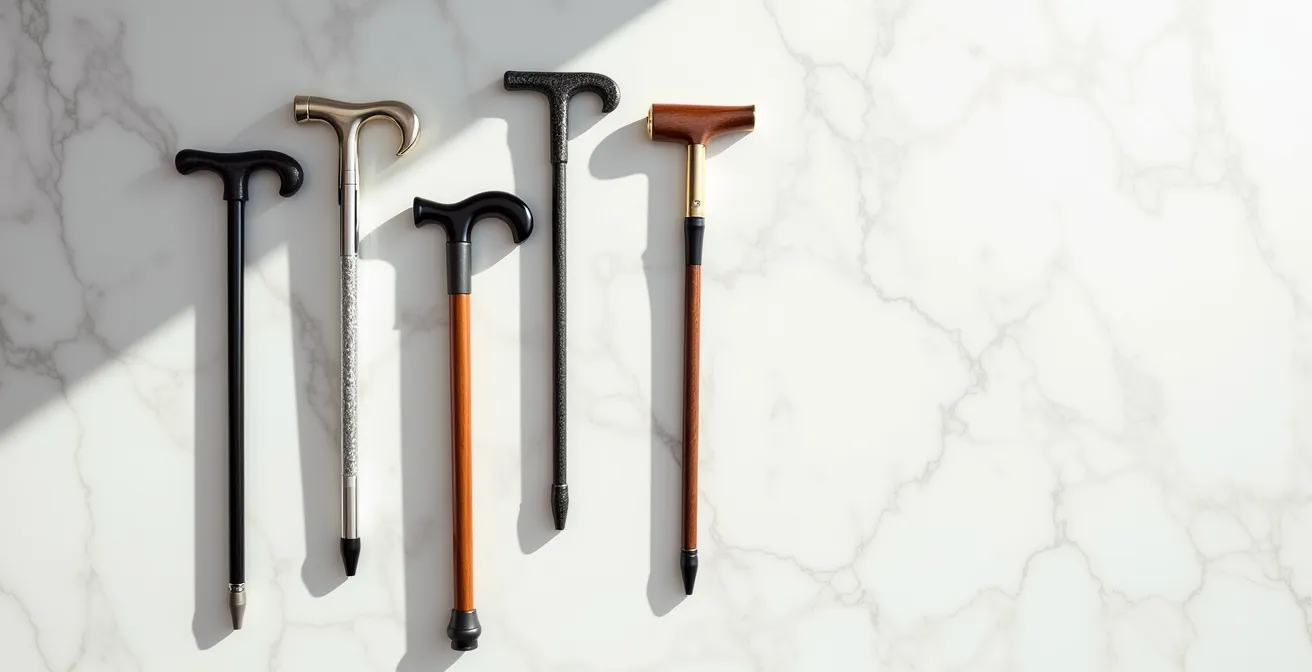
This shift from a medical tool to a fashion statement empowers the user to integrate the aid into their life on their own terms. It becomes an extension of their personality, a conversation starter, and a source of compliments rather than pity. This small but powerful change can be the tipping point for many, making the decision to use an aid not just easier, but genuinely desirable. It’s no longer about hiding a perceived weakness, but about showcasing your unique style.
Using a wheelchair at the museum: saving energy for the art, not the walk
Let’s apply the “energy budget” concept to a real-world scenario: a trip to a large museum. You have a finite amount of energy for the day. Do you want to spend 80% of it just walking across vast marble floors, leaving only 20% for actually appreciating the art? Or would you rather flip that ratio? Using a transport chair or wheelchair in this context is not a sign of inability; it’s a strategic choice to invest your energy where it yields the most joy. You are saving your energy for the art, not the walk.
This is the essence of seeing assistive tools as keys to a richer life. It’s about optimizing your experience. The wheelchair becomes your “museum companion,” a tool that not only conserves your stamina but can also carry your coat and bag, and provides a guaranteed seat in front of a masterpiece. This reframe moves the focus from “I can’t walk that far” to “I choose to experience this fully.” It’s a proactive decision to maximize your engagement and enjoyment.
This perspective is echoed by many who have made this mental shift. It’s a journey from shame to empowerment, as one personal reflection highlights. As one user eloquently stated in a piece for UCP, what once felt like something that set them apart became the very key to a more independent and accessible life. The initial feeling of being different is replaced by the realization that these tools make everyday life easier and more fulfilling. It is, in their words, the key to independence, not the loss of it.
What to say when people ask “What happened to your leg?”
One of the most daunting aspects of using a mobility aid is navigating the social landscape. The questions from curious strangers, while often well-intentioned, can feel intrusive and force you to repeatedly explain a personal situation. Mastering this interaction is key to feeling confident and in control. The goal is to have a few prepared responses that allow you to control the narrative and steer the conversation in a direction you choose. As the experts at Dynamo Mobility put it, mobility aids should empower their users, and that empowerment extends to social interactions.
There are several effective strategies you can employ, depending on the situation and your personality. A powerful technique is to acknowledge, reframe, and redirect. For example, in a professional setting, a good response might be: “Thanks for asking—this helps me stay active and productive. Now, about that project…” This politely closes the topic and returns the focus to your capabilities. For more informal settings, humor can be a brilliant deflector. Lines like, “I’m training for the Senior Olympics,” or, “It’s my stability upgrade—the latest model!” instantly shift the focus from disability to capability and lightheartedness.
The most empowering approach of all is to be proactive. Instead of waiting for the question, introduce the aid on your own terms. Referring to it as your “adventure companion” or “new tech” sets a positive and confident tone from the outset. This pre-empts awkward questions and frames the aid exactly as you want it to be seen: not as a problem, but as a part of your empowered life. These strategies, highlighted in discussions on eliminating cane stigma, are not about being defensive; they are about owning your story with confidence and grace.
The hiking pole bridge: using trekking poles before transitioning to a cane
For some, the leap to a traditional, medical-looking cane feels too abrupt. The social perception is just too high a barrier. In these cases, a “bridge” can be incredibly effective. Trekking or hiking poles serve as a perfect transitional tool. They offer similar benefits in terms of stability and energy conservation, but they carry a completely different social connotation. A person with hiking poles is seen as active, outdoorsy, and adventurous—the very opposite of the stigma attached to a cane.
This is a strategy endorsed by many physical therapists. As shared in a webinar hosted by the American Parkinson Disease Association, an assistive device is anything that helps you walk farther, faster, and safer. If using hiking poles is what makes you comfortable in a social setting and keeps you active, then it’s the right choice. It was noted that about 20% of the webinar’s attendees already use hiking poles for this very reason. This acts as a “gateway” to aid acceptance, allowing a person to experience the physical benefits without the psychological weight of the stigma, making a future transition to a single cane feel much less daunting.
The differences in perception and function are significant and worth comparing directly.
| Feature | Trekking Poles | Traditional Cane |
|---|---|---|
| Social Perception | Active lifestyle accessory | Medical device |
| Adjustability | Highly adjustable for terrain | Fixed or limited adjustment |
| Usage Pattern | Two poles for balance | Single point support |
| Transition Ease | Can gradually move to single pole | Direct adoption required |

Using trekking poles first allows you to acclimate to the feeling of using an aid for support. You can start with two poles for maximum stability and then, as you grow more comfortable, transition to using just one, which functions very similarly to a cane. It’s a gradual, low-stakes way to prove the benefits to yourself.
How to Build a Daily Wellness Routine That Preserves Independence After 65?
True independence isn’t a passive state; it’s an active practice. Building a daily wellness routine is the cornerstone of preserving that independence, and integrating a mobility aid is a proactive part of that strategy, not a reactive measure. The goal is to see the aid as a piece of wellness equipment, just like your yoga mat or your walking shoes. With market research indicating that 25% of the USA population is projected to be over 65 by 2035, adopting proactive mobility strategies is more important than ever.
This means weaving the aid into your daily habits in a positive way. For instance, you can use the act of picking up your cane as a “habit trigger” to perform five simple standing balance exercises before you head out. This reframes the cane from a symbol of need to a catalyst for strength-building. Another powerful technique is to schedule “pre-hab” sessions with your aid. This involves practicing with it in various environments—on stairs, ramps, or uneven ground—before you absolutely need it. This builds mastery and confidence, reinforcing the “performance gear” mindset.
Joining a walking group where aids are normalized can also be transformative. Seeing others use their aids as tools for wellness and social connection dismantles any lingering internal stigma. It celebrates the shared goal of staying active and engaged. The key is to make the aid an integral part of your wellness journey, a partner in your commitment to a vibrant and independent life.
Your Action Plan: Integrating an Aid into Your Wellness Routine
- Use your cane pickup as a habit trigger – perform 5 standing exercises before each walk.
- Track your walking distance with the aid versus without to measure improvement and build motivation.
- Schedule ‘pre-hab’ sessions – practice with your aid before you absolutely need it to build skill and confidence.
- Join a walking group where aids are normalized and celebrated as wellness tools.
How to explain the benefits of telecare to a parent who resists “being watched”?
While a telecare device and a mobility aid serve different functions, the psychological resistance to them often stems from the same place: a fear of losing autonomy and a feeling of being monitored. The parent who resists a telecare system because they don’t want to be “watched” is expressing the same core emotion as the person who refuses a walker because they don’t want to be “seen” as frail. Understanding this parallel can unlock new ways to approach the conversation around mobility aids.
The key, just as with telecare, is reframing. Instead of positioning a fall-alert pendant as a “panic button,” it can be framed as “independence insurance.” It’s a safety net that protects their ability to continue living independently by preventing a small incident from becoming a catastrophic, independence-ending event. This shifts the focus from the negative possibility (a fall) to the positive guarantee (continued independence). Similarly, a walker isn’t about the inability to walk; it’s the insurance that allows you to walk safely and confidently, protecting your long-term mobility.
Another powerful reframe is to present the device not as a service for them, but as a gift of peace of mind for their loved ones. Explaining, “This helps me worry less, which allows me to be a more present and relaxed son/daughter for you,” can shift the dynamic. It’s no longer an imposition on their independence, but a way for them to actively care for their family’s well-being. This same logic applies beautifully to a mobility aid. Using it isn’t just for you; it’s a way of showing your loved ones that you are taking proactive, responsible steps to stay safe, which in turn relieves their anxiety.
Key Takeaways
- A mobility aid is performance gear, not a medical crutch.
- Proper fitting is crucial for comfort and prevents injury, reinforcing the “equipment” mindset.
- Personal style and aesthetics play a key role in overcoming the psychological barrier to use.
Fitting a Cane or Walker: How to Measure Height to Prevent Shoulder Pain?
Once you’ve made the mental shift to viewing your cane or walker as high-performance gear, the final step is to ensure it’s perfectly calibrated for your body. Just as a cyclist adjusts their seat height for optimal power, or a golfer selects the right club for their swing, a properly fitted mobility aid is essential for comfort, safety, and performance. An ill-fitting cane doesn’t just work poorly; it can create new problems, like shoulder pain, back strain, or poor posture. Mastering the fit is the ultimate expression of taking ownership of your new tool.
The process starts with a basic measurement, but it doesn’t end there. The standard guideline is to have the top of the cane’s handle align with the crease of your wrist when your arm is hanging naturally at your side. However, as physical therapist Teresa Baker, DPT, advises, the goal is functional comfort. In a webinar for the American Parkinson Disease Association, she emphasizes, “You want a soft bend in the elbow when using the cane. You don’t want the height of the device to be so high your shoulders are scrunched up by your ears.”
This is where dynamic fitting comes in. The ideal height for walking on a flat surface may not be the same for climbing stairs, which might require a slightly shorter setting for better leverage. It’s crucial to test your aid in various real-world situations. Pay close attention to your body. Is your shoulder hunching? Is your wrist bending at an awkward angle? Adjust the height until your posture feels upright, stable, and natural. Regularly self-auditing your comfort, especially when you change footwear, ensures your “performance gear” is always perfectly tuned for you.
By moving through these stages—from shifting your mindset to mastering the practicalities of a proper fit—you complete the journey from resistance to empowerment. The final step is to embrace this newfound freedom and see your mobility aid not as a barrier, but as your trusted partner in a continued, active, and fulfilling life. Evaluate the solution that best fits your needs and begin your journey toward greater independence today.
Frequently Asked Questions about Overcoming the Cane Stigma
How can I respond humorously to deflect unwanted questions?
Try responses like ‘I’m training for the Senior Olympics’ or ‘It’s my stability upgrade – latest model!’ This shifts focus from disability to capability.
What’s a professional way to handle questions at work?
Use the acknowledge-reframe-redirect technique: ‘Thanks for asking – this helps me stay active and productive. About that project…’
How do I proactively control the narrative?
Introduce your aid first: ‘Meet my adventure companion’ or ‘I’m test-driving some new tech today’ to set a positive tone from the start.