
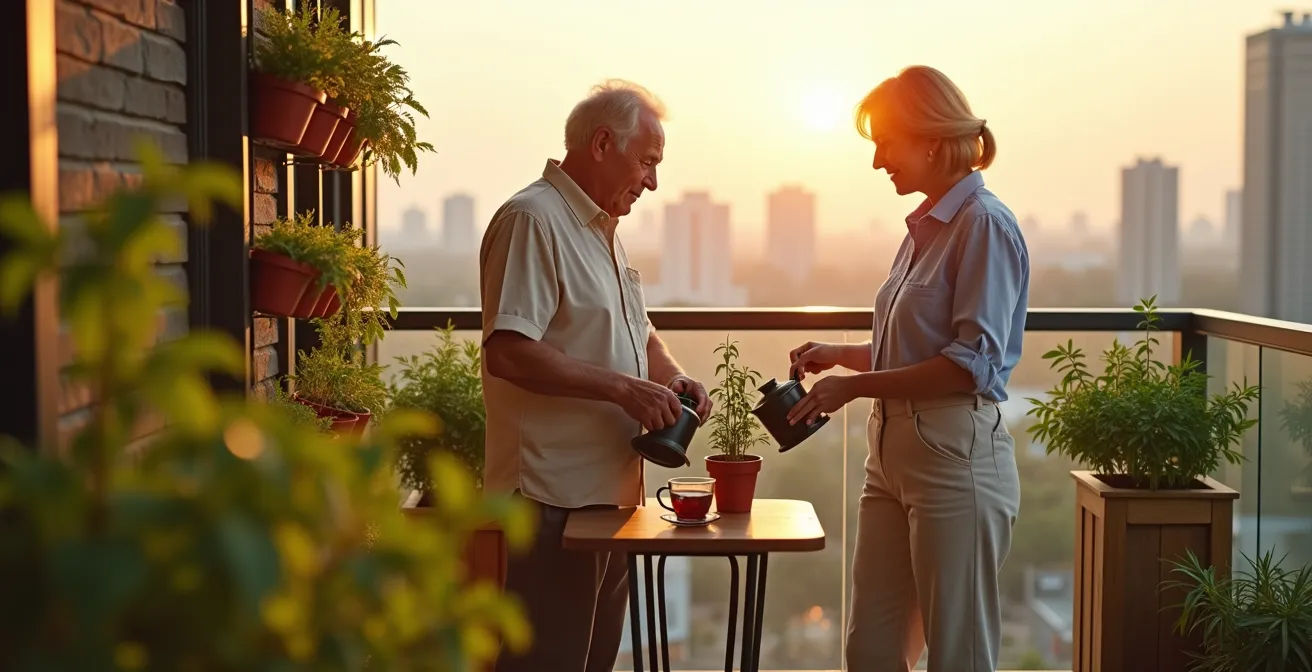
The secret to a long, healthy life isn’t moving to a remote island; it’s about intentionally redesigning your immediate environment—even a city apartment—to make healthy choices effortless.
- Proactively build “micro-inconveniences” into your home to promote constant, natural movement.
- Focus on purpose (Ikigai) and committed social circles (Moai) as non-negotiable pillars of well-being, just as important as diet and exercise.
Recommendation: Start by auditing one room in your apartment. Identify one change you can make this week to engineer more movement or mindfulness into your daily routine.
The allure of the Blue Zones—those pockets of the world where people live dramatically longer, healthier lives—is powerful. We read about the garden-tending Okinawans and the mountain-walking Sardinians and feel a pang of longing. But for the millions of us living in high-rise buildings and navigating concrete jungles, that lifestyle can feel like a distant, unattainable dream. The common wisdom suggests you need a specific zip code to access this level of vitality, leaving urban seniors feeling that the opportunity has passed them by.
But what if this core assumption is wrong? What if the power of the Blue Zones lies not in their location, but in their environment’s design? The truth is, longevity is less about geography and more about engineering. Research consistently shows that our environment and lifestyle choices have a far greater impact on our lifespan than our genetics. This is fantastic news, because your environment is something you can control, starting today, right within the four walls of your apartment.
This guide reframes the entire approach. We will move beyond simply listing Blue Zone habits and focus on a practical, actionable strategy: environmental retrofitting. You will learn how to systematically redesign your home and daily routines to make longevity-promoting choices not just easy, but automatic. It’s about creating a personal ecosystem where movement, healthy eating, purpose, and connection are the path of least resistance. This is your blueprint for building a vibrant, long life, no matter your address.
This article will provide you with a structured approach to transform your home and habits. Follow along as we deconstruct the core principles of a long life and translate them into practical strategies for the modern city dweller.
Contents: A Guide to Your Urban Blue Zone
- Ditching the remote: how to build inconvenience back into your life for fitness?
- How to shift to a 95% plant-based diet without losing muscle mass?
- Ikigai for retirees: finding the reason to get out of bed without a job
- The 5 PM ritual: transitioning from busy-ness to rest to lower blood pressure
- Moai groups: how to form a committed social circle for accountability?
- Eating 5 small meals vs 3 large ones: which aids digestion better?
- What low HRV tells you about your autonomic nervous system’s flexibility?
- Why the “Floor-to-Stand” Transfer Is the Single Most Critical Skill for Independent Living?
Ditching the remote: how to build inconvenience back into your life for fitness?
Our modern urban lives are masterpieces of convenience. With a tap, we can order groceries, change the channel, and dim the lights. While efficient, this frictionless existence is a primary culprit behind our increasingly sedentary lives. The Blue Zone philosophy flips this on its head: the world’s longest-lived people don’t “exercise” in a gym; they live in environments that demand constant, low-intensity movement. Their fitness is a byproduct of their day. We can replicate this principle by intentionally designing “micro-inconveniences” and movement triggers into our apartments.
This isn’t about making life difficult; it’s about making it more physically engaging. It starts with a simple audit of your space. Where are the opportunities to stand instead of sit, to stretch instead of strain, to walk instead of reaching? This could mean placing the remote control across the room, storing frequently used kitchen items on a higher or lower shelf to encourage squatting and reaching, or hand-washing a few dishes instead of using the dishwasher for every single item. As a compelling example, Singapore’s urban design actively fosters this by creating interconnected, walkable public spaces and housing that encourages multi-generational living, proving that an active lifestyle can be engineered even in a dense city.
The goal is to create a home that prompts you to move without you having to think about it. This builds a foundation of consistent, natural activity that is far more sustainable than sporadic, high-intensity workouts. It’s about turning your living space from a passive container into an active partner in your health.
Your Action Plan: Audit Your Apartment for Natural Movement
- Identify Inactivity Hotspots: List every location in your apartment where you are most sedentary (e.g., the specific armchair for watching TV, your desk chair, the breakfast nook).
- Inventory Your Tools of Convenience: Make a list of all the items that reduce your movement (e.g., remote controls, long-handled dusters, rolling office chairs, step-stools).
- Assess Against Blue Zone Principles: For each hotspot, ask: “How could this space encourage natural movement instead of stillness?” Could a wobble cushion be added to a chair? Could a remote be eliminated?
- Spot Opportunities for “Movement Snacks”: Look for unique places to add a “movement station”—a pull-up bar in a doorway, resistance bands in the kitchen, a yoga mat by the bed—for two-minute bursts of activity.
- Create Your Retrofit Plan: Choose three small changes to implement this week. Prioritize the easiest wins to build momentum in transforming your home into a movement-rich environment.
How to shift to a 95% plant-based diet without losing muscle mass?
One of the most consistent habits across all Blue Zones is a diet that is overwhelmingly plant-based. People in these regions eat a wide variety of garden vegetables, legumes, whole grains, and nuts, with meat consumed sparingly, often as a small side or a celebratory dish. This dietary pattern is a cornerstone of their longevity. However, a common and valid concern for seniors considering a similar shift is the risk of sarcopenia, or age-related muscle loss. How can you reap the benefits of a plant-forward diet while ensuring you get enough high-quality protein to maintain strength and mobility?
The key is to be strategic and knowledgeable about your plant protein sources. Not all plant proteins are created equal. The most crucial factor for muscle synthesis is the presence of essential amino acids, particularly leucine. By focusing on leucine-rich plant foods and pairing them correctly to form a complete protein profile, you can effectively support muscle health. This isn’t about guesswork; it’s about smart food combinations. The encouraging news from a landmark Danish twin study is that genes dictate only 20% of longevity; the other 80% is lifestyle, and diet is a massive part of that.
Transitioning doesn’t have to be an overnight overhaul. Start with “Meatless Mondays” or by making one meal a day entirely plant-based. Focus on incorporating protein-dense sources like firm tofu, lentils, and seeds into meals you already enjoy. The following table provides a clear guide to some of the best plant-based protein sources to get you started on a path to a stronger, longer life.
This table, based on recent nutritional analysis, breaks down the protein and leucine content of several powerhouse plant foods, offering suggestions for creating a complete protein meal.
| Plant Source | Protein per 100g | Leucine Content | Best Pairing |
|---|---|---|---|
| Tofu (firm) | 15.5g | 1.2g | Brown rice |
| Lentils (cooked) | 9g | 0.7g | Quinoa |
| Edamame | 11.9g | 0.9g | Whole grain pasta |
| Hemp seeds | 31.6g | 2.1g | Oatmeal |
| Pumpkin seeds | 19g | 1.4g | Salads |
Ikigai for retirees: finding the reason to get out of bed without a job
In Okinawan culture, there is no word for “retirement.” Instead, they have “Ikigai,” which roughly translates to “a reason to live” or “a reason to get out of bed in the morning.” This sense of purpose is not a nice-to-have; it is a fundamental component of their longevity and vitality. For many in the Western world, our professional careers provide a built-in sense of purpose, structure, and social connection. When that ends, a profound void can appear, leaving many feeling adrift. Finding your Ikigai in retirement is one of the most powerful proactive health strategies you can adopt.
Your Ikigai doesn’t have to be a grand, world-changing mission. It is found at the intersection of what you love, what you are good at, what the world needs, and what you can be valued for. For a retiree in an urban apartment, this could manifest in countless ways: mentoring a young entrepreneur online, curating a family history through a digital archiving project, mastering a complex skill like a new language or musical instrument, or leading a community initiative from your living room. It’s about shifting the mindset from “What will I do to pass the time?” to “What can I contribute that gives my day meaning?”

The impact of this is not merely psychological. It has a measurable, biological effect on your health. As Blue Zones founder Dan Buettner’s research highlights, purpose is a powerful driver of longevity.
Knowing your sense of purpose is worth up to seven years of extra life expectancy
– Dan Buettner, Blue Zones Project Research
This quest for purpose is an active, ongoing process of self-discovery. It requires introspection and a willingness to try new things, even if they feel small at first. The goal is to find that activity that engages you so deeply you lose track of time—that is where your Ikigai lies.
The 5 PM ritual: transitioning from busy-ness to rest to lower blood pressure
People in Blue Zones have ingrained, culturally reinforced routines to shed the stresses of the day. Whether it’s a nap in Ikaria or happy hour in Sardinia, they have a clear transition from work and activity to rest and social connection. In our hyper-connected urban world, this boundary has all but vanished. We carry the day’s stress with us into the evening, scrolling through news and emails, keeping our nervous system in a constant state of high alert. This chronic activation can contribute to elevated blood pressure and poor sleep. A powerful countermeasure is to create a deliberate “downshifting” ritual around 5 PM.
This ritual is a form of behavioral scaffolding; it’s a structured routine designed to signal to your brain and body that the “productive” part of the day is over and it’s time to transition to a state of rest and digest. It’s not about being lazy; it’s about actively managing your autonomic nervous system. The goal is to shift from the sympathetic “fight-or-flight” state to the parasympathetic “rest-and-digest” state.
This can be a simple, 20-minute sequence that involves all your senses. The key is consistency. When you perform the same calming actions at the same time each day, your body learns the cue and begins to relax in anticipation. Here is a simple protocol you can adapt to create your own end-of-day transition, turning your apartment into a sanctuary of calm.
- 5:00 PM: Switch your lighting from bright, blue-toned daylight bulbs to warm, dim evening bulbs (around 2700K). This change in light signals to your brain to start producing melatonin.
- 5:05 PM: Turn off all news channels and silence notifications on your phone and computer. Consciously disengage from the inflow of stressful information.
- 5:10 PM: Start a dedicated “downshift playlist” of calming instrumental music or nature sounds. Sound has a profound effect on our nervous system.
- 5:15 PM: Mindfully prepare and sip a non-caffeinated herbal tea, such as chamomile. Focus on the warmth and aroma.
- 5:20 PM: Spend five minutes with a “worry journal.” Write down any anxieties or tasks for tomorrow to get them out of your head and onto paper.
This simple, structured transition can have a significant impact on your evening relaxation, sleep quality, and even your blood pressure over time.
Moai groups: how to form a committed social circle for accountability?
The world’s longest-lived people are surrounded by a supportive, lifelong social network. In Okinawa, this concept is formalized into a “Moai”—a small group of friends who commit to supporting each other for life. These groups provide financial, emotional, and social support, celebrating good times and weathering bad times together. This built-in sense of belonging and accountability is a powerful buffer against stress and a key driver of healthy behaviors. In the relative anonymity of a large city, however, such deep-rooted connections can be harder to form and maintain.
But the principle of the Moai can be adapted for urban living, especially with the help of technology. A “Digital Moai” can be just as powerful as a traditional one. The key is to be intentional. It’s not about having hundreds of social media friends; it’s about curating a small, committed group of 3-5 people who share a specific, positive goal. This could be a daily walking goal, a commitment to trying new healthy recipes, or a shared meditation practice.
Case Study: The Okinawan Moai System
The Moai is a cornerstone of Okinawan society. From a young age, individuals are placed into these small groups of about half a dozen companions. This group becomes their second family for their entire lives. They pool resources, offer support during illness or hardship, and share in each other’s successes. This constant social fabric ensures that no one faces life’s challenges alone, which is a major contributor to their remarkable longevity and low rates of depression.
The modern, urban version of this requires a clear structure. A successful Digital Moai is built on a shared purpose, a regular communication rhythm, and a system of mutual accountability. It transforms a lonely health goal into a shared, social journey, dramatically increasing your chances of success.
Eating 5 small meals vs 3 large ones: which aids digestion better?
As we navigate our dietary choices, the frequency of meals often becomes a point of debate. The traditional model promotes three substantial meals a day, while another popular approach suggests five or six smaller “mini-meals.” For seniors, where digestive comfort and nutrient absorption are paramount, the answer isn’t one-size-fits-all. The optimal strategy depends on your individual physiology, health conditions, and daily schedule. Understanding the trade-offs is key to finding the right rhythm for your body.
Eating three larger meals allows for longer periods of fasting between them. This is crucial for activating the Migrating Motor Complex (MMC), a “housekeeping” wave that sweeps undigested food and bacteria out of the small intestine. Constantly snacking can interrupt this vital cleaning cycle. On the other hand, for individuals with conditions like GERD or gastroparesis, large meals can increase pressure on the stomach and worsen symptoms. In these cases, smaller, more frequent meals are often better tolerated.
Ultimately, the most powerful principle might not be meal frequency, but meal size and timing. Okinawans famously practice “Hara Hachi Bu,” a habit of stopping eating when they feel 80% full. This practice of caloric moderation is a major factor in their longevity. Research from Okinawa shows that this simple habit is associated with a significantly longer life expectancy. Combining this principle with time-restricted eating—consuming all your meals within an 8-10 hour window—can be a powerful strategy regardless of how many meals you choose.
The following table compares the two approaches across several key factors relevant to senior digestive health, helping you make an informed decision.
| Factor | 3 Large Meals | 5 Small Meals |
|---|---|---|
| Migrating Motor Complex | Allows 4-5 hour gaps for gut cleaning | May interrupt cleaning cycles |
| Blood Sugar Control | Stable with low-glycemic choices | More frequent spikes possible |
| Acid Reflux Management | May increase pressure | Better for GERD patients |
| Circadian Alignment | Easier to fit in 8-10 hour window | Challenges time-restricted eating |
What low HRV tells you about your autonomic nervous system’s flexibility?
While we often focus on external health metrics like weight or blood pressure, a powerful internal marker of our well-being is Heart Rate Variability (HRV). HRV measures the variation in time between each heartbeat. It might seem counterintuitive, but a healthy heart doesn’t beat like a metronome; it subtly speeds up and slows down in response to your breath and environment. A high HRV indicates a flexible, resilient autonomic nervous system (ANS) that can easily shift between stress (sympathetic) and rest (parasympathetic) states. Conversely, a low HRV suggests your system is “stuck” in a state of stress, making you less resilient to physical and emotional challenges.
For seniors, tracking HRV (which can be done with many modern wearables) provides a window into your body’s recovery and stress levels. A consistently low HRV can be an early warning sign that your lifestyle is pushing your nervous system too hard. It’s a signal that your body isn’t effectively recovering from the day’s demands. The good news is that you can actively improve your HRV through simple, targeted practices that strengthen your parasympathetic nervous system.
One of the most effective techniques is coherent breathing. This specific breathing pattern, with an equal inhale and exhale of around 5.5 seconds, has been shown to directly stimulate the vagus nerve and bring the heart and respiratory systems into a state of coherence, thereby increasing HRV. As Dan Buettner wisely points out, creating an environment for these practices is key.
If you set up your environment so that you make it easier and unconscious and unavoidable, it’s creating an enabling environment to do the things that we know lower stress
– Dan Buettner, Good Life Project Podcast
Setting aside just 5-10 minutes a day for this practice, perhaps as part of your 5 PM downshifting ritual, can train your nervous system to become more flexible and resilient over time. It’s a simple, powerful tool for managing internal stress and boosting your overall vitality.
Key Takeaways
- Longevity is a skill of environmental design, not a matter of location. You can build your own Blue Zone anywhere.
- Focus on four key pillars: engineered natural movement, a strategic plant-forward diet, a clear sense of purpose (Ikigai), and a committed social circle (Moai).
- The single most important physical skill for maintaining independence is the ability to get up from the floor unassisted.
Why the “Floor-to-Stand” Transfer Is the Single Most Critical Skill for Independent Living?
Of all the physical skills we cultivate for healthy aging—strength, balance, cardiovascular endurance—one stands out as the most critical predictor of long-term independence: the ability to get up from the floor unassisted. This movement, known as the Floor-to-Stand transfer, is a complex sequence that requires a unique combination of lower body strength, core stability, flexibility, and coordination. Its importance cannot be overstated. A loss of this ability is a major risk factor for a fall resulting in a long lie, which can lead to severe complications and a rapid decline in independence.
The ability to get up from the floor is, in essence, a practical test of your functional fitness. It demonstrates that you have the requisite strength and mobility to handle an unexpected event and recover your autonomy. It’s not just about fall recovery; it’s a proxy for your overall physical resilience. People who can perform this movement with ease tend to have better overall health outcomes.
Case Study: The Sitting-Rising Test (SRT) and Mortality
Powerful research on the Sitting-Rising Test (SRT) provides stark evidence of this connection. The test assesses an individual’s ability to sit down on and rise up from the floor using minimal support. A landmark study published in the European Journal of Preventive Cardiology demonstrated a direct link between SRT scores and all-cause mortality. The research showed that subjects who required the most support had a 5-6 times higher risk of death over the study period compared to those who could perform the movement without using their hands, arms, or knees for support.
This skill is not something to be taken for granted; it must be practiced and maintained. Fortunately, it can be trained progressively, even if it seems daunting at first. The key is to start where you are and gradually decrease your reliance on external support. By breaking the movement down and strengthening the component parts, you can work towards mastering this fundamental skill for a long and independent life.
To truly build a life of vitality and independence, start today by implementing these strategies. The first step is not to overhaul your entire life, but to choose one area—be it movement, diet, or connection—and take a single, concrete action to redesign your environment for success.