
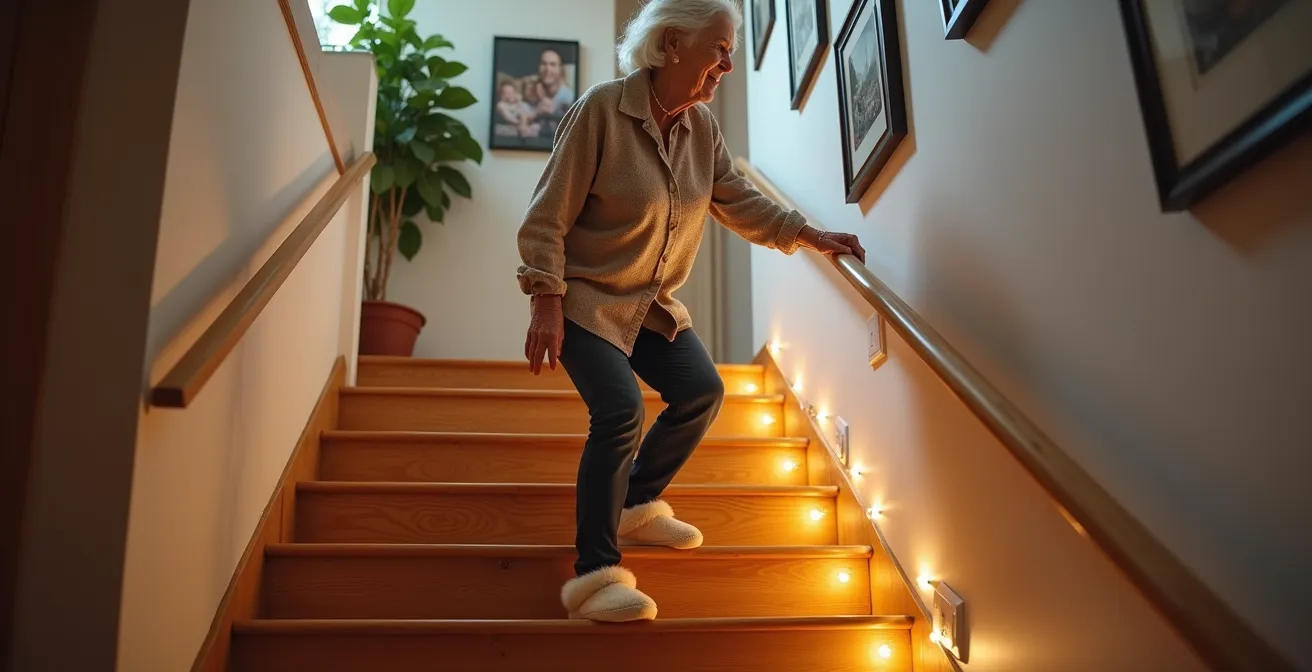
The key to preventing nighttime falls is not just adding lights, but engineering an automated “path of illumination” that supports the body’s natural balance.
- Dedicated motion detectors react instantly, unlike smart bulbs which can have dangerous delays.
- Searching for a light switch in the dark actively compromises balance by shifting your center of gravity and increasing cognitive load.
Recommendation: Prioritize hardwired or battery-operated systems with dedicated sensors placed to create a seamless light trail from bedroom to bathroom, focusing on instant activation and system reliability.
The sudden need to navigate a dark home at night is a common source of anxiety for many seniors and their families. A trip to the bathroom can feel like traversing a minefield, where one misstep on the stairs could have serious consequences. The typical response is to plug in a few nightlights, hoping for the best. But this is a passive, often inadequate solution to a critical safety problem. These low-power lights may cast confusing shadows and fail to illuminate the most hazardous areas, like the top and bottom steps.
The real issue isn’t just a lack of light; it’s the lack of an intelligent, responsive system that guides you safely. But what if the solution wasn’t just to add more light, but to create an automated, intuitive path of illumination? The secret lies in strategically placing motion-sensor lighting to create a system that anticipates your movement, preserves your biomechanical stability, and completely removes the dangerous act of fumbling for a switch in the dark. This isn’t just about lighting; it’s about engineering confidence and safety into your home’s very architecture.
This guide will illuminate the principles of creating that perfect path of light. We will explore how to fine-tune sensors to coexist with pets, understand the science behind why searching for a switch is so risky, and compare the technologies that ensure your light path never fails. By focusing on a system-based approach, you can transform your nighttime hallways from a source of worry into a beacon of safety.
To help you navigate these crucial safety considerations, this article is structured to address the most pressing questions. The following summary outlines the key areas we will cover, from initial setup to long-term maintenance and a broader view of home safety.
Summary: A Strategic Guide to Nighttime Home Safety Lighting
- How to set sensor sensitivity so pets don’t trigger lights all night?
- Why tactile searching for light switches causes balance loss in the dark?
- The battery check routine: avoiding sensor failure when it matters most
- Plug-in vs hardwired sensors: which is safer for high-traffic hallways?
- Smart bulbs vs separate motion detectors: which reacts faster to movement?
- How to increase lumen output in hallways without rewiring the house?
- Anti-reflective coatings: do they really help with night driving glare?
- Age in Place Securely: How to Fortify Your Home Against Intruders and Scammers?
How to set sensor sensitivity so pets don’t trigger lights all night?
One of the biggest concerns with motion lighting is the risk of false alarms, especially from pets. A cat or dog roaming at night can turn your carefully planned path of illumination into a disruptive disco. This is more than an annoyance; it can disturb sleep and lead homeowners to disable the system, defeating its purpose entirely. The good news is that modern sensors are designed with this in mind, particularly since 66% of American households have pets. The solution lies in calibration.
Most quality motion detectors feature “pet immunity,” which uses a combination of weight thresholds and smart detection zones. By properly setting these, the sensor can differentiate between a 15-pound cat and a 150-pound human. The key is a combination of vertical and horizontal placement. Placing sensors higher on the wall creates a detection zone that a pet is unlikely to enter. By following a methodical setup process, you can achieve a system that is responsive to you but blind to your furry companions.
- Weight Threshold: Adjust the sensor to ignore movement from objects below a certain weight, typically between 40 and 85 pounds. Check your sensor’s manual for its specific capabilities.
- Mounting Height: Install sensors at a height of 7-8 feet. This creates a natural detection zone above the level where most pets roam.
- Sensor Angle: Angle the sensor downward. This focuses the passive infrared (PIR) beams to detect the upright form of a person, rather than movement low to the ground.
- Clear Zones: Ensure there is no furniture near the sensor that a pet could climb on, which would allow them to enter the human detection zone and trigger the light.
Why tactile searching for light switches causes balance loss in the dark?
The act of waking up and fumbling for a light switch seems minor, but it is one of the most perilous moments of nighttime navigation. When you move through a dark space, your body is already in a state of compromised balance. Your visual system, which provides critical cues for stability, is offline. This forces you to rely on your proprioceptive (your sense of body position) and vestibular (inner ear balance) systems. Introducing the task of searching for a switch adds two dangerous variables: biomechanical instability and cognitive load.
As you reach out an arm to feel for the switch, you are actively shifting your center of gravity outside your base of support. Research from AARP confirms that this simple reaching motion is a significant factor in falls, as it becomes harder to distinguish individual steps and accommodate to the dark with age. This physical imbalance is compounded by the mental effort of searching. Instead of focusing solely on the act of walking, your brain is now performing a “dual task”: navigating and searching. This cognitive overload dramatically increases the risk of a misstep. Motion-activated lighting eliminates this entire hazardous sequence by creating the path of light for you, allowing you to walk with both hands free and your focus entirely on your movement.
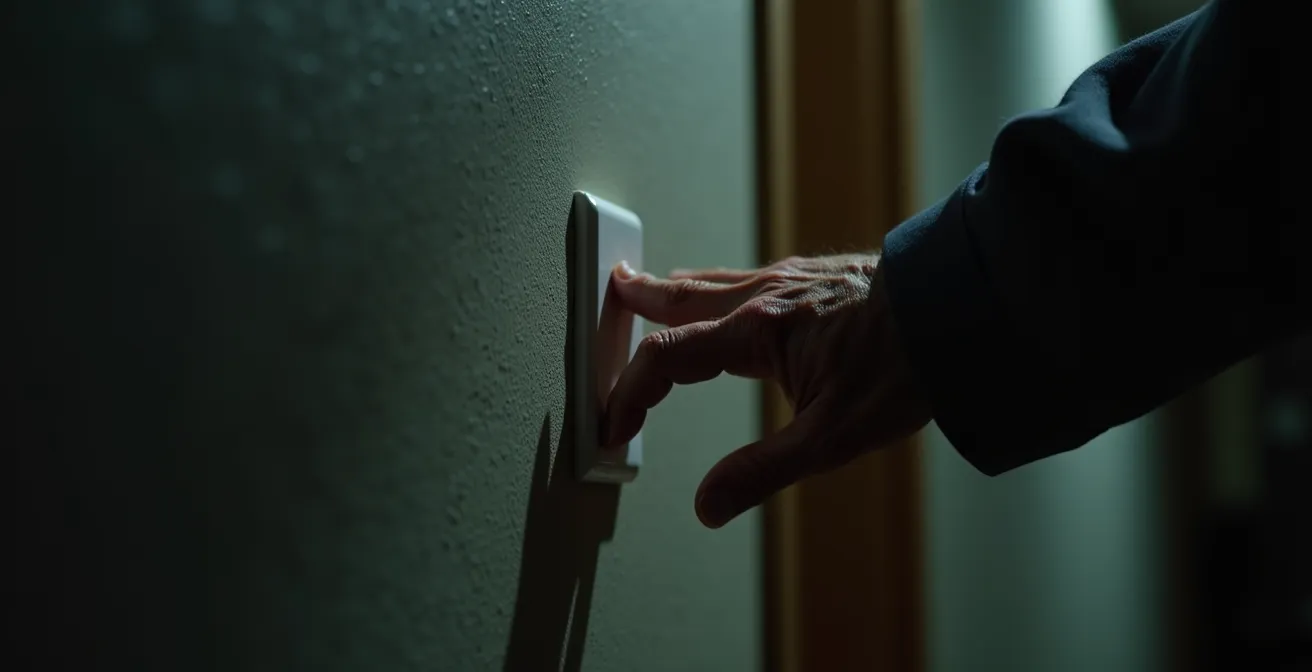
This image perfectly captures the moment of vulnerability. The subtle lean and outstretched hand illustrate how the search for a switch forces the body into a precarious position. An automated lighting system prevents this scenario, preserving natural posture and balance when you are most disoriented. According to AARP’s research on stair safety, this combination of visual impairment and physical searching creates a dangerous cognitive distraction, particularly during the vulnerable transition from sleep to wakefulness. Eliminating this search is a foundational step in fall prevention, as confirmed by a study on making stairs safer, which notes that depth perception becomes more difficult as we age.
The battery check routine: avoiding sensor failure when it matters most
A motion-sensor lighting system is only as reliable as its power source. For battery-operated units, which offer fantastic flexibility, “set it and forget it” is a dangerous mindset. A dead battery means a dark staircase, instantly reverting your home to its most hazardous state precisely when you need the protection most. The consequences of such a failure are severe; CDC data reveals that falls are a leading cause of fatal and non-fatal injuries among older adults, with over 38,000 deaths among those age 65+ caused by falls in 2021 in the U.S. This isn’t just a statistic; it’s a stark reminder that safety systems must be flawlessly maintained.
Establishing a simple, recurring battery check routine is non-negotiable. This is a core component of creating system redundancy and reliability. The goal is to be proactive, not reactive. Waiting for a low-battery indicator to chirp at 3 a.m. is not a plan; it’s a precursor to failure. By synchronizing your battery checks with memorable dates, like daylight saving time changes, you create a sustainable habit. Furthermore, replacing all batteries at once, even if some seem to have life left, ensures consistent performance across your entire path of illumination. Investing in quality lithium batteries (like the common CR123A) also extends the time between changes, often providing a lifespan of several years.
Your Essential Battery Maintenance Checklist
- Schedule Checks: Tie your battery checks to biannual events like daylight saving time changes to ensure a consistent routine.
- Replace in Unison: When one battery needs replacing, replace the batteries in all sensors simultaneously to maintain uniform performance and avoid staggered failures.
- Prioritize Low-Battery Indicators: When purchasing sensors, choose models that provide a clear visual (blinking LED) or audible (chirp) low-battery warning.
- Document and Test: Keep a log of replacement dates and test each sensor’s functionality monthly by walking the path to confirm activation.
- Stock Up: Keep a dedicated stock of the correct spare batteries (e.g., CR123A) in a cool, dry, and easily accessible location.
Plug-in vs hardwired sensors: which is safer for high-traffic hallways?
When designing your path of illumination, one of the most critical decisions is the power source: a simple plug-in unit or a professionally hardwired system. While plug-in sensors offer convenience and low cost, from a safety electrician’s perspective, they introduce unacceptable risks in high-traffic areas like stairs and hallways. Their primary weakness is their vulnerability. An exposed cord presents a significant trip hazard, especially for individuals with a shuffling gait. Furthermore, the unit can be easily knocked loose or accidentally unplugged by a vacuum cleaner, a pet, or a visitor, instantly disabling a key part of your safety net.
A hardwired system, while requiring a larger upfront investment and professional installation, offers unmatched reliability and permanence. The wiring is concealed within the walls, eliminating all trip hazards and making the installation tamper-proof. It draws power directly from your home’s electrical system, so you never have to worry about batteries or loose plugs. For the critical pathway between the bedroom and bathroom, hardwiring is the gold standard for safety. It transforms the lighting from a temporary accessory into a permanent, integrated feature of your home’s safety architecture. The following table breaks down the key differences to help you make an informed decision.
This comparison highlights the fundamental trade-off between convenience and robust safety, as detailed in an analysis of motion sensor installation methods.
| Safety Factor | Plug-in Sensors | Hardwired Sensors |
|---|---|---|
| Trip Hazard Risk | High – exposed cords especially dangerous for shuffling gait | None – wiring concealed in walls |
| Installation Permanence | Can be accidentally unplugged by vacuum, pets, or visitors | Permanent installation, tamper-proof |
| Power Reliability | Subject to outlet issues, loose connections | Direct electrical connection, more stable |
| Response Time | Instant local activation | Instant local activation |
| Professional Installation | Not required | Electrician recommended |
| Cost | $20-50 per unit | $100-300 including installation |
Smart bulbs vs separate motion detectors: which reacts faster to movement?
In the world of home automation, smart bulbs with built-in motion sensing seem like an elegant, all-in-one solution. However, when it comes to the split-second timing required for fall prevention on stairs, they have a critical flaw: latency. Smart bulb systems often rely on a Wi-Fi or other wireless signal to communicate between the sensor and the bulb. This communication introduces a delay. While it may seem short, this lag can be dangerous. Research on lighting response times shows a delay of 0.5 to 1.5 seconds is typical for some smart bulb systems. In that brief moment of darkness, a person can take a full, uncertain step onto a staircase.
A dedicated motion detector, whether hardwired or battery-operated, is engineered for one task: instant activation. The sensor is directly wired to the light fixture or, in the case of integrated units, is part of the same circuit. When it detects motion, the command to turn on the light is instantaneous. There is no wireless signal to send, no network hub to consult, and no app to process the request. This immediate response is the core of an effective path of illumination. The light should appear the very instant your foot is about to enter the space, not a second after.
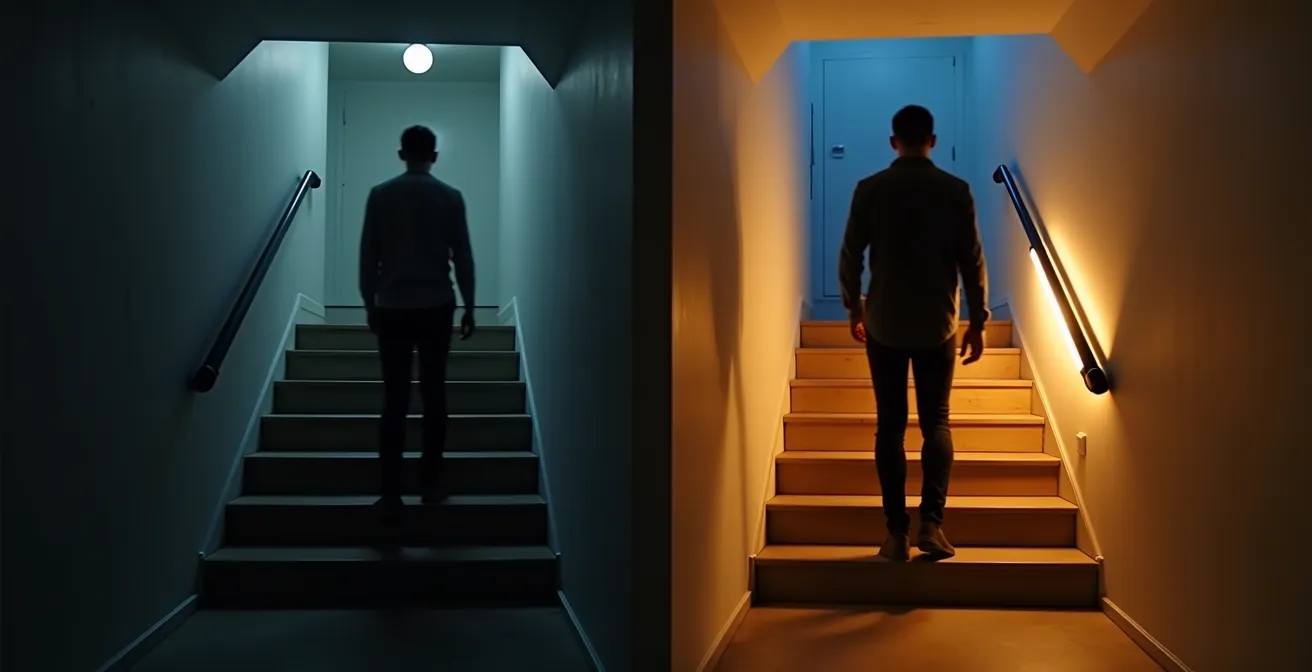
As this comparison shows, the difference is stark. On the left, the delay of a smart system leaves a person in hazardous darkness mid-step. On the right, the instant reaction of a dedicated sensor fully illuminates the path before the foot lands. For a high-risk area like a staircase, sacrificing speed for convenience is a trade-off that is simply not worth making. The reliability of a dedicated system provides true peace of mind.
How to increase lumen output in hallways without rewiring the house?
A common mistake in home lighting is assuming that a single, bright overhead fixture is sufficient. For a senior navigating at night, this can create harsh glare and deep shadows, obscuring the very steps you’re trying to illuminate. A much safer and more effective strategy is light layering—using multiple, lower-intensity light sources at different heights to create even, comprehensive illumination without needing to call an electrician. This approach focuses on defining edges and pathways, which is far more important than raw brightness.
It’s especially important to illuminate the top and bottom steps because that’s where most falls occur.
– AARP, 8 Ways to Make Your Stairs Safer for Older Adults
Achieving this layered effect is surprisingly simple with modern battery-powered and stick-on LED technology. Instead of one harsh light from above, you can create a “runway effect” that clearly guides the user. The goal is to wash the area in soft, useful light that enhances visibility and depth perception. Painting walls in a light, satin, or eggshell finish can also dramatically boost ambient light levels by reflecting it more effectively throughout the space.
- Under-Handrail Lighting: Install battery-powered LED strips under the length of your handrails. This casts light directly onto the stair treads, defining each step clearly.
- Baseboard-Level Lights: Position motion-sensing puck lights or bar lights at baseboard level (6-12 inches from the floor). This illuminates foot placement without causing upward glare.
- High-CRI Bulbs: Choose bulbs with a high Color Rendering Index (CRI 90+). They may not be brighter in lumens, but they render colors more accurately, making it easier to distinguish the edge of a step from the floor.
- Reflective Tape: Apply high-visibility, non-slip reflective tape to the edge of each stair nosing for a passive, fail-proof visual cue.
Key Takeaways
- The goal is not just light, but an automated “path of illumination” that supports balance and reduces cognitive load.
- Dedicated motion sensors are superior to smart bulbs for stair safety due to their instant, zero-latency response.
- System reliability is paramount; this means prioritizing hardwired solutions or implementing a strict battery check routine for other units.
Anti-reflective coatings: do they really help with night driving glare?
Just as we engineer a path of light to navigate safely inside the home, it’s crucial to consider the visibility challenges that seniors face outside of it, particularly when driving at night. One of the most common complaints is the blinding glare from oncoming headlights. This glare can cause momentary blindness and disorientation, a dangerous situation at any speed. This is where technology like anti-reflective (AR) coatings on eyeglasses comes into play. From a safety perspective, anything that can preserve clear vision in a critical moment is worth examining.
An AR coating is a microscopically thin layer applied to the surface of a lens. Its purpose is to allow more light to pass through the lens rather than reflecting off it. This has two main benefits. First, it reduces the distracting reflections and halos that appear around light sources like streetlights and headlights, sharpening a driver’s view of the road. Second, by allowing more light to reach the eye, it can subtly improve visual acuity in low-light conditions. For a senior whose eyes already struggle to adapt quickly to changes in brightness, this can make a noticeable difference.
However, it’s important to have realistic expectations. An AR coating is not a magic bullet that will completely eliminate the dazzle from modern, ultra-bright LED headlights. It will, however, reduce the intensity of the glare and minimize the visual “noise” around it, allowing the driver’s eyes to recover more quickly. When combined with other safe driving habits—such as keeping the windshield clean inside and out, aiming headlights correctly, and avoiding looking directly into oncoming lights—an AR coating is a valuable tool in the broader toolkit for maintaining nighttime driving independence and safety.
Age in Place Securely: How to Fortify Your Home Against Intruders and Scammers?
Creating a safe path of illumination is a foundational element of aging in place, but a truly secure home environment extends beyond fall prevention. A well-lit exterior, for example, is one of the most effective deterrents against potential intruders. Motion-activated floodlights not only provide safe passage to your door but also make a property a much less attractive target for burglars. This demonstrates how a single safety system can serve multiple protective functions. Fortifying your home means adopting a layered, 360-degree security mindset that addresses physical vulnerabilities and modern threats like scams.
Physical security starts at the perimeter. All exterior doors should have solid cores and be fitted with a high-quality, one-inch deadbolt. Sliding glass doors and windows, which are common points of entry, can be easily secured with simple and inexpensive blocking bars placed in the track. Beyond physical barriers, it’s about situational awareness. Scammers who target seniors have become increasingly sophisticated, using phone calls, emails, and even door-to-door visits to exploit trust. The most powerful defense is a healthy dose of skepticism. Never provide personal or financial information to an unsolicited caller, and be wary of anyone pressuring you to make an immediate decision, whether it’s for a “free” home repair inspection or an “urgent” issue with your bank account.
A secure home is a place of comfort, not fear. By taking proactive steps to reinforce physical entry points and adopting a cautious approach to unsolicited contact, you build a fortress of safety. This holistic view—combining automated lighting for safety and deterrence, strong physical barriers, and smart digital-age awareness—is the ultimate expression of aging in place with confidence and independence.
To truly secure your home and peace of mind, the next logical step is to conduct a complete home safety audit, evaluating everything from your lighting pathways to door locks and scam awareness protocols. Begin today by creating a checklist and methodically assessing each area for improvement.